Search this Site
Friday
May172013

Friday News Digest

Four days on the road is about the max for me before homesickness becomes overwhelming. At least, if "on the road" is without my wife and kids. I feel really fortunate to have been able to spend the past seven days traveling coast to coast from New York to Washington State. I've met a lot of great people and shared our message with hundreds. Time well spent, but that doesn't change the fact that I have two little girls that need a hug and a wife that has a delayed Mother's Day coming. There's no place like home -- I can't wait to get there.

Enjoy this week's news.

  • There are some cities that are being proactive about Tactical Urbanism, working with residents to identify modest, incremental improvements that are the real high return investments in our communities. There are others that are, well....slightly less progressive. Mike Lydon is not only one of my friends, he is one of my heroes.

Public Works General Manager Gerry Davis warns:

"These changes to City streets are illegal, potentially unsafe and adding to the City's costs of maintenance and repair. The City can consider this as vandalism, with the potential for serious health and safety consequences for citizens, particularly pedestrians. There is potential liability and risk management claims to both the City and the individuals involved."

Of course, left unmentioned is the ongoing danger to individuals and liability to the city from Hamilton's status quo of pedestrian- and cyclist-unfriendly automobile oriented streets, a shameful legacy that has continued unimpeded for decades despite the overwhelming weight of evidence, expert testimonial, and even official policy.

If citizens are taking street design into their own hands, it is out of extreme frustration with the failure, year after year after year, of city leaders on Council and in senior management, to make the necessary changes themselves.

  • Detroit should top the list of places where a bottom up approach should meet little resistance, but unfortunately you still have the gatekeepers and their bureaucratic inertia there as well. Fortunately a couple of brave guys are calling them out, refusing to quit doing the job that others should be doing, making their place better in the process.

Molnar told The Huffington Post that the project serves a real need, because many of DDOT's existing benches are in disrepair and passengers are being forced to create makeshift seats out of objects like newspaper stands.

"There [are] grocery carts that are upside down next to bus stops. People are looking for things to sit on," Molnar said. "It's not about whether or not DDOT likes it. This is something that needs to be done."

DDOT and the City of Detroit did not respond to requests for comment from The Huffington Post, but the agency has said the project hasn't gone through the appropriate procedures.

"There is protocol that takes place," DDOT's deputy director Anjelica Jones told USA Today after the first bench was installed last week, "but it is our understanding that it did not take place regarding this bench."

  • Some of my CNU NextGen friends have been discussing a company called Airbnb, which provides a way for people to rent out their home as if it were a hotel room. The site circumvents the myriad of regulations and, more importantly, taxes that are part of the hotel industry and relies instead on the now-familiar user rating system to police the system without government oversight. I've not used it myself, but like the concept.

Airbnb, the website that allows people to rent their apartments by the night, has over the past few years quietly become an economic leviathan in New York City. About 30,000 New Yorkers are signed up as hosts, and last year hundreds of thousands of visitors paid a fraction of the cost of a hotel to stay in the city an average of six nights. That kind of demand is expected to generate around $1 billion in local economic activity in 2013, outstripping the impact of the city's booming cruise-ship industry five times over, according to figures cited by tech-industry leaders with knowledge of the site.

But the San Francisco-based company is hardly trumpeting its success here. A long-awaited study expected to back up the bold economic claims has been delayed indefinitely. There are no ads for the site in New York City. And Airbnb declined to comment for this story.

The reason is simple: Airbnb posts listings that are illegal in New York state.

  • A few months ago I received a flurry of solicitations in my mailbox from attorneys in Florida letting me know they could get me out of trouble with the state of Florida for just $99. This was odd and felt like a scam since I don't live in Florida (although I have been there five times over the past year) and was not aware of any legal problems I had in the state. This week, as I was giving talks in New York and Washington states, my wife was getting phone calls back home from a collection agency saying I owe the state of Florida $600 for a traffic violation. What? I already had this article on engineers helping to rig traffic signals so red light cameras see an increase in fine revenue -- a concept that I found repugnant, particularly since it only makes things more dangerous -- but had no idea it would be me being fleeced. This is disgusting, Florida.

Red light cameras generated more than $100 million in revenue last year in approximately 70 Florida communities, with 52.5 percent of the revenue going to the state. The rest is divided by cities, counties, and the camera companies. In 2013, the cameras are on pace to generate $120 million.

"Red light cameras are a for-profit business between cities and camera companies and the state," said James Walker, executive director of the nonprofit National Motorists Association. "The (FDOT rule-change) was done, I believe, deliberately in order that more tickets would be given with yellows set deliberately too short." 

  • Yesterday I spoke at the Washington State Main Street conference. As I told them, the New Economy is a Main Street economy. We can't afford the ineffective, distorting subsidies of the old business model that persist throughout the economy. Of these myriad of subsidies, local governments can most easily stop the direct ones to local businesses. If you are not doing economic gardening, your subsidy program is throwing money away in a reactive manner. If you are doing economic gardening, you don't need subsidies to show your residents you are moving ahead.

Currently, the businesses best able to garner generous grants and tax incentives by promising to create jobs within specific political boundaries are large, mobile corporations that can pit communities against one another, demanding ever-higher subsidies.

...

A bias toward large companies has been particularly obvious in the retail sector, where big-box stores have been big winners, with adverse effects on small independent businesses. Critics of Walmart have developed an entire Web site devoted to monitoring the public subsidies it receives.

  • If you are trying to do a small business startup, you might want to check this out. An intriguing concept. Not sure if it is scalable, but certainly worth keeping an eye on.

Work out of our space, connect with our world-class mentors, and build awesome products that solve real problems for small businesses. Our goal is to bring together talented and creative people and create an environment where big ideas can come to life.

Each team will get $25,000 in seed capital at the start of the program, up to $100,000 in convertible debt, and the opportunity for additional follow on funding at the end of the program.

One-on-one time with some of the best talent in the industry. Entrepreneurs, business leaders, tech gurus, pitch experts, and more from all over the country and our community will provide you with the guidance, expertise, and connections you'll need to bring your idea to life.

  • This week I reiterated my belief that bike and walk infrastructure is the highest return investment a community can make. If done right, it is a low cost, high usage option of the perfect user: the one who will have an eye to eye, direct and intimate interaction with your community. One of the obstacles to building bike/walk infrastructure is the totally outdated and false notion that gas tax dollars somehow pay for auto infrastructure. They have been decoupled for a long time on the revenue side. Let's disconnect them on the expenditure side as well.

...people who drive less than average tend to subsidize their neighbors who drive more than average. Somebody who never drives pays, on average, about $267 in annual general taxes to fund roadways. Highway cost allocation studies have estimated the roadway costs imposed by various types of vehicles. Although these studies focus on motor vehicle costs, this research indicates that these costs increase exponentially with vehicle size and weight, which indicates that cycling imposes very small costs, and since cyclists tend to travel fewer annual miles than motorists, bicyclists impose minimal roadway costs per capita.

  • Thank you to John Shepard for sharing this post he wrote on small town planning with me. This is where my heart is, and his opening line is the primary insight that the last sixty years has ignored: Small town and rural planning is not city planning writ small. This country is literally going to lose hundreds, potentially thousands, of small towns as their dwindling subsidies and demographic realities combine to reveal the underlying, fatal fragility that infects their local economies. This is one of the great tragedies of the Suburban Experiment, one that pains me greatly. It gives me some optimism to see other people coming to grips with the extent of the problem and working to find strategies that will help.

I felt a renewed optimism at this year’s conference.  Outgoing APA President Mitchell Silver of Raleigh, North Carolina, has been a tireless advocate questioning the way we’ve been building (and maintaining) cities of all sizes.  He’s brought in people like “reformed engineer” Chuck Marohn from the Strong Towns organization in rural Brainerd, Minnesota, to talk about why it’s bad business to apply metropolitan highway standards to small town main streets.  This year, Silver sponsored an Emerging Issues Task Force, which looked at global trends impacting urbanization, infrastructure and demographics affecting all of us in large cities or small towns.

  • Another friend of ours, Eli Damon, wrote a really great piece about the role of experts, one of the subjects I've been obsessing on over the past year. There are some fascinating psychological components to this. Eli does a really good job balancing things, defining a good role for experts in fixing our cities today.

If we like what a purported expert tells us, we believe them without question. They're experts after all, right? Our puny minds cannot hope to comprehend their wisdom. If we don't like what they tell us, then they are out-of-touch intellectual elitists or delusional self-aggrandizing wingnuts. We lob expert opinions at each other like cannonballs and the faction with the most famous, most powerful, or most emphatic experts wins.

  • Sometimes we can do so much more by simply doing less. In Florida, subsidizing the insurance of coastal property owners is just an example. States that want to build strong towns would be wise to spend double the amount of effort repealing existing growth and development programs than they spent laying on new ones. (I'm still mad at you, Florida.)

The bill that Florida lawmakers just sent to Scott's desk contains language that ends state-subsidized insurance for people who build in high-risk coastal areas seaward of an "Coastal Construction Control Line." Without the subsidies that the state currently provides for property insurance in storm-prone areas, developers and homeowners wanting to build along the coasts will probably have to either self-insure or buy much more expensive "excess and surplus lines" insurance. This will slow the pace of new coastal development overall and assure that projects built right near storm-prone coasts are both safe (private insurers will insist on it) and economically beneficial (they'll need to be for lenders to back them.) The results will protect millions of acres of wetlands from subsidized development and, because these coastal areas serve as key wildlife habitat, recreation areas, and buffers against storm surge, benefit people who live inland too.

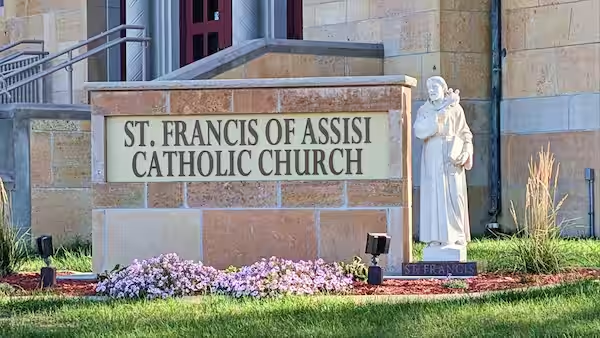
  • And finally, it what has to be one of the most bizarre church stories I've ever heard (and I'm Catholic), a woman in Moscow, Idaho, had her remains embalmed and bronzed then placed in her favorite spot in the front row of the church. Moscow is a really fantastic city. Someone tell me this is a joke.

One man was shooed away by Gert on several occasions when he arrived early and inadvertently took her spot, he says. Now the bronze statue serves as an irritating reminder of the encounter.

“It’s like she’s still there defending her seat,” he says.

When church members enter the sanctuary now, they can’t help but catch the glare of light off of Gert’s bronzed pate. Visitors find it inconvenient to climb over her, and children have stubbed their toes on her hardened shins.

“She was a Christ-like lady, except when it came to giving up that spot,” says a family friend. “She had a real sense of her turf. To her, it was like the Israelites: Once you get land, you don’t give it up.”

Pastor Len Kerralt, who agreed to the odd memorial, looks upon Gert’s frozen smile each Sunday from the pulpit.

“It’s nice to know at least one person is enjoying the sermon,” he quips.

Take care, everyone. See you back here on Monday.


You can get more of Chuck Marohn's insights by reading his book, Thoughts on Building Strong Towns (Volume 1). It is a primer on the Strong Towns movement and an essential read for those wanting to get up to speed quickly.

You can also chat with Chuck, Nate Hood, Andrew Burleson, Justin Burslie and many others over at the Strong Towns Network. Join the ongoing conversation on how to make yours a strong town.

Tuesday
May142013

The Driving Boom is Over

The Driving Boom -- a six decade long period of steady increases in per-capita driving in the United States -- is over.

So says a new report from the U.S. PIRG Education Fund and a think tank called the Frontier Group. Written by Tony Dutzik and Phineas Baxandall, the report provides stark detail to a trend that many have sensed is underway.

Download the report: A New Direction; Our changing relationship with driving and the implications for America's future. Also, simultaneous with the release of the report, Strong Towns is releasing a podcast interview with one of the authors, Tony Dutzik. Click here for the podcast.

Some highlights from findings of the report:

  • Americans drive no more miles in total today than they did in 2004. Per person, we're at levels not seen since 1996. After decades a steady increases, a fifteen year divergence from the trend is beyond significant.
  • Americans took nearly 10 percent more trips via public transportation in 2011 than in 2005. The nation also saw increases in commuting by bike and on foot.
  • A return to the steady growth in per-capita driving that characterized the Driving Boom years is unlikely due to the aging of the Baby Boom generation, the projected continuation of high gas prices, anticipated reductions in the percentage of Americans in the labor force, and the peaking of demand for vehicles and driver’s licenses and the amount of time Americans are willing to spend in travel.

The implications here are enormous. For decades we have overbuilt auto-based transportation infrastructure based on traffic projections. The induced demand -- the effect of more capacity inducing people to drive more -- has been pernicious, particularly in the way it perversely self-reinforced faulty projections and justified underlying assumptions that, ultimately, are not defensible. That we've run out of our capacity to induce evermore miles driven is a fate that was inevitable.

Now the real difficulties start. Projections of funding gaps in transportation budgets -- numbers that were too massive to even discuss honestly in the context of our political system -- all relied on continued growth in miles driven per capita. Without the revenue that comes from such increases, these massive gaps become unfathomable.

It also undermines the arguments for continued growth in highway investments. It is difficult to imagine a scenario where Americans agree to pay significantly more to maintain systems they are using significantly less. Without significantly more investment, the capacity of these systems will degrade precipitously in short order. We have some hard choices ahead.

The first set of hard choices come with projects in the pipeline. Last July at the Strong Towns Network, our friend Josef Bray-Ali wrote about the I-710 project near L.A. and the debate going on regarding traffic projections. When questioned about declining traffic counts, project engineers brushed Josef (and others) off with suggestions that these were short term trends that would reverse once recession was over. They even suggested there would be a "catch up" period to get back to historical norms. Here's a quote from the project spokesman:

The Ports re-evaluated their growth projections after the recession and made adjustments. The revised projections show slower growth in Port activity in the next decade, but the 2035 total TEU estimate remains the same: 42.7 Million. In other words, the Ports anticipate to handle 42.7 Million TEUs by 2035, even if growth is slower in the next few years.

This is a $5 billion project, largely predicated on bogus projections. Do we have the courage to stop this folly and others like it, big and small, when developers, contractors, politicians and others all still want to believe the in the magical Growth Fairy? 

All of this also reinforces just how important walking/biking infrastructure is now becoming. I've been very skeptical of the way we are doing rail in this country (Transit-oriented Parking) and have a hard time supporting any rail project that not serving existing productive land use patterns (as opposed to being a speculative catalyst for top-down engineered growth -- a more PC version of what we did with highways five decades ago), but walking and biking infrastructure within established neighborhoods is almost always a high return investment. This is especially true when it is done with an incremental mindset. We should be narrowing traffic lanes and adding bike lanes anywhere we have or want a productive street.

Make sure and listen to that podcast -- it is a good listen -- and read the report. They are both worth your time. Then share them with every engineer and public official that you know. The next time you go to that meeting and they say they need to expand the lanes due to traffic projections, you throw down this report. If that doesn't work, call me.

This insanity needs to end. The New Direction report really helps.


You can get more of Chuck Marohn's insights by reading his book, Thoughts on Building Strong Towns (Volume 1). It is a primer on the Strong Towns movement and an essential read for those wanting to get up to speed quickly.

You can also chat with Chuck, Nate Hood, Andrew Burleson, Justin Burslie and many others over at the Strong Towns Network. Join the ongoing conversation on how to make yours a strong town.

Monday
May132013

On the road

At 10AM EST we'll be posting information on a new research report from U.S. PIRG and Frontier Group as well as releasing a podcast with one of the authors of the report. Please check back at 10AM EST.