Embracing Congestion
Tuesday, October 23, 2012 |
Charles Marohn After sixty years of the Suburban Experiment, we have a conditioned response to congestion on our streets: we add automobile capacity. We widen streets, add turning areas, remove parking and add additional lanes. Economists tell us that congestion costs us billions of dollars a year. What if that was backwards? What if congestion was the essential ingredient our cities needed to prosper?
Did you experience withdrawal symptoms yesterday when we didn't publish our regular Monday morning post? Have no fear -- you can help us keep the Strong Towns medicine coming by making a tax-deductible donation. Recurring contributions of as little as $5 per month (a steal considering everything we provide here for free each week) help us out tremendously. Please consider making a commitment to us today so we can continue to share this important message.
I've spent the past couple of months discussing traffic projections and why our approach to managing traffic is glorified guess work with a veneer of science. I recently offered an alternative approach, one that did not require us to make enormous bets on a future we pretend we understand. Today I'm going to talk about getting there; the transition it will take for us to change our transportation system in pursuit of a Strong Towns vision.
It starts with something we all know and understand: automobile congestion. Many of us experience congestion to one degree or another every day. Cars stopped at traffic lights. Streets backed up while someone tries to turn across traffic. Arterials clogged during rush hour while more cars try to get on. This is the America we know.
We also know the "solution" to congestion. The traffic engineering profession -- a formal pursuit still in the adolescent stage of its development -- has conditioned us to the proper response: add capacity. This has become so common sense in our culture that the average person can, from their driver's seat, prescribe the myriad of complex solutions that will immediately gain societal acceptance.
Add new lanes of traffic. Remove on street parking. Build turn lanes. Add signalized intersections. We rarely even debate the necessity of such improvements, let alone their effectiveness.
We also intuitively understand the economic impact of fighting congestion. With each increase of automobile mobility, we see new investments occurring. Strips malls, big box stores and new housing subdivisions, all signs of progress made possible by increasing automobile mobility. Investment responds to the increase in mobility and coalesces where it can be put to most efficient use. This means the big box retailer is able to compete at a lower price than the corner hardware store. The chain grocer is able to offer a wider selection than the corner grocer. The national coffee shop is able to offer the brand recognition not available to ma and pa.
In America, circa 2012, we call this "the market" as a way to sooth ourselves into believing that somehow this represents a consumer preference. That somehow the subsidies meted out in our War on Congestion did not predetermine as winner those few that compete at the narrow margins of quantities of scale. We need to believe that Wal-Mart out competed the old hardware store. Our genuflecting to the American ethos of competition is the only way we can culturally justify buying products made in China, with credit dispensed from China, from pitifully compensated American workers barely paid enough to afford the products they sell.
What would happen if we removed this subsidy?
When I suggest that we convert our STROADS back into streets -- changing unproductive transportation corridors into platforms for growth and investment -- the push back I get is that congestion will become unbearable. If we narrow those lanes, bring back the on-street parking, take out the turn lanes, remove the traffic signals, slow the automobile speeds and welcome a more complex urban environment, somehow we wouldn't all be able to rapidly get to where we want to go.
To this I say: AMEN!
We have spent untold amounts of wealth reducing the time spent in the first and last mile of each auto trip. The result: a nation of fragile and unproductive places, an economy subsisting on financial meth and other desperation moves along with a built environment that forces (let me emphasize that to reinforce the notion that having only one option in a marketplace is quite un-American) FORCES nearly all of us to drive everywhere we need to go.
If we began to unwind this system, converting those nasty STROAD corridors into wealth producing streets, we would have congestion, of course, but in this case, congestion would simply be another word for opportunity. And not the type of opportunity that benefits the global corporation that can purchase toilet paper for 0.005 cents over cost, ship it around the world on subsidized transportation systems using subsidized energy all while protected by the U.S. military. I'm talking about opportunity for real people in real neighborhoods.
Need a gallon of milk? In an America of Strong Towns, you can get in your car and drive or -- if the cost in terms of your time or quality of experience is worth more to you than you would choose to give up in dollar wealth -- you can walk down the street to the corner grocer. Today that is considered quaint, but stop wasting enormous sums of money fighting congestion and now that becomes a real choice. Am I going to sit in my car for half an hour on clogged streets to save two dimes on milk or will I just walk up the block?
With choice comes opportunity. With opportunity comes investment. I want to free the local entrepreneurs in this country to reinvest back in our cities and core neighborhoods. A tiny bit of love to these places will financially return scores more to our GDP than all the grand infrastructure projects we could ever imagine. All we have to do is stop subsidizing their competition.
And please understand what I'm saying: We can actually spend lots less, have a government that is smaller and more effective and see a ton of local investment -- stuff that will make a city wealthier and more prosperous over the long run -- while providing small business opportunities and a growing, stable and diverse workforce. This is a vision for a New America, one much more closely tied to the best of our heritage than the current consumption-centric, faux incarnation of the American Dream.
To make this happen, we need to realize that congestion is the answer, not the problem. People who want to shop at big box stores can live next to them. That is a choice in the markeplace that I can accept. People that want to live in neighborhoods will also have choices, options that do not exist for them today because we subsidize their competition at every opportunity.
So will congestion be unbearable? Perhaps for a while, but it is not like we are going to go out tomorrow and convert every wealth-destroying STROAD into a revenue-generating street (although a few cans of paint in a city determined to reform could go a long ways in a hurry). This is going to happen gradually over time. And it will be self-regulating; the greater the level of congestion, the more incentive there will be on our blocks and in our neighborhoods to develop alternatives. That's the way markets work.
Spend less money. Build places that create real wealth. Provide options. Drive competition. These are Strong Towns values that we can all buy in to. We just need to start seeing congestion for the partner it is.
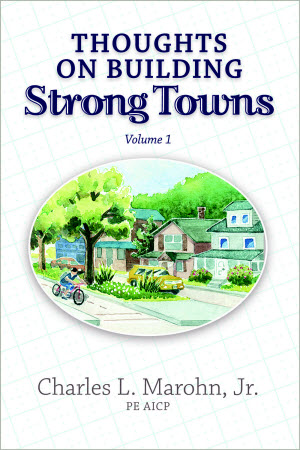
If you would like more from Chuck Marohn, check out his new book, Thoughts on Building Strong Towns (Volume 1).
You can also chat with Chuck and many others about implementing a Strong Towns approach in your community by joining the Strong Towns Network. The Strong Towns Network is a social platform for those working to make their community a strong town.
Roads and Streets,
Strategies 


Reader Comments (13)
Or what if we reinvent work, so people aren't forced to go to "a place" to get their jobs done. Yes, some people need to be physically present to do their work, but a vast majority of us - CPAs, attorneys, insurance agents, etc. don't need anything more than an internet connection and cell phone to work. Imagine the congestion that could be avoided!
That little bit of technomancy has been around for some time, but like all technomantic bargains, it's more than a bit Faustian.
Let me put it this away: a job that can be telecommuted can be outsourced. Are you willing to risk your salary for a nonexistent commute?
Here is my response to this article:
*slow clap*
Thank you, Chuck, for articulating these thoughts so well!
I was literally discussing just this idea with my wife regarding our kindergartener's walk to school (literally across the street) and how much more pleasant it would be if some of the vacant buildings around us were filled with people, and if instead of parking lots there were instead structures which increased density and foot traffic.
How much safer it would feel if hundreds more students walked to this "neighborhood school" instead of being driven by their parents: More adults walking from their homes to their jobs would make more parents feel comfortable with their children walking to school which in turn would make more parents feel comfortable with the idea...A positive feedback loop.
As a city dweller I can tell you, I want more density, more "congestion"; I want more of what makes a city a city. As Kunstler has said, in many ways suburbs are about keeping more of what you have away from where you have it, whereas in cities we want more of what we have close to us.
Great article and lots of great points.
But planning and zoning departments need to create the proper mixed use zoning if the post WW II sprawl will ever feel like a real city. Its great to turn the arterials back into streets, but only density will make it possible to walk your community...and that gets regulated by city commissioners voting on comprehensive plans and rezoning applications...
Chuck, loved the article as always. Thanks for the medicine. I second Joshua's slow clap!
Steve and Kevin, most people in this country didn't have jobs 100yrs ago...at least not in the sense of the word that we think of today. This is just another part of the American story that interconnects with the Suburban Experiment.
Bobby, I agree that land use planning is so critical to creating Strong Towns in our current approach to building cities. Few too people understand it or are engaged in it. I also suggest that land use planning follows transportation planning, and I would advocate our energies go there first. As Chuck alludes to, the land use planning will follow if our transportation planning stops distorting the market towards the Suburban Experiment. I do not believe this is a chicken-or-egg argument, but a linear cause-and-effect scenario.
As usual what you say makes a lot of sense; and as usual, reading it from the other side of the Atlantic, I keep wondering when and how what you are preaching stopped being obvious in the States. I suppose that mainly depends on the fact that European cities were older and much harder to be retrofitted for cars, without being literally shredded to pieces.
I'm not saying that this has never happened in the sixties and the seventies, but it was very rare. In the huge majority of the cases the response to the problem "we have congestion" (i.e. too many cars) was simply to reduce the number of cars in some way or (more radical) dispose of them altogether, In fact the commercial success of most European inner cities, from the metropolis to the relatively small Italian medieval town where I live, is largely based on the fact that large areas are totally closed to cars and in even larger areas the flow of traffic is strictly and severely regulated.
Do not get me wrong; Italians absolutely LOVE their cars, and they keep driving them too much even with the gas prices around 8 US$ per gallon. However they have come to terms with the fact that you can't (and you won't) drive a car everywhere.
And that driving on a stroad clogged with traffic is about as pleasant as a trip to the dentist.
Talk about big picture! This ties it all together. Govt interference is what allows Walmart and other big boxes to survive, which is the opposite of the accepted wisdom. There's no need for the "mom and pop shop" ideal when Walmart is four minutes away on a 40-mph road through a neighborhood.
Great post as always. It reminds me of something Andres Duany (who else?) said in one of his brilliant lectures. Namely that congestion is a constant, you just have to decide if you want congestion at 4 lanes, 8 lanes, 16 lanes, 40 lanes, etc. If a city decides that congestion at 4 (or even better 2) lanes is enough, then they can put a lot more effort into alternatives that will actually be palatable. If the congestion is delivered on 6 or 8 or 10 lane streets and highways though, then it becomes much more difficult because those mega-streets suck up so much funding and create a huge pool of self-interested constituents. Those wide streets also make walking, cycling, and transit much harder to encourage because they're such harsh places to be in. It's just that "solving" congestion by adding capacity is the simple solution, even if it is the most destructive and least remunerative.
There's also the inescapable notion that the nicest places are naturally difficult to park and drive in, otherwise there'd be too much space devoted to parking lots or garages, thus sapping street life, or there'd be too much traffic to make the streets nice places to be in, or both. Some places resist densifying and improving their built environment because it's already very difficult to find parking or it's causing traffic. The thing is, that means people want to be there, and they want more places like that. So shutting down new growth of that sort only causes further sprawl and more traffic elsewhere, while leaving the demand for good urbanism unsatisfied and causing prices to increase astronomically. Enough people benefit from the artificial scarcity created through zoning and the effects it has throughout the landscape that they're afraid to try anything else.
I tend to think we are on the verge of technological revolutions in power systems and automation that will make the idea of the personal. manually-driven cars, as they fit in this Suburban Experiment entirely irrelevant. That is not to say I don't think there is plenty of time between now and then to adapt to best practices with today's tech... but you cannot assume "the car" forever, I think, and I'd be interested to know how that changes the preference and need for congestion, it will likely be a causal factor in these technologies' development: automated navigation, integrated traffic management, "linked" cars. I think that's just the near-term, too ~Bob
I'll note that I am not a big fan of on-street parking. Too few good spots leads to people circling to find a place to park, that adds to traffic problems that makes a place less desirable (common complaint: too much traffic, too hard to find parking.) Too many good spots leads to people just doing their business, in and out and that's it, no place making happens.
But if you make the car just a little less convenient by lets say landscaped hidden corner parking lots (or one block off), you can get more people to mingle on the street (place making) just in and out is discouraged in a good way. Parking can be expanded if needed.
In short I would rather see sidewalks expanded and more trees then on-street parking.
Thanks Charles. This series about transportation models is both well considered and well written. I've been battling this very issue on a small development file for weeks now and was seriously starting to think I was being irrational. I'm glad I came across it.
This is great stuff.
Now, whom do we need to bring on board in order to move on these ideas?