The Crash Analysis Studio Provided a Feasible Path Toward Safety for "Death Boulevard"
The Issue
When Nothing Changes with a Known Hazard, Tragedy Ensues
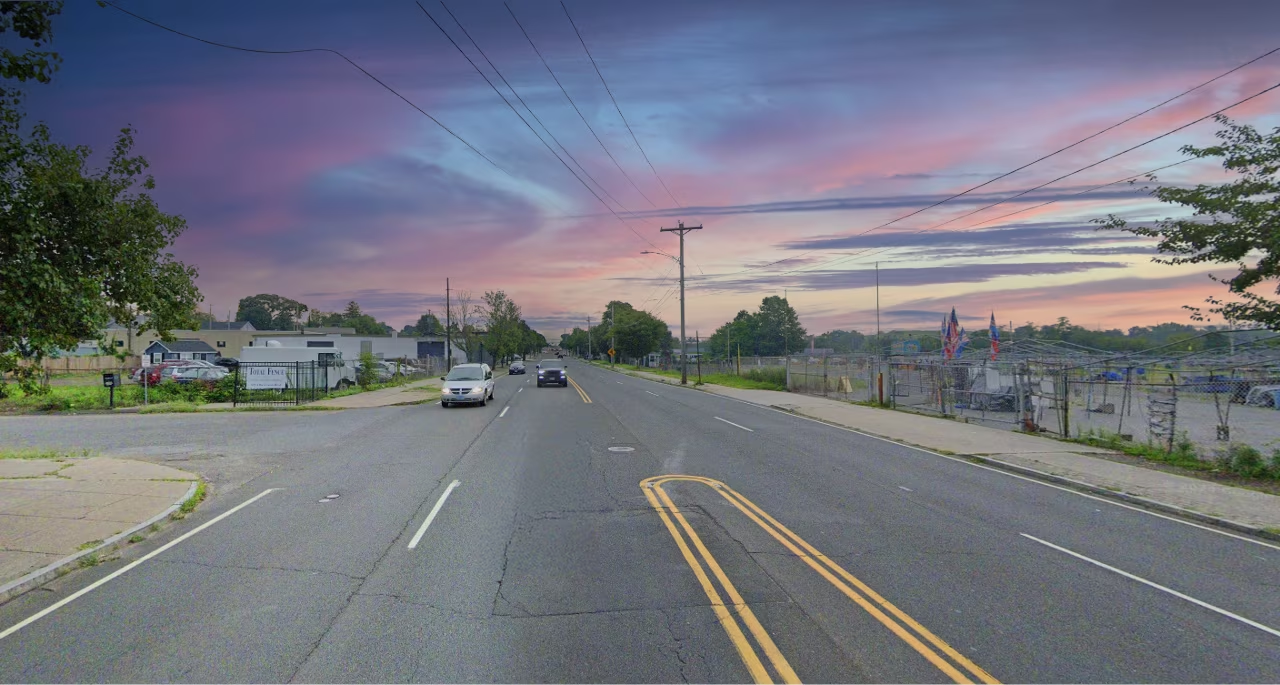
In some circles, Ella T. Grasso Boulevard in New Haven, Connecticut is known as "Death Boulevard." The four lane stretch near Columbus Avenue has been notorious for its perilous conditions. The area is a hodgepodge of commercial spots, like the Boulevard Flea Market, and essential services such as the Columbus House homeless shelter. Residential zones are sprinkled in, but the disjointed layout and lack of cohesive planning suggest that additional urban planning could do this area well.
For road users behind the wheel, the boulevard is a mix of drag strip and obstacle course. The road’s design encourages speeding, and with minimal pedestrian infrastructure, drivers may be caught off guard by unexpected foot traffic.
On the flip side, those outside of a vehicle face a gauntlet of challenges. Many sections lack sidewalks, forcing walkers onto makeshift dirt paths littered with debris. Crossing the boulevard may feel like a high-speed game of chance.
In 2023, two separate crashes took the lives of two people, both crossing Ella T. Grasso Boulevard. Following the crashes, the official investigations focused on the circumstances of each collision, including the fact that both pedestrians were crossing outside of marked crosswalks. But that explanation left a more important question unanswered: Why were people crossing there in the first place?
The Response
Looking Beyond the Final Moments Before the Crash
Rather than focusing only on the final moments before each crash, New Haven utilized the Crash Analysis Studio to examine the broader environment that shaped those moments. Participants reviewed crash reports alongside speed data, roadway geometry, surrounding land uses, and how people actually moved through the corridor every day.
The Studio found that the boulevard consistently encouraged fast driving while serving a place where people routinely needed to walk. Wide travel lanes, long crossing distances, infrequent crossing opportunities, and frequent driveways all contributed to an environment where serious crashes became more likely. Instead of asking only who made a mistake, the discussion shifted toward a more productive question: What about this street made those mistakes more likely to happen and more likely to have tragic consequences?
From that analysis came a series of practical recommendations, including lane narrowing, pedestrian-activated beacons, improved lighting, signal timing adjustments, and other quick-build safety measures that could begin reducing risk.
The Result
Enacting Changes Across New Haven
The Crash Analysis Studio went beyond an explanation of what happened. It provided a roadmap for what to do next.
The recommendations demonstrated that meaningful safety improvements could begin with practical, incremental changes rather than waiting for a complete transformation of the corridor. The Studio gave city staff and community members a shared understanding of the street’s underlying safety challenges and a framework for addressing them.
New Haven has since applied many of these quick-build safety strategies on other streets across the city, using the same principles identified through the Crash Analysis Studio to reduce risk and improve safety for people walking, biking, and driving.