A Lifetime of Attention

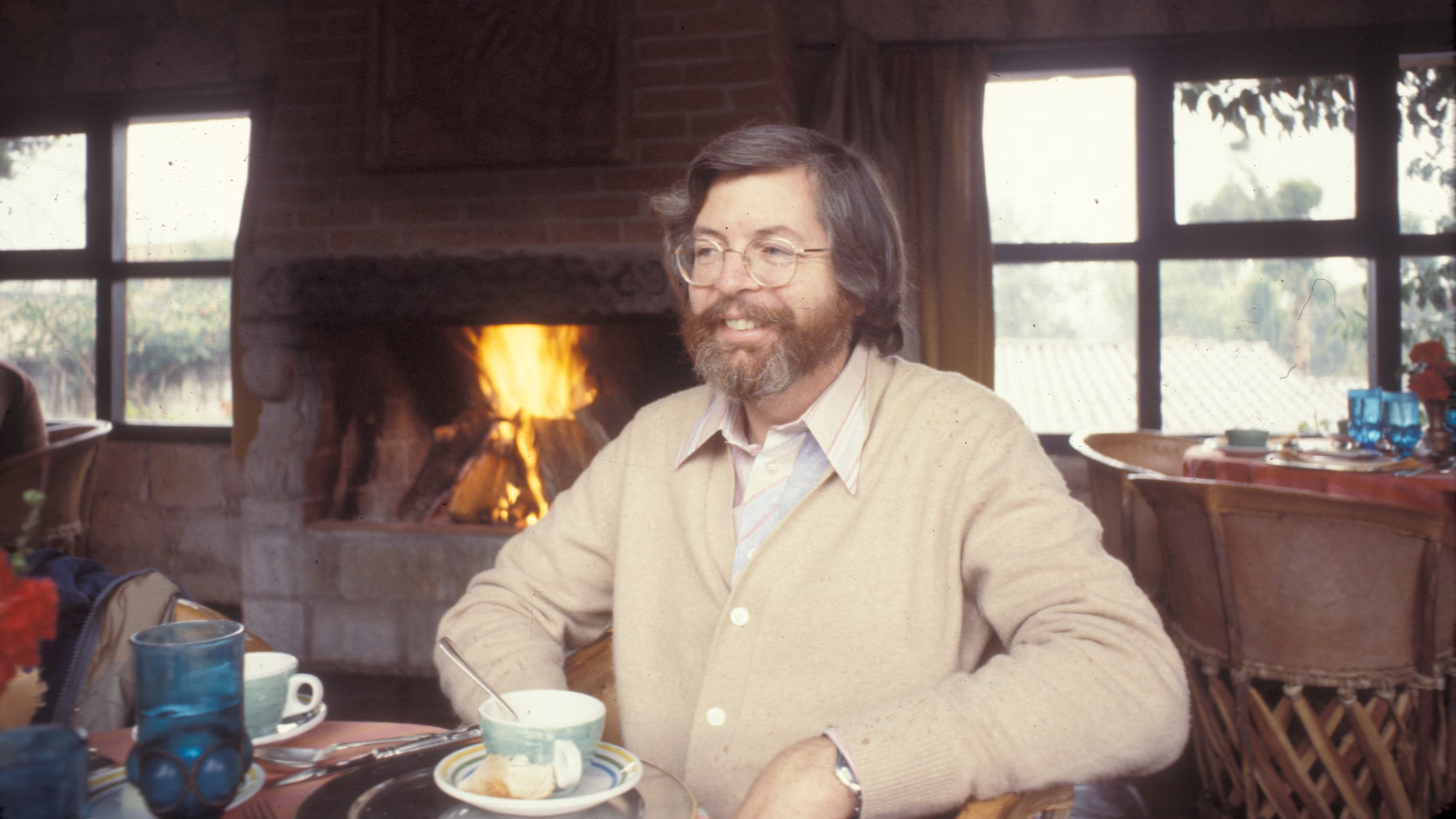
American urban designer, planner, architect, educator, and author Sinclair Black.
There is a certain kind of professional success that is easy to recognize.
You can point to the building, the project, the completed work. You can walk people through it, explain the decisions, describe the constraints that were overcome. Over time, those accomplishments accumulate into something like a résumé you can see and touch.
And then there is another kind of work that doesn’t present itself that way at all.
It is harder to isolate, harder to measure, and often harder to explain. It unfolds over decades, moves through different forms, and is carried forward as much by other people as by the person who initiated it. You don’t always know when it begins, and you rarely know when it is finished. In many cases, it never is.
That is the kind of work Sinclair Black has done in Austin, Texas.
As the Strong Towns National Gathering kicks off, and the Congress for the New Urbanism winds down, in Fayetteville, Arkansas, I want to take a moment and reflect on the career of someone who has meant a lot to both organizations.
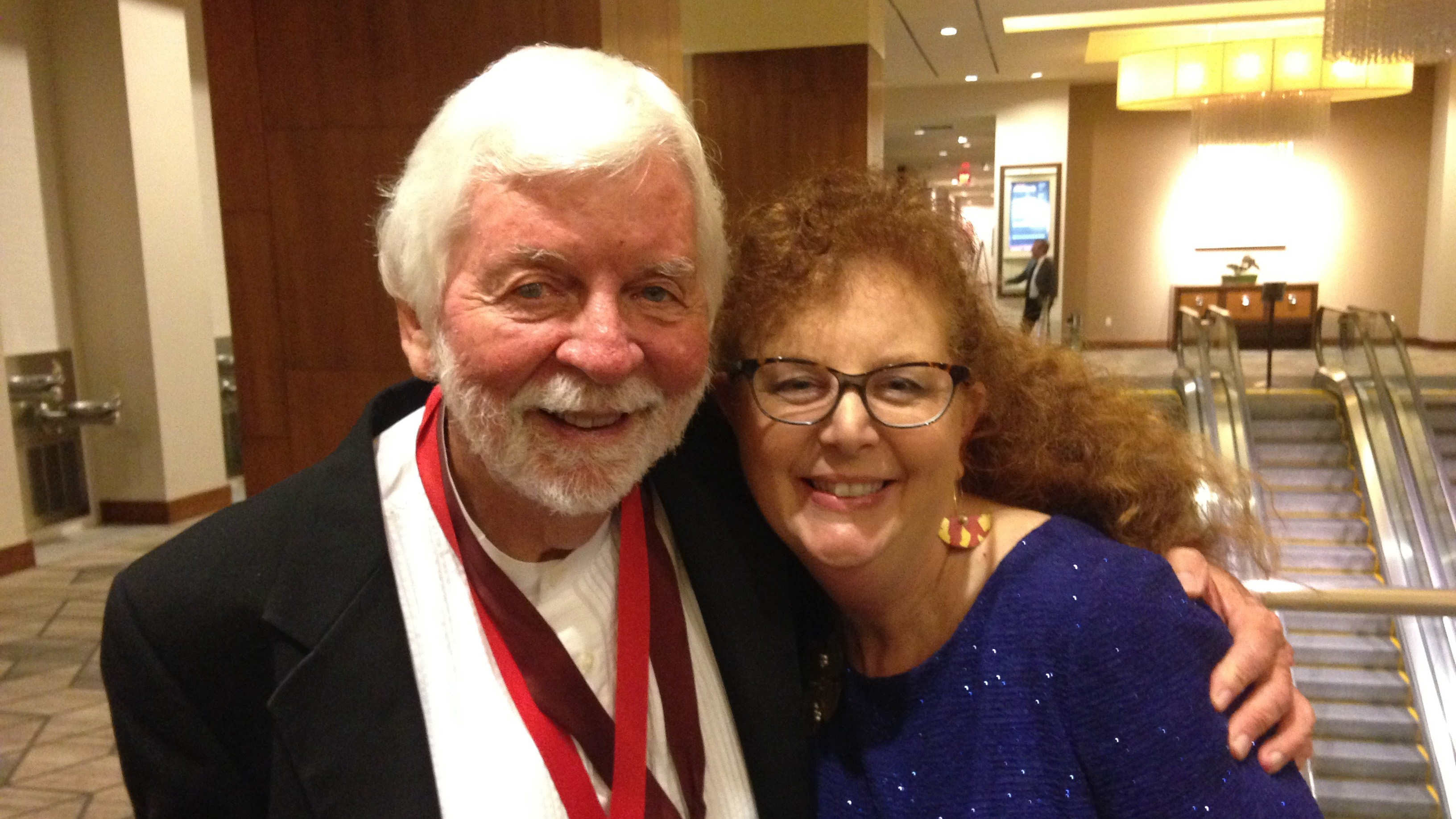
If you try to understand Sinclair by listing projects, you can certainly do that. There are plans, buildings, studies, and proposals spanning more than half a century. There are students, hundreds of them, who have gone on to shape cities in ways large and small. There are moments where an idea took hold and became something visible and lasting.
I think such an approach misses the more important pattern.
What stands out, looking across his work, is not the individual project but the consistency of attention. He has spent decades looking at the same place, asking variations of the same question: how could this work better? What is possible here that we’re not yet seeing?
In just one example, those questions led him to look at Austin not as a collection of parcels and roads, but as a network of creeks. Eighteen of them, forming hundreds of miles of potential public space. That idea did not begin as a capital project. It began as a way of seeing.
From there, it moved in the way these things often do for visionaries. It became a study, then a set of conversations with students and neighborhood groups, then a modest publication that helped people understand what was being proposed. Over time, those conversations led to funding, to preservation, to the gradual build-out of parks and trails. Much of that work is still ongoing, carried forward by people who may not even know where the original idea came from.
There is no single moment you can point to and say: that was the achievement. The achievement is that the idea took hold and continued. That’s a Strong Towns version of change.
In a recent conversation, I asked Sinclair what he would say to architects who feel stuck, people who have developed skills and insight but find themselves doing work that doesn’t seem to matter.
He didn’t offer a complicated answer. He said that if you have developed the ability to see something — really see it, in a way that others don’t — you have an obligation to act on that. To put it to work. To try to make things better, even if the path is unclear and the outcome uncertain.
There is a simplicity to that idea that can be easy to dismiss, especially in a profession like architecture where the incentives often point in a different direction. It is easier, and often more rewarding, to do work that is clearly defined, compensated, and completed. It is harder to invest time and energy in things that may not resolve cleanly, that may take years to influence outcomes, or that may ultimately be carried forward by someone else.
And yet that is the pattern his work follows. Again, it’s very Strong Towns before there ever was a Strong Towns.
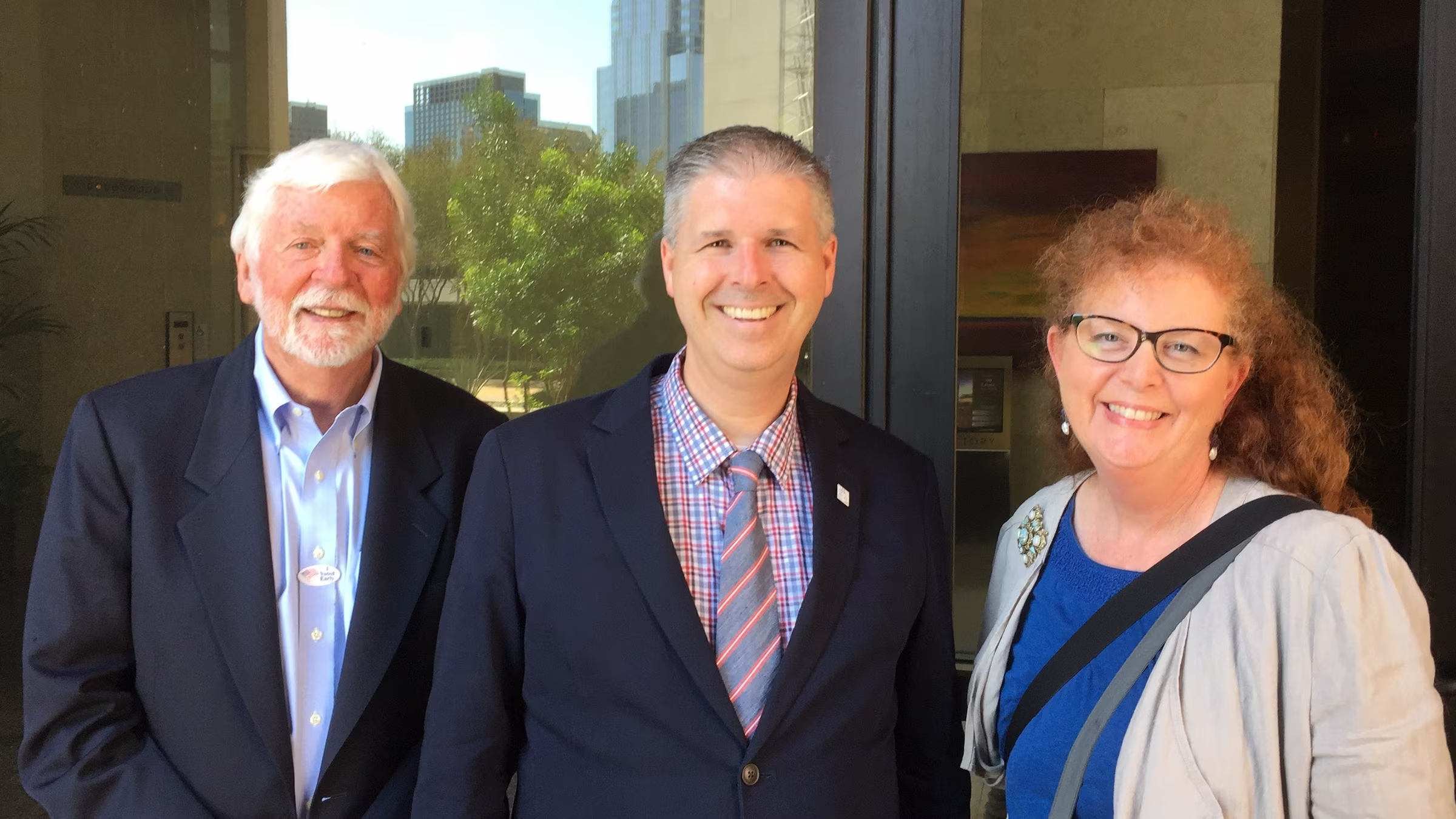
There is also a humility embedded in Sinclair’s approach that is also uncommon. At one point in our conversation, I suggested that many architects are drawn toward projects that function, in one way or another, as monuments to themselves. Not always intentionally, but as a natural outcome of a profession that places a high value on authorship.
What I have observed in his work is something different. The focus is not on producing an object that reflects the designer, but on shaping a place in a way that serves the people who use it. The result, over time, is that the work becomes part of the city itself, absorbed into its fabric, no longer associated with a single person.
The book he and his family recently assembled (40 visions from across his career) could be read as a retrospective. It certainly contains enough material to function that way. But it is more useful to think of it as something else.
It is a collection of ways of seeing.
Some of the visions were built. Some were partially realized. Some never moved beyond the idea stage. But taken together, they show a consistent approach to understanding a place, identifying its latent potential, and articulating what that potential might look like if it were taken seriously. In that sense, the book is less about what has been accomplished than about what remains possible.
There is a line in the book where he reflects on a lifetime of experience and describes it as a kind of reservoir, an accumulation of observations, influences, and insights that, over time, allows you to see things differently and to imagine new possibilities.
That idea resonates, but it also points to something we tend to overlook. That kind of reservoir is built slowly. It requires sustained attention, a willingness to stay with problems that do not have immediate solutions, and a level of patience that is increasingly uncommon.
It also requires a certain tolerance for ambiguity. When you are working at that scale — thinking about systems, about long-term patterns, about the evolution of a place — you rarely have the satisfaction of a clear endpoint. Progress is incremental. Outcomes are uncertain. The feedback loops are long.
And yet, over time, the work accumulates. We should all aspire to a life so well lived.
When you commit yourself to a place, to understanding it, to improving it, to helping it become something better, you are stepping into a process that extends beyond your own timeline. The goal is not to bring that process to completion. The goal is to move it forward.
And if you do that well enough, and long enough — as Sinclair Black has — the work continues, sometimes in ways you can see, and sometimes in ways you can’t.
That is a harder story to tell than a list of accomplishments.
But it is, I think, a more meaningful one.
Charles Marohn (known as “Chuck” to friends and colleagues) is the founder and president of Strong Towns and the bestselling author of “Escaping the Housing Trap: The Strong Towns Response to the Housing Crisis.” With decades of experience as a land use planner and civil engineer, Marohn is on a mission to help cities and towns become stronger and more prosperous. He spreads the Strong Towns message through in-person presentations, the Strong Towns Podcast, and his books and articles. In recognition of his efforts and impact, Planetizen named him one of the 15 Most Influential Urbanists of all time in 2017 and 2023.