How to Work With Evil Developers
.avif)
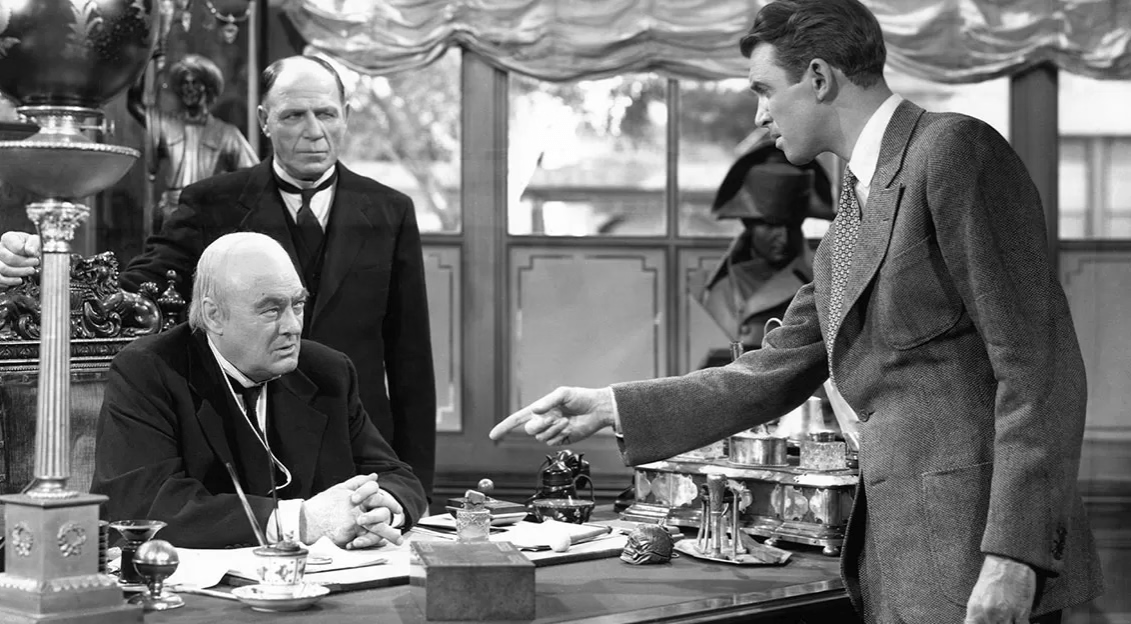
Mr. Potter from "It’s A Wonderful Life." The Evil Developer archetype.
Hollywood hates developers. "It’s A Wonderful Life," "Superman," "Up," "The Blues Brothers," "Barbershop 2," "The Goonies," "Poltergeist," "Breakin’ 2: Electric Boogaloo" (a personal fave) — the list goes on. I guess it’s not good cinema to show the developer listening to the community, revising the plans, and building something everyone loves. When you picture a developer, you picture the bad guy.
In these movies, the issue comes down to money. The community must rally to find the cash to save a building, prevent foreclosure, or protect their neighborhood from being bought up and redeveloped. The greedy, corrupt businessmen can only be defeated by deepening our own pockets. But, y’all, that’s the movies.
In reality, our ability to negotiate is stronger than we realize. But the perceived zero-sum game of evil developer vs. good community members limits our imaginations. Fight-or-flight is not a development strategy. This response keeps us from getting the deals our city needs. Let’s change that.
Create a Property Watchlist
Every neighborhood character-defining properties properties that influence daily life. Track them — work with a neighborhood organization or crowdsource it. Use public information: list of key properties, tax delinquency data, for-sale listings, deed transfers, and permit applications. Know the zoning and potential uses. An early-warning system creates an opportunity for community leaders to present a solution before an asset goes into foreclosure or sells at an auction.
Don’t Settle for a Vape Shop
Mixed-use developers often white-box first-floor retail space and hope for the best. It’s expensive space not built for the needs of local businesses. It sits empty. Everyone hates it. Here’s the move: build a list of local entrepreneurs ready for a brick-and-mortar location. Get them the business support to clean up their books, clarify build out requirements, qualify for funding, and draft an outline of their ideal lease terms. Bring your bench to the developer as early as possible — way before a shovel hits the ground. You've just solved their hardest underwriting problem and made the project better for your community.
Negotiate Like a Developer
Whether a Community Benefits Agreement (CBA) is required varies by city. But, if it is publicly owned land or if public incentives are being requested by the developer, CBAs are a must. Either way, push to understand the deal’s numbers and use developer language. "We want affordable units and hope you'll do the right thing" is messy. "We want 20% of units at 60% AMI. How does that impact the proforma and what tools could close the gap?" is a negotiation. Know what you want, ask for it up front, show the math works.
Develop it Yourself
Instead of reacting to someone else's vision, build your own. Learn to run a basic feasibility analysis: what’s the zoning, what are the rent comps, what might construction cost, does it cashflow, could incentives help bridge the gap? People invest in strong visions backed by real numbers. Keeping ownership in the community is powerful. Need help? Call me.
This is a preview of a talk I’m giving at the Strong Towns National Gathering, May 18–20 in Fayetteville, Arkansas. If you have ideas or feedback, send them my way!
[[divider]]
This article was originally published, in slightly different form, in Winter Wheat's newsletter, Brighten the Corners. It is shared here with permission.
MK Lindsey has spent 15 years structuring over $1.4B in complex real estate deals. She's sourced over $130M in creative gap financing and closed more than $500M in deals across eight states and 10 asset classes, with a specialty in walkable, mixed-use districts and historic renovations.
A community-focused rebel of a gal, MK left a VP role at a $3B regional firm to start Winter Wheat because she believes the same financial rigor that makes big deals work should be accessible to the people actually trying to fix their neighborhoods, not just the developers trying to extract value from them.
%20(1).avif)
%20(1).avif)
%20(1).avif)
%20(1).avif)