What We Owe the Place We Call Home

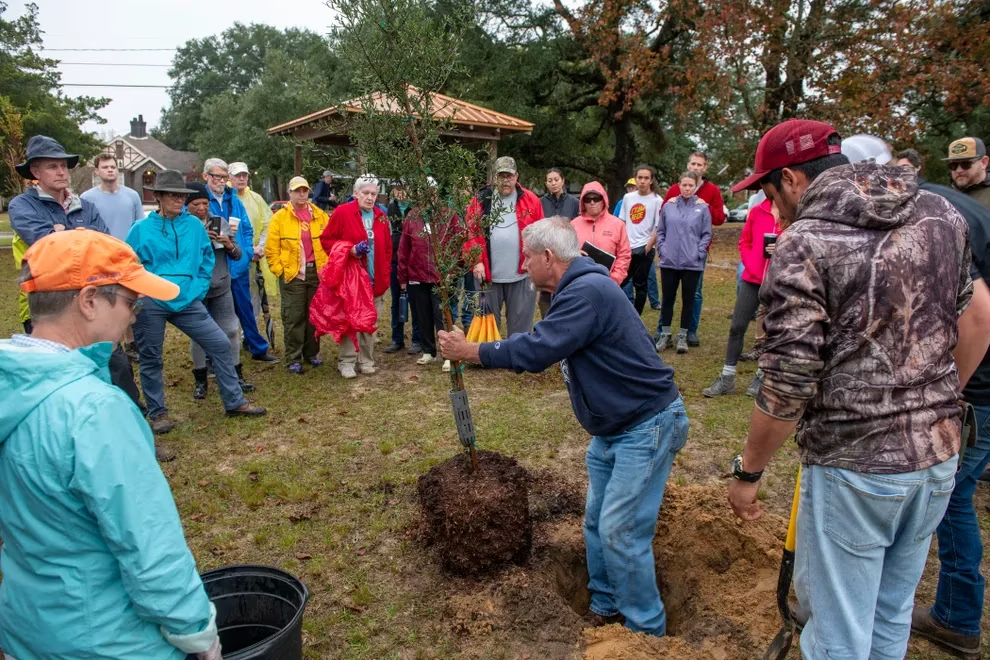
Volunteers planting trees for the Canopy Restoration Project in Pensacola, FL. (Source: Canopy Restoration Project)
I want my children to inherit a city worth loving — and to understand that loving it will require something of them.
Too many of us have learned to treat civic life as a spectator sport. We spend hours consuming — or being consumed by — algorithmic content on so-called social networks, posting and sharing and feeding the rage-bait fire. We can become intimately acquainted with the failings of people we will never meet while knowing almost nothing about the people living three doors down.
I include myself in that indictment. It is easier to have an opinion about the country than to assume responsibility for some small part of it. The screen offers an inexhaustible supply of things to resent. A neighborhood makes more particular demands: someone needs help, something needs repair, a decision needs our attention.
As a father of seven, I want my children to learn how to answer those demands. I want them to know their neighbors, recognize what is worth preserving, and become capable of doing something useful when the place they love needs them.
In the Catholic tradition, there is a name for the obligation beneath that ambition: pietas. Saint Thomas Aquinas writes that “man is debtor chiefly to his parents and his country, after God.” We have received something we did not make for ourselves. Gratitude places a claim on us.
I find that obligation easier to grasp at the scale of a city. Here, the inheritance has an address. Someone planted the trees shading our sidewalks. Someone built the schools and laid the water mains. Someone kept a parish or neighborhood association alive through years when the work fell to a handful of tired people. We live among the consequences of their decisions. Our children will live among ours.
Some of what we have inherited needs repair. Some deserves preservation. Some should never have been built as it was. Gratitude does not relieve us of the obligation to tell the difference.
Love of a city ought to make us capable of both affection and judgment. The debt we owe a place is not uncritical loyalty. It is stewardship: maintaining what we have inherited, testing new promises against what we can afford, and sharing the work widely enough that civic life does not depend on a few exhausted people.
We can cherish the place where we live and ask whether a proposed deal makes financial sense. We can thank an elected official for good work and still insist on an answer to an inconvenient question. We can recognize genuine progress without pretending that everyone has benefited from it.
When Chuck Marohn opened the CivicCon series here in Pensacola, Florida, on Sept. 26, 2017, he offered a useful way to examine our inheritance: could we afford to care for the city we were building?
Nine years later, the question is still the right one. And answering it requires more than a healthy balance sheet. It requires citizens capable of caring for what they inherit.
In 2025, I wrote for Strong Towns about the ways places form people. The arrangement of a neighborhood can help us practice patience, hospitality and responsibility — or make those habits harder to acquire. The work of improving a place can form us, too. Caring for something together gives us reasons to become more competent and dependable. It also provides ample opportunity to discover how far we still have to go.
Pensacola offers useful examples.
The particulars are local, but the disciplines are portable: maintain what you own, examine the obligations you take on, and cultivate enough civic capacity to do the work together.
When Pensacola won the Strongest Town Contest in 2019, Strong Towns highlighted an expanding local economy and tax base, downtown reinvestment, the city’s historic development pattern, and efforts to make its code more supportive of walkable development. Those themes remain relevant.
Infill puts underused land to work within the footprint of infrastructure we already maintain. Done well, it makes room for another household or business while helping support the street outside its door. The city’s current effort to revise its development code gives us an opportunity to make ordinary, modest growth easier.
The details matter. Existing infrastructure has limits. Rising property values can create real hardship for residents whose incomes do not rise with them. A stronger balance sheet matters because of the common life it can sustain; it is a poor substitute for one.
Stewardship also means caring for what we already own.
Direction ’25 is a $21.7 million multiyear program of repairs and improvements across at least 54 parks and public facilities in all seven city council districts, with work scheduled through spring 2027. Courts need resurfacing. Playground equipment wears out. Places advertised as public need to be accessible to the people they are meant to serve.
Funding the work is only part of the obligation. Projects have to be completed, and their upkeep must find a durable place in future budgets. Still, there is something morally serious about a city turning toward its maintenance backlog. A neglected park is a promise allowed to deteriorate. Repairing it honors both the people who use it now and those who entrusted it to us.
On the Gulf Coast, stewardship also requires taking water seriously.
The Hollice T. Williams Stormwater Park project seeks to combine flood control and stormwater infrastructure with recreation, landscaping, and better neighborhood connections on land beneath and beside the interstate that divided these neighborhoods.
The project still has to be built. But the underlying principle matters: public investment should protect lives and property while making a place more useful and hospitable. Flood protection, living landscapes and neighborhood life do not have to be separate conversations.
And repairing a neighborhood should make it easier for the people who live there to remain and flourish. Families should be able to enjoy the improvements they have spent years asking for.
Love also needs enough financial literacy to recognize a bad bargain.
A public-private partnership can be worthwhile. It can also create obligations that receive far less attention than the initial announcement. Who maintains the asset? What happens if revenue projections fail? What else could we accomplish with the same land and money? Those questions should matter more than how much we like the rendering — or the people presenting it.
The same discipline belongs in transportation planning.
After the Florida Department of Transportation withdrew its support in June for converting MLK Drive and Davis Highway to two-way traffic, I wrote to the department in August asking to see the cost projections and the differences among the alternatives. Had the analysis counted adjacent taxable value, economic activity and the value of preventing injuries? What, beyond moving vehicles, qualified as a benefit?
I was asking for evidence, not claiming to possess the answer. Citizens ought to be able to examine the reasoning behind decisions that will shape their neighborhoods for decades.
This is the civic competence I want us to keep developing. Officials who explain tradeoffs and take maintenance seriously strengthen public trust. Residents who read the documents and ask difficult questions are doing useful work, even when they make a meeting less comfortable. Neither expertise nor public office exempts anyone from having to show the math.
Does that make a city more resilient — perhaps even better able to learn from stress rather than merely endure it? Only if the experience changes what we do next.
Surviving a storm or a failed proposal does not automatically make a community stronger. What matters is whether we correct an assumption, make a more prudent commitment, or build relationships that help us respond to the next difficulty.
Some of that learning happens with a shovel in hand.
In a recent interview, Chelsea Mahan described the beginnings of Pensacola’s Canopy Restoration Project. She was walking with her colicky daughter when she met another neighbor, Edna Laura, who was caring for her dying mother. Their conversations helped grow a project to replace trees lost from the neighborhood. Volunteers would plant them. Residents would water them.
I find that a moving account of civic life: two people already carrying responsibilities, finding room to undertake another together. Their work will eventually shade people who never knew their names.
Other days, the work means showing up for a marathon council or county commission meeting. Or attending a state agency’s public meeting when the agenda appears largely settled and you doubt your comment will change the outcome.
You show up anyway. You ask the question. You find out who else cares. Perhaps the decision changes; perhaps it does not. But someone now knows whom to call, and the next person confronting the same problem need not begin alone.
That companionship matters.
A healthy civic culture cannot run indefinitely on the exhaustion of its most devoted members. People have children to put to bed and parents to care for. The work has to be shared widely enough that someone can miss a meeting without feeling they have abandoned the city.
I have little reason to expect a faultless city populated by faultless citizens. I have every reason to take seriously the neighbors I have actually been given. We are trying, slowly and sometimes awkwardly, to build a place worth caring about now and a hundred years from now. That requires a culture capable of outlasting a mayor’s term, a founder’s enthusiasm or a disappointing vote.
Wendell Berry understood the fellowship that grows from shared work. His accounts of neighbors helping one another with the tobacco harvest belong to a world in which membership involved being needed and needing others in return. In "Jayber Crow," his narrator describes a community “always failing and yet always preserving a sort of will toward goodwill.”
I recognize something of Pensacola in that sentence.
Some of our projects will fail. Others may bear fruit too late for us to enjoy it. We should do the work carefully enough to give them a chance, and love our neighbors well enough that a setback does not destroy the fellowship that made the work possible.
Joy and sorrow are both better shared with a neighbor.
I hope my children inherit a city that has learned that — and know they owe it something in return.
[[divider]]
If you want to help build a city worth passing on to the next generation, join us at the Civic Leader Summit in Pensacola, Florida, Oct. 6–8 to explore practical ways to care for the places we love and share the work with our neighbors.
Jarah V. Jacquay is a Northwest Florida native, husband and father of seven, practicing nurse, and managing principal of Virtuous Cycle LLC, a real estate and community development advisory firm. He is co-founder and president emeritus of Bluffline Inc., a Pensacola nonprofit working to reconnect neighborhoods through greenways and trails. His writing and civic work focus on health, infrastructure, stewardship, and the common good.