10 Questions to Ask Someone Running for Local Office

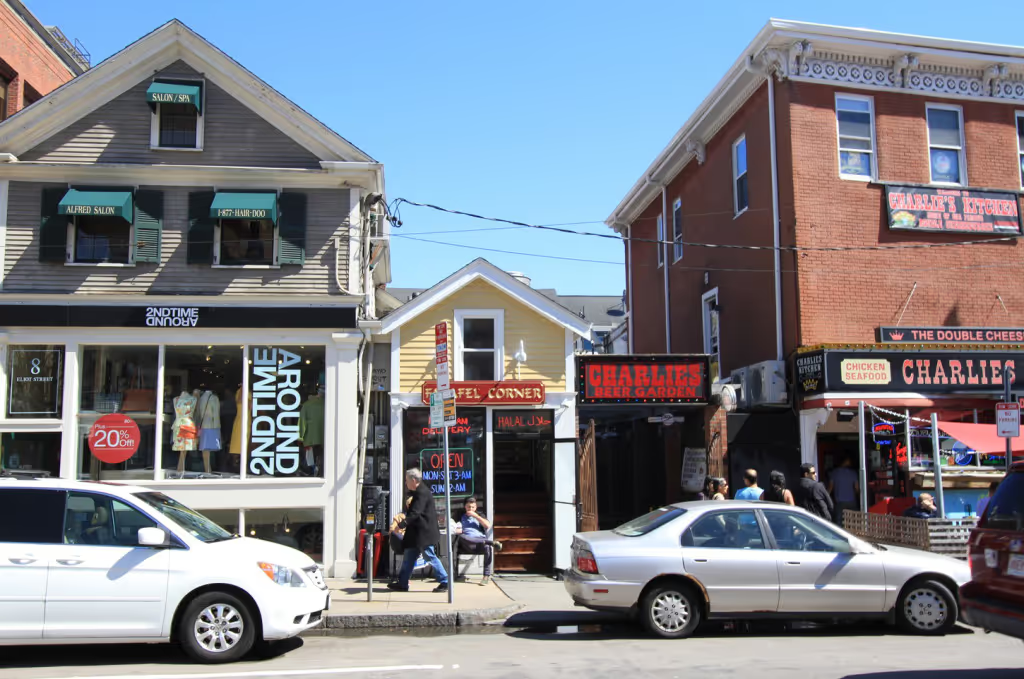
How's your main street doing? Take our Strength Test to find out. (Image via Johnny Sanphillippo.)
How can you tell if someone running for local office will do a good job? How can you ensure that he or she will improve your town's economy—and not get your community further into debt? How can you figure out whether this candidate for mayor or city council is going to uphold Strong Towns principles and take a thoughtful, incremental approach to your community's problems?
Below, we've put together a list of 10 questions you can pose to someone running for office in your town to see whether he or she is worthy of your vote. You could raise these questions in a public forum, at a personal meeting, or even informally, if you happen to run into the candidate at the grocery store.
1. Do you think our main street/downtown is healthy and successful? If not, what would you do to change that?
What To Listen For: First ask yourself what you think could be improved about your main street. Is it safe to walk there? Are businesses thriving? Do people spend time there? If so, then this might be an easy question for your candidate to answer. If not, then think about the small steps that could be taken to make Main Street safer: narrowing lanes of traffic, installing benches, planting trees, hosting pop-up shops in empty storefronts to encourage business activity, etc. Does the candidate mention these sorts of initiatives and understand the importance of a healthy downtown, or does he/she just talk about moving traffic or increasing parking?
2. What’s more important for our city right now: building new homes and commercial space or rehabbing/expanding/better utilizing our existing homes and storefronts?
What To Listen For: Depending on what sort of community you live in, you probably have a sense of whether your town has vacancies and endless subdivisions on the edge of town, or whether you truly have a housing shortage. But even if you are one of the rare cities that falls in the latter category, you likely still have plenty of underutilized properties that could be renovated or expanded to accommodate more people and businesses. Your candidate should respond with a balanced perspective that focuses on the need to better utilize existing buildings and only build when truly necessary with an eye toward adaptability and keeping costs down.
3. How do you feel about the transportation options currently available in our city? Can all of our residents affordably get where they need to go? If not, what will you do to improve transportation in our city?
What To Listen For: Keep an ear out for a candidate who understands the real cost of car dependency. They shouldn't just give lip service to other transportation options, but actually demonstrate a familiarity with the issues facing bus riders, cyclists, and pedestrians. Also note whether the candidate advocates for an incremental approach to improving transportation options (thumbs up) or advocates for top-down megaprojects (thumbs down).
4. Some people in our community say that we have traffic problems. What do you think? How would you mitigate those concerns or change the situation?
What To Listen For: Chances are, you don’t actually have traffic problems. In fact, congestion is often a good thing because it means more people passing by local businesses. Check out this article on the causes of congestion for more info. If your candidate starts suggesting things like adding lanes and building new roads, that's a major red flag. Concerns about traffic should be redirected toward making neighborhoods more walkable, putting businesses and homes in close proximity and other tactics to create “complete neighborhoods” that don’t require a ton of driving.
5. If you could change one thing in our zoning code, what would it be and why?
What To Listen For: Your candidate should demonstrate an awareness that greater zoning flexibility will allow for profitable development, business success and a broadened tax base. They might propose removing parking minimums or legalizing the next increment of development for single-family homes.
6. How do you plan to involve residents in the decision making process in our town?
What To Listen For: Your candidate should be able to genuinely answer this question with specific plans for engaging residents and listening to their concerns, not just platitudes about how "decisions are made by those who show up."
7. If someone came to you with a proposal to build a new piece of public infrastructure in our city (road, bridge, etc.), how would you evaluate whether or not that project was worth implementing?
What To Listen For: First, the candidate should assess whether the project is truly needed by the community. Second, the candidate should look at how much the project will cost and fully account for the long-term maintenance expenses associated with the project, then consider where that funding will come from — for both the immediate and long-term costs. Finally, the candidate should examine how this project will impact the rest of the city, both financially and physically. For example, a new bridge might enable people to take a convenient short cut through your downtown, but would the maintenance costs strain the municipal budget in 20 years? Would the bridge’s presence harm local businesses?
8. If elected, what three steps would you take to put our city on a firmer financial footing?
What To Listen For: Your candidate should be able to quickly answer this question. If he or she takes a long time to come up with a response, that’s a problem. Moreover, their response should encompass an approach based on incremental and affordable tactics, not going into more debt or expanding the liabilities of your city further.
9. If you received a $1 million grant to use for the city any way you wanted, what would you do with it and why?
What To Listen For: A candidate who utilizes a Strong Towns approach should focus on small, incremental investments and bottom-up action over large-scale, top-down projects. With that in mind, your candidate should ideally mention several small projects that would benefit the people and neighborhoods of your city rather than a big, all-or-nothing endeavor. Here are some ideas for taking on small projects based on demonstrated community need.
10. What neighborhood do you live in? Why? Where are your favorite places to spend time in our town?
What To Listen For: Is your candidate deeply familiar with the whole town and its needs? Where he or she lives might tell you that. If the candidate lives far on the edge of town and doesn’t spend much time in the community’s parks, downtown, local businesses, etc., that suggests a lack of knowledge about the whole community. Conversely, if the candidate spends all of his or her time in just one neighborhood and doesn’t seem familiar with other parts of the city, that’s a red flag too.
(Cover image via U.S. Air Force / Roland Balik.)
Rachel Quednau served as Director of Movement Building at Strong Towns. Trained in dialogue facilitation and mediation, she is devoted to building understanding across lines of difference. She has worn many different hats at Strong Towns since joining the team in 2015. Rachel also previously worked for several organizations fighting to end homelessness and promote safe, affordable housing at the federal and local levels. A native Minnesotan and honorary Wisconsinite, Rachel received a Masters in Religion, Ethics, and Politics from Harvard Divinity School. She currently lives in Milwaukee, Wisconsin with her husband and two young children. One of her favorite ways to get to know a new city is by going for a walk in it.