Zoning and the Erosion of Civic Life: Notes Inspired by Léon Krier
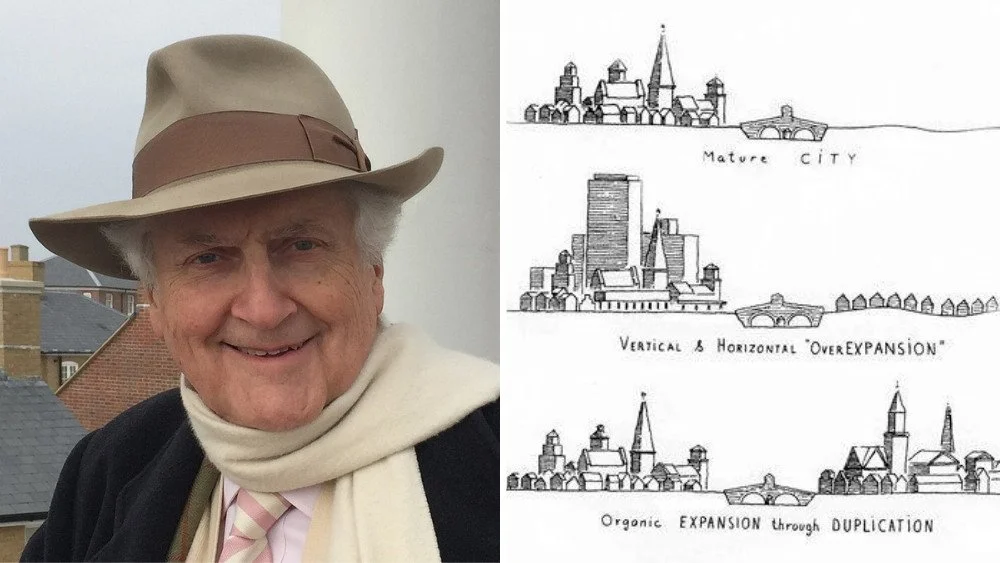
Leon Krier alongside an example of his work. (Source of right-hand image: Rebeca.ggv on Wikimedia Commons.)
%20(1).avif)
%20(1).avif)
%20(1).avif)
%20(1).avif)
Léon Krier often reminds us in his sketches and writing that architecture is not merely the arrangement of buildings; it is the material expression of civic life. When we encounter a place that feels coherent, dignified, or humane, we are experiencing a built form that reflects a social order rooted in reciprocity and shared purpose. The inverse is also true: when our built environment feels fragmented or alienating, it often mirrors a civic order that is equally fractured.
Attending his Hommage brought me back to the ideas that first set me on this path: that good urbanism isn’t an academic abstraction but a lived experience we can see and feel in the world around us. Standing alongside peers, mentors, and teachers, I was reminded that much of what our profession treats as unquestionable truth runs counter to what Krier spent a lifetime demonstrating. Krier reminded the world through drawing, advocacy, and relentless clarity that human-scaled, mixed-use, incrementally grown places remain the most resilient model we have.
Lately, I’ve been thinking about how our current zoning paradigm interrupts that connection entirely. If we are trying to cultivate authentic urbanism, zoning is not merely insufficient. Zoning is fundamentally misaligned with the nature of civic life, and it may be time to abandoned it.
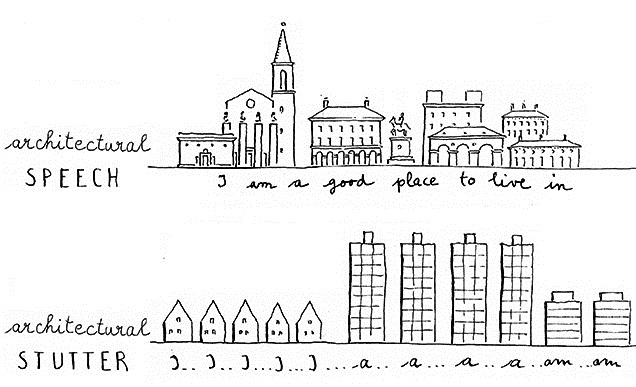
Horrible Public Meetings Are Not an Accident. They Are the Manifestation of Zoning
Anyone that is working in the city, urbanist, planner, or citizen, has experienced it: the disastrous public meeting where the conversation dissolves into frustration, hostility, and confusion. We talk a lot about how public engagement is broken, but we rarely acknowledge an uncomfortable truth:
These meetings are exactly what you get when zoning is the operating system of local decision-making.
When the central tool for managing our human habitat is a system of abstract, technocratic, pseudo-scientific rules, public discourse naturally contorts around those same rules. People stop talking about what truly matters in the built environment such as human needs, relationships, prosperity, safety, beauty, and instead are forced into debating setbacks, parking ratios, floor-area calculations, and other arbitrary performance standards that have no grounding in civic life.
It is little wonder civility collapses during these meetings and through this process. Zoning forces us to exhaust an enormous amount of time and energy on arguing about all the wrong things.
Zoning Is an Attempt to Impose Artificial Order on a Naturally Messy City
Zoning was invented out of fear of natural chaos. The fear of disorder, the fear of change, the fear of unknown neighbors, and the fear of the city itself. It tries to impose a mechanical order on a living organism. In doing so, it generates enormous and often unseen consequences:
- It divorces building from civic purpose.
- It replaces judgment with compliance.
- It elevates abstract standards over human outcomes.
- It channels local debate into narrow technical disputes rather than broad civic possibilities.
Under zoning, the question is never, “Will this strengthen our community?”
It is only ever, “Does this check the right boxes?”
The Box-Checking Ritual Crowds Out Civic Conversation
By design, zoning compresses the development process into a tangle of boxes neatly described as process. The process elevates dimensional standards, prescribes use categories, and layers on performance requirements which almost always conflict. Each of these are pretending to offer certainty, but none of these metrics capture human behavior, community needs, or the patterns that facilitate civic life.
This creates a perverse dynamic:
- Applicants arrive with consultants hired to navigate the bureaucracy instead of designers.
- Staff arrive armed with reports evaluating abstract compliance, that are removed from asking why.
- Residents arrive confused, emotional, and often fearful of change, lost in the tangled mess of the process.
- Elected officials sit at the center, struggling to translate human desires into legal determinations, and left only with the choice to approve or deny bad or badder.
No one is satisfied because the system gives no one a meaningful role. We all just participate in a ritual of order without the substance of community.
The Public Meeting Is Where Zoning’s Flaws Are Exposed
Public meetings are often framed as moments of community input, but in reality they function as the collision point between human expectation and bureaucratic limitation. People show up wanting to talk about quality of life, identity, values, and future aspirations. The believe they have been invited into the process to provide public participation. Yet, the system only allows responses in the form of best possible outcome are further technical constraints.
This mismatch produces outrage, not because people are uncivil, but because the system itself is non-responsive. A living city requires conversation, adaptation, intuition, and empathy. Zoning offers none of these. Zoning at its best only offers rules, procedures, and compliance pathways. And when the mechanisms we use to guide change cannot respond to human needs, the people within the system begin to assume that engagement itself is pointless. Cynicism spreads. Outrage fills the vacuum.
It is not that people don’t want to participate in civic life. They unequivocally want to participate. The struggle is that the system we give them to participate through is structurally deaf. In this sense, zoning isn’t just a technical failure, its also a cultural failure. Zoning replaces civic dialogue with bureaucratic automation.
If we truly want to return to a civil discourse where participation results in a meaningful conversation, we should abandon the systems that create roadblocks.
Edward Erfurt is the Chief Technical Advisor at Strong Towns. He is a trained architect and passionate urban designer with over 20 years of public- and private-sector experience focused on the management, design, and successful implementation of development and placemaking projects that enrich the tapestry of place. He believes in community-focused processes that are founded on diverse viewpoints, a concern for equity, and guided through time-tested, traditional town-planning principles and development patterns that result in sustainable growth with the community character embraced by the communities which he serves.