New York City and the Myth of a Balanced Budget

.avif)
New York City is, by almost any measure we use, one of the most successful places in the world. It is dense, walkable, and enormously productive. It generates wealth at a scale that few places can match. If you were trying to design a financially resilient city, you would likely end up drawing something that looks a lot like New York.
And yet, here we are, talking about a multibillion-dollar budget gap.
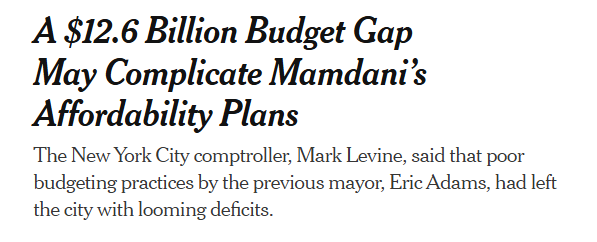
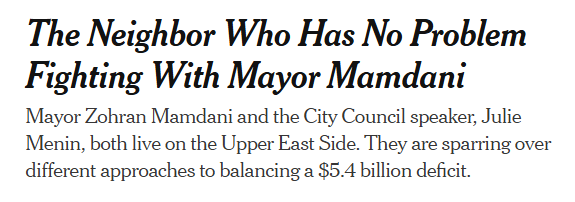
Depending on who you listen to, that gap is $5 billion, or $12 billion, or something in between. The mayor says taxes need to go up. The council insists the numbers can be adjusted. Analysts argue over projections, assumptions, and whether savings are real or double-counted. At one point, the council claimed it had “found” $6 billion to close the gap.
That word, "found," is doing a lot of work.
Because if you can find $6 billion, it raises an uncomfortable question about the nature of the problem itself. Is the gap a fixed reality, something that reflects the underlying condition of the city? Or is it something more fluid, something that can expand or contract depending on how you choose to count?
That question points to something deeper than a disagreement over numbers. It suggests that the budget itself may not be functioning as a clear reflection of reality, but as something more malleable — something that can be adjusted, reframed and negotiated until it produces an acceptable result.
To understand why, it helps to look at how local governments actually do budgeting. At the most basic level, they operate on a cash basis. They look at how much money they have, or expect to have, in the coming year and match that against what they plan to spend. If the numbers line up, the budget is considered balanced. It is a straightforward exercise and, on its own terms, it can appear disciplined.
At the same time, those governments with balanced cash budgets are taking on obligations that extend far beyond the current fiscal year. Pension commitments, infrastructure systems that must be maintained, programs that grow automatically, and policies that create long-term financial expectations are not minor considerations. In many cases, they are the dominant financial reality of the city.
Ignore this reality for long enough and the culmination of all those short-term fixes is rather predictable. Year after year, the budget may appear balanced, but the city is quietly accumulating obligations it has no realistic way to cover.
There is a way to measure this cumulative effect. It’s called Net Financial Position, the running total of past budget decisions (the surpluses or, in New York’s case, the deficits) that have been pushed into the future. At the end of 2024, the Strong Towns Financial Decoder shows that NYC’s Net Financial Position was nearly a negative $300 billion. The trend is not difficult to interpret.
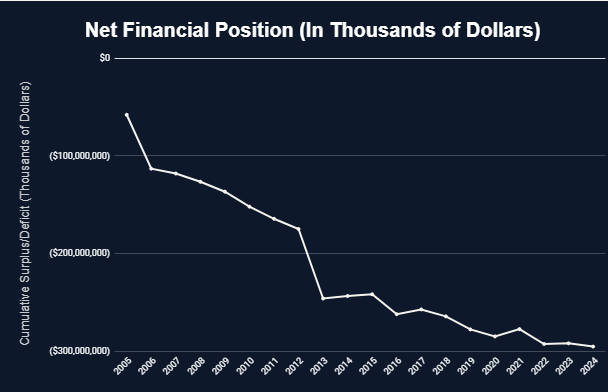
For cities, there is no meaningful requirement to reconcile these long-term obligations within the short-term budget. A city can balance its books this year while accumulating commitments that will overwhelm it in the future. It can defer maintenance, rely on optimistic assumptions, or depend on revenue streams that may not be stable. It can make decisions that feel responsible in the moment but create fragility over time. The system allows for all of this — almost encourages it — while still producing a “balanced” budget on paper.
Once you recognize that, the conversation happening in New York starts to look less like a serious debate over difficult tradeoffs and more like a negotiation over which version of unreality to accept.
The mayor argues that new revenue is needed. The council responds that the numbers can be adjusted with no increase in taxes or cuts in service. Each side disputes the other’s assumptions, but neither steps outside the basic frame. The objective is to close the gap, and there are many ways to do that within the rules of the system.
You can propose new taxes, delay decisions or search for savings that may or may not materialize. You can revise projections or shift costs. We’ve seen cities close gaps by shifting cash from capital funds in their public utilities — essentially spending money dedicated to maintaining critical infrastructure and replacing it with an IOU to themselves, all to make the ledger balance.
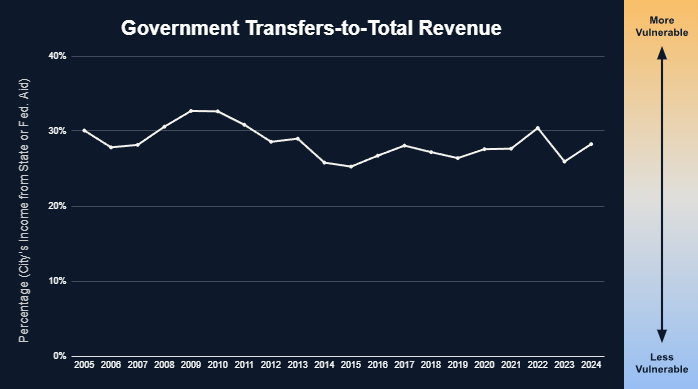
In New York City, all of the players in this drama are seeking support from the state government. This, too, is a familiar approach. Already, roughly 30% of the city’s budget comes from state and federal transfers: an extraordinary level for a place of this size and productivity. Even here, in one of the most economically productive cities in the world, the system depends on outside support to function. New York City is, effectively, a ward of the state.
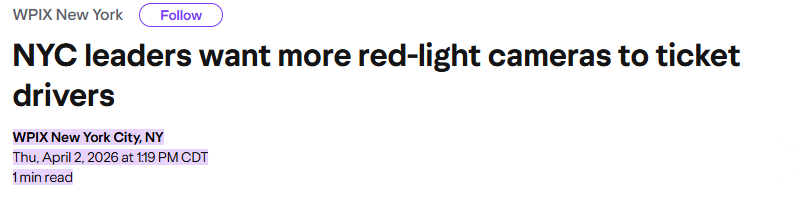
Desperate cities frequently look for ways to generate revenue more directly, even in ways that seem predatory. One of the proposals put forward in New York City is to expand the use of red-light cameras, increasing their number to well over a thousand intersections. The justification is straightforward: more cameras mean more tickets, and more tickets mean more revenue. By some estimates, the program could generate close to $200 million per year.
I’ve had difficult conversations with advocates for automated traffic enforcement. Many are thoughtful and sincere, motivated by a desire to improve safety and reduce harm on city streets. They believe these systems can save lives, and in some cases, they are likely correct.
But I’ve also warned that when these tools are placed inside a financially stressed system, their purpose will not remain fixed. When there is a large budget gap to close, and a program that can generate hundreds of millions of dollars annually, it becomes difficult to treat that program as being solely about safety. The incentives shift. The conversation shifts. What was once justified on one set of grounds begins to serve another.
In New York, you can see that shift happening in real time. Regardless of how it started, today the discussion of red-light cameras is not centered on safety outcomes or changes in behavior. It is framed in terms of revenue potential, as one of many tools available to close the financial gap. That should raise an uncomfortable question: does NYC really want to solve the speeding problem when balancing their budget depends on them not solving it?
That is the predictable outcome of a system that prioritizes balancing the current budget without requiring any alignment with long-term financial reality. When the goal each budget cycle is simply to close the gap, everything becomes a candidate for revenue generation. Programs, policies and enforcement mechanisms are all evaluated, at least in part, by how much money they can produce. The original purpose may still be present, but it is no longer the only, or even the primary, consideration.
The result can feel predatory — city versus the residents it is supposed to serve — even though that outcome is not a function of bad intentions. It is what happens when a system measures success in a very narrow way, one that distorts reality and encourages short-term rationalizations over long-term stewardship.
New York City is not lacking in wealth. This is not a marginal place struggling to attract investment or opportunity. It is one of the most productive urban economies in the world. If there is anywhere that should be able to align what it does with what it can sustain, it is New York. And yet, even in this context, the conversation never fully connects spending to underlying capacity.
That should give us all pause.
At the end of 2024, New York City reported roughly $155 billion in total assets and $365 billion in total liabilities. By their own numbers, New York City is insolvent to the tune of over $200 billion — an accumulated deficit built up over many years of “balanced” budgets.
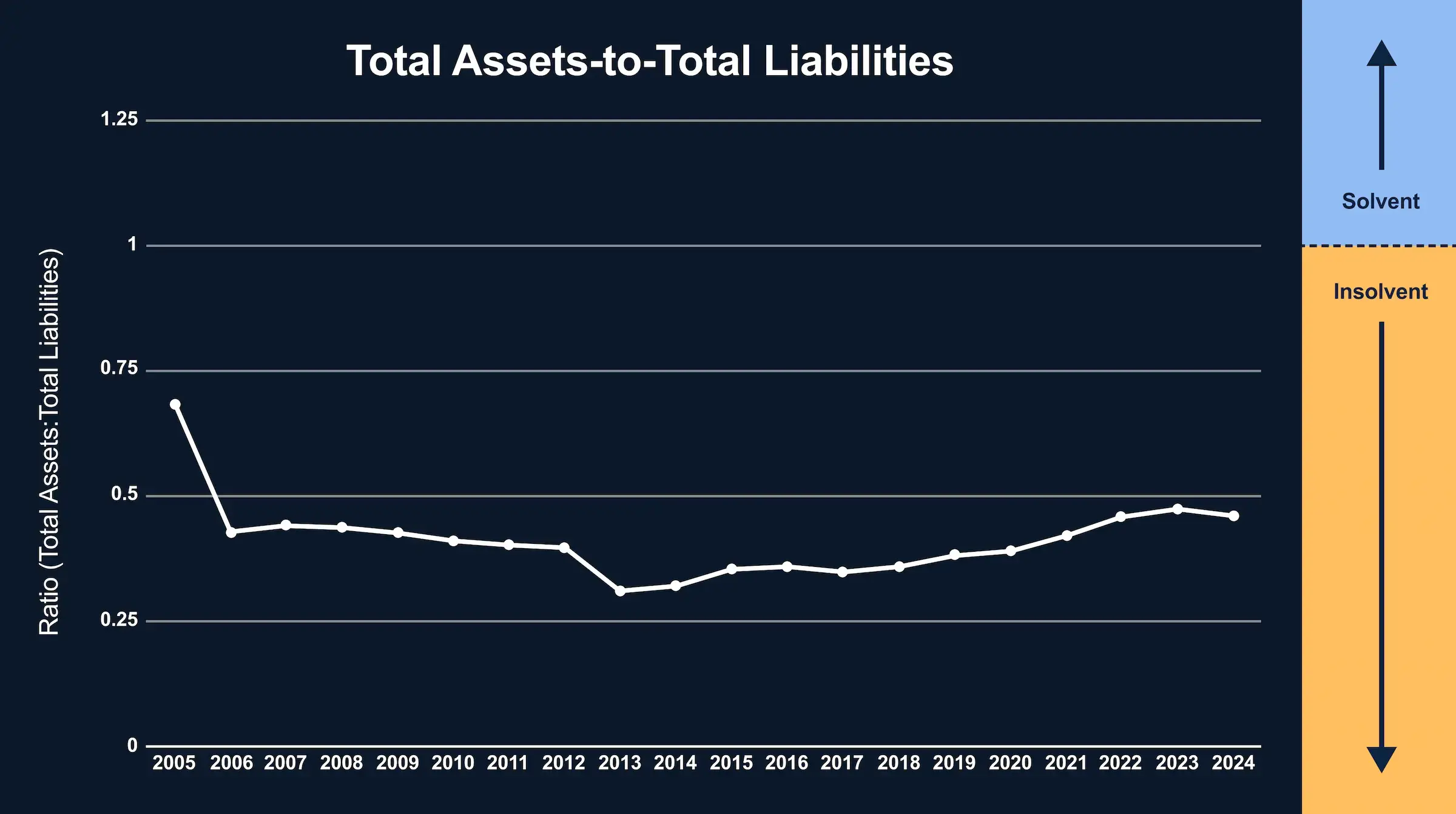
If New York City were a private corporation instead of a public one, it would already be in bankruptcy protection.
Only, it’s not a private corporation. As an incorporated municipality, it provides drinking water, sewage disposal, police protection, transportation and other essential services to millions of people. That distinction should raise the standard for how we think about its finances, not lower it. If anything, the responsibility to be financially solvent is more urgent, not less, for a city.
United States policymakers have constructed a framework for public finance that allows governments to claim balance without confronting the full scope of their commitments. It encourages short-term alignment of revenues and expenditures while obscuring the long-term consequences of those decisions.
In that context, “balanced budget” becomes worse than a misleading phrase. It falsely suggests stability and discipline when, in practice, it reflects nothing more than a temporary alignment of numbers that are, themselves, products of obfuscation.
A more serious approach would begin with a different set of questions. What are the long-term obligations of this place? What level of wealth does it actually produce? Are those two things aligned in a way that is sustainable over time? These are the questions we’re trying to get to with the Finance Decoder, which is a completely free tool Strong Towns developed that I’m begging you to use to improve the budget discussions in your community.
In New York, they say, “If you can make it here, you can make it anywhere.” If they can’t make their budget work there — the most productive city in the country — what does that say about everywhere else?
Charles Marohn (known as “Chuck” to friends and colleagues) is the founder and president of Strong Towns and the bestselling author of “Escaping the Housing Trap: The Strong Towns Response to the Housing Crisis.” With decades of experience as a land use planner and civil engineer, Marohn is on a mission to help cities and towns become stronger and more prosperous. He spreads the Strong Towns message through in-person presentations, the Strong Towns Podcast, and his books and articles. In recognition of his efforts and impact, Planetizen named him one of the 15 Most Influential Urbanists of all time in 2017 and 2023.
%20(1).avif)
%20(1).avif)
%20(1).avif)
%20(1).avif)