When the Decision Is Too Big for the City

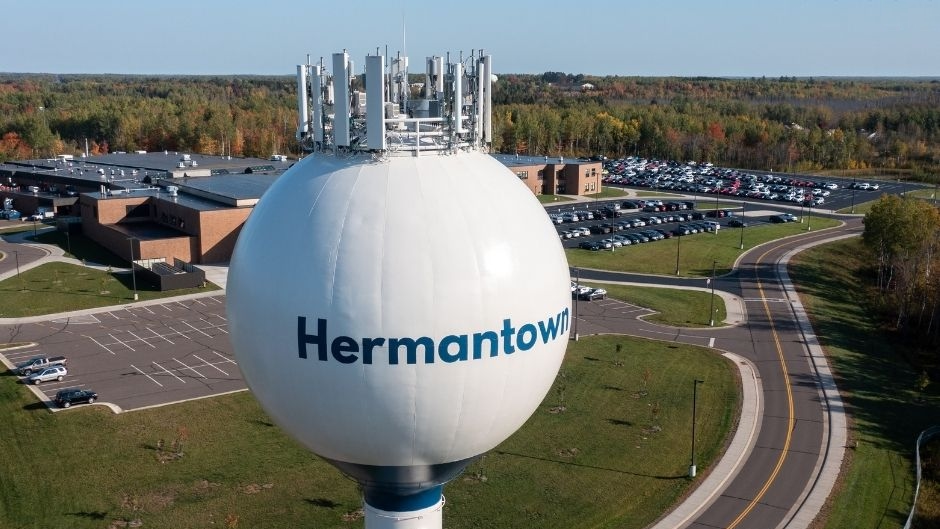
(Source: City of Hermantown/Facebook)
There are some decisions a city can make and recover from. A bad zoning call, a misjudged project, even a poorly timed investment. These things can all be corrected over time. They may be painful, but they are not fatal.
And then there are decisions that, if they go wrong, will blow up a city’s budget. Will ruin it for generations. Will make it a ward of the state.
Those are the decisions we should be most careful about. Those are the decisions where we should be asking not just what should be done, but who should be allowed to decide.
Right now, the city of Hermantown, Minnesota, is considering one of those decisions. Their situation is illustrative of a larger problem facing American cities, including their relationship with state governments.
Hermantown is a city of about 10,000 people. It is currently negotiating a development agreement with Google to build a large data center on the edge of town. The proposal includes roughly $130 million in new infrastructure — water, sewer, roads — built by Google and then turned over to the city.
Hermantown has also offered to provide a long-term tax abatement worth tens of millions of dollars. Under the draft terms, the city would collect only about 15% of the property taxes it would normally receive, with the rest effectively returned to Google to pay for the infrastructure.
This agreement would last 28 years. Google has not even been a company for 28 years.
Hermantown is a small, resource-constrained city on the outskirts of Duluth. Google is one of the wealthiest corporations in the world. This data center is just one of many Google is pursuing across North America. For Hermantown, this would be, by far, the largest development in its history.
This is not David and Goliath. It is a small city being asked to make a decision far beyond its institutional capacity to fully evaluate.
When Scale Breaks Decision-Making
There is a debate to be had about whether data centers are good or bad. That’s not the debate I’m having today. I’m also not making an argument about whether Google is acting in good faith. And it’s not even about whether this specific deal will ultimately work out for Hermantown.
What I’m interested in exploring is whether a city like Hermantown should be in a position to make a decision like this at all.
It is easy to understand why this deal is appealing to Hermantown. Google is offering to build out major public infrastructure at its own expense. City officials have noted that this infrastructure could unlock development opportunities the city currently lacks. There are jobs associated with the project, along with payments to the local school district and the promise of broader economic activity. For a small city with limited resources, this looks like a way to solve multiple problems at once.
One city official described the arrangement this way: “We’re paying them back for the infrastructure they’re giving to us.”
That framing is revealing. What is being described is not a typical development deal. It is essentially a long-term financing arrangement, one that trades future revenue for infrastructure delivered today.
At this scale, the ability of local officials to make a sound decision starts to break down.
Hermantown is not a large or complex organization. Its public works department consists of roughly a dozen people responsible for maintaining all the city’s infrastructure. Its annual budget for that work is just over $1 million. The infrastructure proposed here would require a level of operational capacity far beyond what the city currently possesses.
That leap is not an incremental adjustment. It suggests a fundamentally different kind of organization.
The transition is particularly concerning because, financially, the city has not operated from a position of stability. Over the past decade, its net financial position has swung from positive to negative and back again. There are multiple years where the city has more obligations than assets, meaning it is relying on future revenues to cover past commitments.

Like many small cities, it is also heavily dependent on outside funding, with significant swings in state and federal transfers from year to year.
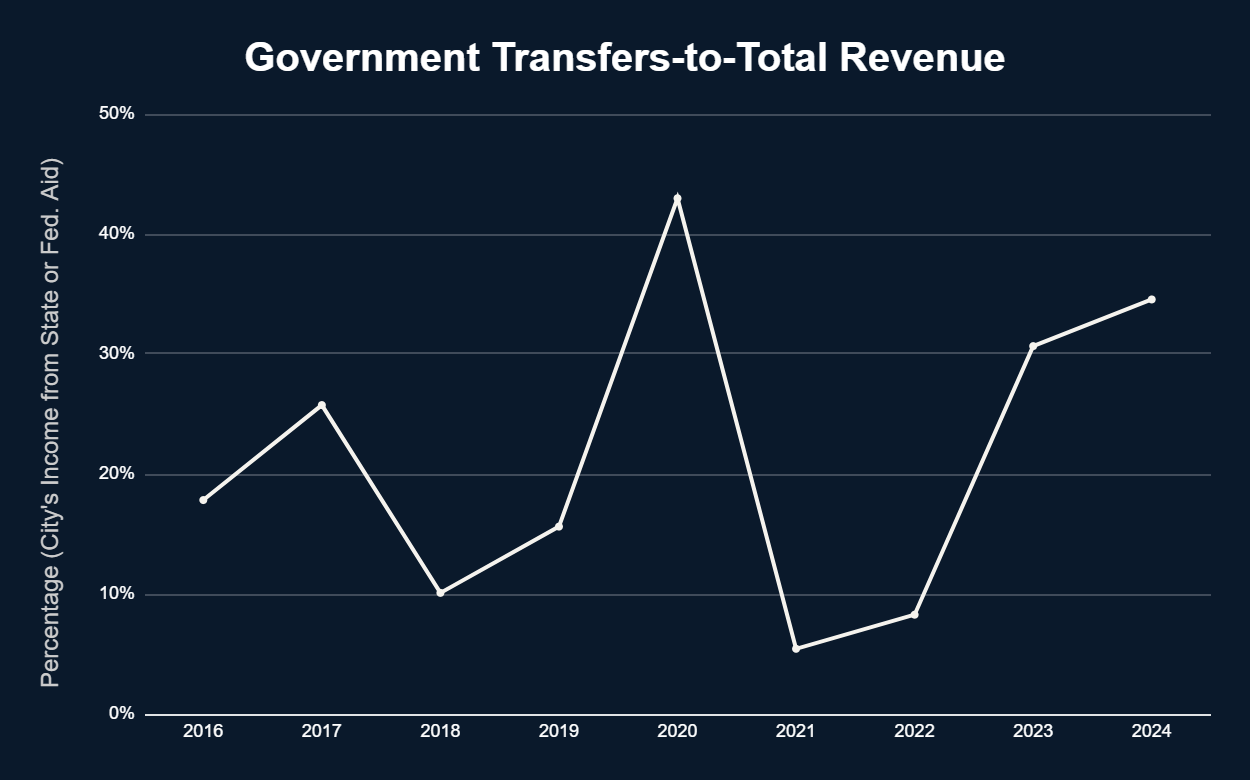
None of this is unusual. In most ways, it is typical of small cities across the country. They manage aging infrastructure with limited and often unpredictable resources. They patch together budgets from local taxes and outside aid. They make incremental decisions, adjusting as they go.
And in that context, a deal like this makes sense. It brings in outside capital. It upgrades infrastructure that might otherwise take decades to replace. It creates the possibility of future growth. In the short term, it solves real problems.
But it also changes the scale of the system the city is responsible for.
The infrastructure built for this project does not remain Google’s responsibility. It becomes Hermantown’s. The city takes ownership of the pipes, the roads, the systems, along with the obligation to maintain them for decades into the future.
A city that currently spends about $1 million a year maintaining its entire public works system is being asked to take on infrastructure that costs more than one hundred times that amount to build. Not just to accept it, but to sustain it. Indefinitely.
To get a sense of the scale, consider Minneapolis. Its annual budget is just over $2 billion. For Minneapolis, a comparable move would be taking on a single infrastructure project on the order of $10 billion — not spread across a system, not phased in over time, but tied to one development agreement with one user.
That is the level of decision we are talking about. That is not an incremental change. It is a phase shift into an entirely different category of risk.
The Asymmetry Problem
At this point, it is natural to ask whether this is a good deal or a bad one. But that question misses something more important.
The problem is not that cities are making bad decisions. The problem is that they are being asked to make decisions far beyond their institutional capacity to fully evaluate, and then given strong incentives to take on the risk.
There is an asymmetry here that is hard to ignore.
Google negotiates projects like this across the country. It brings teams of lawyers, engineers, and financial analysts to structure these agreements. It knows its own payback windows and the return on investment required to make a project work. It also understands the long-term implications of what is being built and how its portion will be maintained.
Hermantown does not operate at that scale. It does not have that depth of specialized expertise. It is not set up to model decades of maintenance costs on complex infrastructure systems tied to a single large user. It does not have a way to evaluate the long-term usefulness of a massive facility — one that will represent a dominant share of demand — in an industry as fast-changing as technology.
It also does not have a clear understanding of how much additional tax base will be needed to meet the future obligations of all this “free” infrastructure, or whether that level of growth is even plausible within a generation. This is not a criticism of the people involved. It is a recognition of the limits of the institution.
One side is equipped to fully understand the deal. The other is not.
There is another dynamic at work here, one that makes the situation even more precarious. Cities like Hermantown are already struggling to maintain what they have. Infrastructure ages. Costs rise. Revenues fluctuate. The gap between what is needed and what is available grows over time. By the city’s own numbers, they are already behind in maintaining what they have.
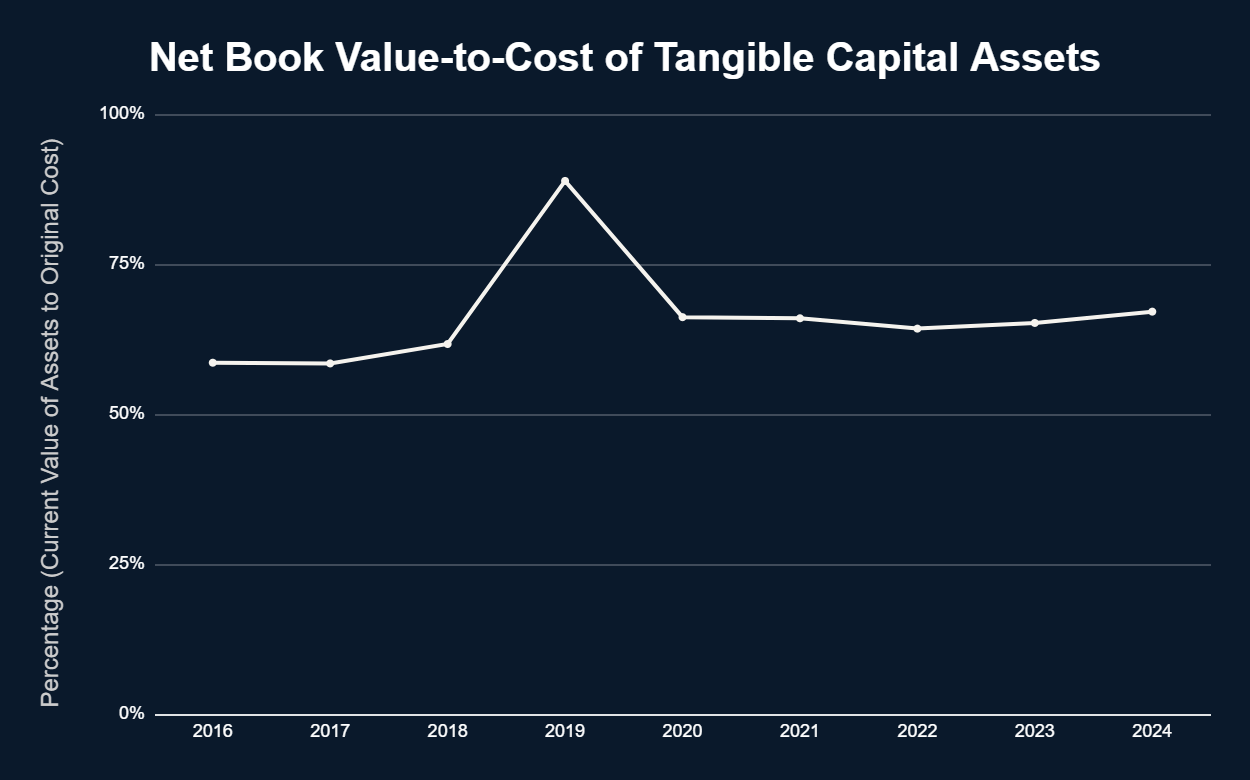
In that situation, the promise of new infrastructure is incredibly attractive. It feels like a way to catch up, to fix longstanding problems, to create new opportunities. But solving a maintenance problem by taking on significantly more infrastructure does not eliminate the underlying issue. It extends it.
When you struggle to maintain what you have, taking on more does not make you stronger. It buys time while increasing the consequences when the bill comes due.
The Limits of Local Control
I have spent years arguing for giving local governments more tools to solve problems. More autonomy, fewer mandates, and less state interference in local decision-making. I’ve opposed state preemption in areas like zoning because I believe communities should have the flexibility to shape their own future, along with the responsibility for the outcomes that follow.
But that principle has always had a limit.
We want cities to experiment, to grow, to learn, and to innovate. That requires flexibility and a tolerance for failure. Cities should be able to make mistakes and recover from them.
What we cannot do is give cities the ability to make decisions that, if they go wrong, they cannot recover from. Taking on obligations that are wildly disproportionate to their capacity. Making long-term commitments that bind future generations to liabilities they may not be able to sustain. Entering into arrangements where the downside risk is existential.
Those are not the kinds of risks we should leave entirely to local discretion.
There should be clear limits on the scale of obligations a city can take on relative to its capacity — limits on debt, on long-term infrastructure commitments, and on arrangements that concentrate risk in a single project or user. When those limits are exceeded, the decision is no longer purely local. It becomes a matter of broader public concern.
At that point, a higher level of scrutiny is not enough. If a project is large enough to exceed the capacity of the local government, then the state — on behalf of all its residents — should be directly involved. Not just in reviewing the deal, but in sharing both the upside and the downside.
After all, in a city the size of Hermantown, we are all exposed if today’s data center becomes tomorrow’s abandoned brownfield.
If we want cities to succeed, we cannot afford to have them implode.
A 28-year agreement tied to infrastructure of this scale is not a routine local choice. It is a commitment that shapes the financial and physical future of the city for generations. We are right to question whether a city like Hermantown be allowed to take on that level of risk.
This is not about whether Hermantown should welcome a data center. It is not about whether Google should build in Minnesota. Those are separate questions.
This is about whether we are comfortable asking small cities, with limited capacity and volatile finances, to make decisions that will define their future for decades, with consequences they are not fully equipped to understand.
There are some decisions a city cannot afford to get wrong. When we place those decisions in the hands of institutions that lack the scale and capacity to manage that risk, we are not empowering them.
We are exposing them.
That is not how we build a nation of strong towns.
Charles Marohn (known as “Chuck” to friends and colleagues) is the founder and president of Strong Towns and the bestselling author of “Escaping the Housing Trap: The Strong Towns Response to the Housing Crisis.” With decades of experience as a land use planner and civil engineer, Marohn is on a mission to help cities and towns become stronger and more prosperous. He spreads the Strong Towns message through in-person presentations, the Strong Towns Podcast, and his books and articles. In recognition of his efforts and impact, Planetizen named him one of the 15 Most Influential Urbanists of all time in 2017 and 2023.
%20(1).avif)
%20(1).avif)
%20(1).avif)
%20(1).avif)