Transportation After the Age of Expansion


Columbus, Ohio. Photo by Walter Martin on Unsplash.
America is trying to do a lot at once.
We want to reshore manufacturing and rebuild domestic supply chains. We want to accelerate the transition to cleaner energy while dramatically expanding the amount of power we generate and distribute. We want more housing, more data centers, more resilience, and more economic opportunity in places that have been left behind. We want to tame inflation without stalling growth. And we want all of this to happen quickly.
None of these goals are unreasonable. In fact, taken individually, most enjoy broad political support. But together they point to a question we rarely stop to ask: Do we actually have the capacity to do all of this at the same time?
For much of the postwar era, the answer was yes. The United States operated in a world of relative abundance. Abundant labor, abundant materials, abundant energy, and a federal government capable of mobilizing all three at enormous scale. In that context, big national projects made more sense. They weren’t just investments; they were organizing principles for economic expansion. But that context has changed. Labor is now scarce. Skilled workers are in short supply across multiple sectors. Materials costs remain volatile. Training pipelines are long. Inflation has reminded us — quite forcefully — that resources are not infinite and tradeoffs are real. We no longer live in an economy where every good idea can be pursued simultaneously without consequence.
And yet, many of our largest federal programs continue to operate as if that earlier era never ended. Nowhere is this more evident than in transportation.
For nearly a century, the federal government has played a dominant role in building out America’s transportation system. Highways, interchanges, frontage roads, arterial networks, commuter transit systems, and more were constructed in the name of mobility, safety, economic development, and national cohesion. For much of that period, this approach fit the economic and demographic realities of the time, connecting markets, enabling suburban development, and supporting large increases in economic activity.
It’s important to say this plainly: the core objective of that effort was largely achieved.
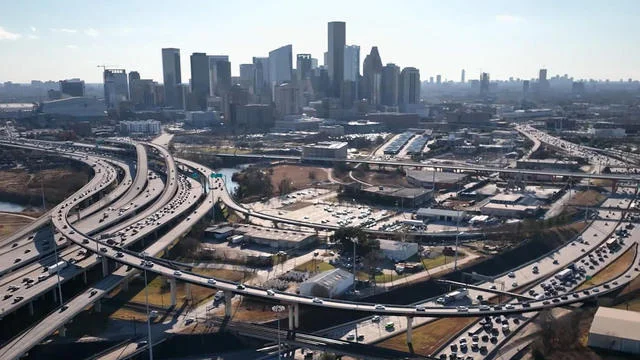
The United States today has one of the most extensive roadway networks in the world. We are not short on highways. We are not short on interchanges. We are not lacking physical connections between major metropolitan regions. If the original goal of the federal transportation program was to build a national network, that goal has long been met.
But success carries consequences when it goes unacknowledged. When a mission is accomplished but the program continues unchanged, the logic quietly flips. What was once nation-building becomes obligation-building. What was once expansion becomes upkeep. And every new addition increases the long-term burden on systems that are already straining.
This is the paradox of modern transportation policy: even as states and cities struggle to maintain the vast systems they already have, federal incentives continue to prioritize expansion. We keep adding lane-miles to networks we can’t afford to care for, while telling ourselves that the next project will finally deliver the returns the last one didn’t.
That alone should give us pause. But it’s only the starting point.
Because maintenance challenges, as serious as they are, are not the most pressing constraint we face. The deeper issue – the one that forces a reckoning – is that the resources required to keep expanding our transportation system are the very same resources we now need for almost everything else we say is a national priority.
Scarcity Changes the Math
For most of the last century, transportation expansion had something else working in its favor: people.
The United States had a large and growing workforce, including millions of workers whose skills aligned naturally with large-scale construction and heavy industry. When the federal government funded highways and interchanges, it wasn’t competing intensely with other sectors for labor. In many cases, it was absorbing excess capacity. That is no longer true.
Today, labor is one of the tightest constraints in the American economy. Employers across multiple sectors report difficulty hiring, not because demand is weak, but because workers are scarce. This is especially true in the kinds of hands-on, skilled roles required to build things: welders, electricians, equipment operators, mechanics, technicians, and tradespeople whose expertise takes years to develop.
Manufacturing is a clear example. After decades of offshoring, the United States has made reshoring and industrial resilience an explicit national priority. Private firms have announced hundreds of billions — indeed, trillions — of dollars in new domestic investment. Semiconductor plants, advanced manufacturing facilities, and supply-chain infrastructure are being planned or built across the country.
Yet even as this investment accelerates, manufacturers report persistent job shortages measured in the hundreds of thousands. These are not temporary vacancies that will vanish with the next economic cycle. They reflect structural constraints: an aging workforce, rising skill requirements, long training timelines, and competition from other sectors that need the same people.
This is where the conversation about transportation expansion changes. Because the workers needed to build factories, install equipment, and expand energy systems are not a different workforce than the one building highways and bridges. They are drawn from the same limited pool. And that pool is already stretched.
Here is the comparison that makes the tradeoff unavoidable.
The current shortfall of unfilled manufacturing jobs in the United States — hundreds of thousands of positions — is on the same order of magnitude as the entire workforce employed building highways, streets, and bridges nationwide. Put differently, the labor gap in manufacturing alone is roughly equivalent to recreating the nation’s highway construction workforce from scratch.
That is not an abstract statistic. It is a measure of how tight labor markets have become and how unrealistic it is to assume that all major national priorities can expand simultaneously without friction.
When we fund large-scale transportation construction programs alongside aggressive onshoring and energy build-outs, we are not just spending money. We are making a choice about where scarce labor will go. At that point, workforce availability and training pipelines stop being firm-level challenges and become system-level constraints, ones federal policy must explicitly account for.
This is not an argument against manufacturing investment, or energy development, or infrastructure spending in the abstract. It is an argument against pretending that capacity is infinite. Every major construction program draws from the same reservoir of people, materials, and attention. Expanding one sector necessarily means crowding out another.
And that brings us back to transportation.
Tradeoffs We Can No Longer Ignore
If labor were the only constraint we faced, the case for restraint would already be strong. But it isn’t. Labor scarcity is simply the most visible symptom of a broader reality: the resources required to expand our transportation system are the same resources we now need for almost everything else.
Steel and concrete are not abstract line items. They are finite, energy-intensive inputs that must be produced, transported, and installed by skilled workers. When inflation surged over the past few years, construction costs were among the most affected. That was not an accident. It was the market signaling that demand for these inputs was outpacing the system’s ability to supply them.
In that context, it is worth asking what we are choosing to build.
Do we want to use our steel and concrete to add another interchange to a highway network we already struggle to maintain? Or do we want to deploy those same materials to build new manufacturing facilities, energy infrastructure, and productive capacity that directly supports long-term economic resilience?
Do we want to commit scarce labor to expanding road capacity in ways that force longer commutes and make more driving a mandatory part of daily life, all while steadily increasing the cost of maintaining the system itself? Or do we want those workers installing solar arrays, reinforcing the electrical grid, building housing, or standing up the physical backbone of a re-industrializing economy?
These are not rhetorical questions. They are unavoidable tradeoffs.
For much of the postwar period, transportation expansion functioned as a kind of standing national mobilization. It absorbed labor, stabilized industrial demand, and provided a clear outlet for public investment. In that sense, it was a continuation of wartime production logic into peacetime, a way to keep the machinery of growth humming.
That war ended. The production system did not.
Today, continuing to expand our transportation system looks less like strategic investment and more like fighting the last war. We are still mobilizing people and materials for a problem we largely solved decades ago, while under-resourcing the challenges that now define our future.
This is not an argument that transportation no longer matters. It matters enormously. But what matters now is reliability, safety, and stewardship, not endless expansion. The economic return on adding another lane or interchange is far lower than it once was, while the opportunity cost has never been higher.
What makes this argument unique is that it should resonate across the political spectrum.
For those on the political left who support ambitious climate action, industrial policy, and public investment, the labor and materials constraints outlined here should be sobering. A clean-energy transition, reshoring manufacturing, and building more housing all require the same scarce inputs that transportation megaprojects consume. Pretending we can expand everything at once risks slowing progress on all of it.
For those on the political right who emphasize fiscal discipline, inflation control, and federalism, the case is equally clear. Continuing to subsidize transportation expansion through federal programs locks states into long-term obligations they cannot afford, distorts labor markets, and fuels cost escalation in construction. A system that once made sense at the national level increasingly does not.
This is not a debate about whether the government should act. It is a question of how and where it should act when capacity is limited. When resources were abundant, the federal transportation program could be both expansive and forgiving. In a world of scarcity, that same approach becomes brittle. It crowds out higher-value uses of labor and capital. It hardens systems that need to become more adaptable. And it delays the reckoning that comes when maintenance obligations finally overwhelm expansion ambitions.
What Comes After Expansion
Transportation expansion did not just happen accidentally. It was the product of a specific historical moment, built around a specific set of assumptions: abundant labor, cheap energy, and a federal government uniquely positioned to mobilize both at scale. For decades, that system worked precisely because it aligned with the realities of the time. But that alignment is gone.
If transportation expansion once functioned as a national mobilization, today it resembles something else entirely: the continuation of a wartime production strategy long after the war has ended. We are still organizing labor, materials, and capital around the physical expansion of a system whose primary challenge is no longer growth, but care. We are still fighting the last war, not because it makes strategic sense, but because the institutions that grew up around it have not yet adapted.
This is how misallocation persists in plain sight. Programs designed for one era quietly outlive their purpose, consuming scarce resources while more urgent needs struggle to compete for attention. The cost of this inertia is no longer theoretical. It shows up in labor shortages, inflated construction costs, delayed energy projects, stalled housing production, and a growing gap between what we say we want to build and what we are actually able to build.
Recognizing this does not require abandoning transportation as a public priority. It requires redefining it.
A post-expansion transportation policy would start with stewardship, not growth. It would focus federal attention on maintaining the systems already in place, improving safety and reliability, and supporting operations rather than expansion. It would recognize that transportation decisions are, by their nature, deeply contextual, and that states and cities are better positioned to weigh tradeoffs when the incentives to expand are no longer distorted by federal funding formulas.
Devolving responsibility is not retreat. It is alignment.
When the federal government steps back from subsidizing perpetual expansion, it frees states to make more honest choices. It also frees national capacity — labor, materials, capital, and administrative attention — for the challenges that genuinely require a federal role. Manufacturing resilience, energy production, climate adaptation, and economic stability are not peripheral concerns. They are defining tests of this era.
In a world of abundance, it was possible to pursue every good idea at once. In a world of constraint, leadership means choosing.
The argument here is not that transportation investment was a mistake. It is that it worked. And because it worked, continuing to treat it as an unfinished project now imposes real costs elsewhere in the system.
Ending an expansion program is often framed as failure. In reality, it is what success looks like. We have to be willing to recognize it as such.
Charles Marohn (known as “Chuck” to friends and colleagues) is the founder and president of Strong Towns and the bestselling author of “Escaping the Housing Trap: The Strong Towns Response to the Housing Crisis.” With decades of experience as a land use planner and civil engineer, Marohn is on a mission to help cities and towns become stronger and more prosperous. He spreads the Strong Towns message through in-person presentations, the Strong Towns Podcast, and his books and articles. In recognition of his efforts and impact, Planetizen named him one of the 15 Most Influential Urbanists of all time in 2017 and 2023.
%20(1).avif)
%20(1).avif)
%20(1).avif)
%20(1).avif)