Rethinking What Makes Winter Roads Safe

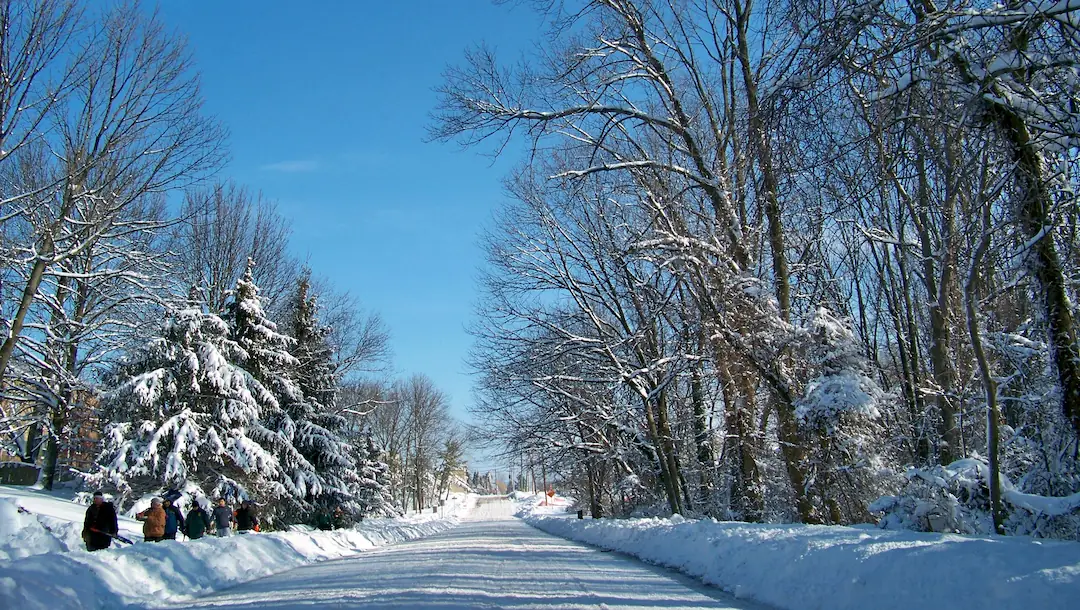
Snowy road conditions and a shoveling crew ready to get to work.
.webp)

I wince at the sound of the salt trucks leaving the township yard up the street from my home. Whenever winter weather arrives, whether it be a foot of snow, an ice storm, or a dusting of dry powder, I hear them whine and rattle down the hill to the stop sign. The harm caused by road salt is well-documented, and through my avocation in ecological restoration I’ve seen its effects firsthand—eroded stream banks and depauperate stream life.
A couple weeks before Christmas, after driving my family over a few miles of roads white with salt spread for a dusting of overnight—snow that had melted in my untreated driveway by 10:00 a.m.—I reached out to some local elected officials who have graciously listened to my concerns. Naturally, the safety of roadway users has been an important topic.
As part of this outreach, I examined statistics produced by the Pennsylvania Department of Transportation (PennDOT) for my home region of Montgomery County, Pennsylvania, a suburban county northwest of Philadelphia with a population of over 850,000.
The following numbers reflect accidents for which police reports were filed between January 1, 2019 and December 31, 2024 where the report identified snowy, icy, or slushy [hereinafter referred to as “slick”] conditions on the road surface at the time of the accident, and the most serious level of injury that occurred:
- Fatal injury: 2 (0.15% of all accidents)
- Serious injury: 10 (0.77% of all accidents)
- Minor injury: 339 (25.98% of all accidents)
- No injury: 946 (72.49% of all accidents)
- Unknown: 8 (0.61% of all accidents)
This table shows the same statistics except in non-slick conditions (dry or wet but unfrozen):
- Fatal injury: 227 (0.50% of all accidents)
- Serious injury: 1199 (2.62% of all accidents)
- Minor injury: 19143 (41.85% of all accidents)
- No injury: (23801) 52.03% of all accidents
- Unknown: 1372 (3.00% of all accidents)
Drivers in northern and mountainous regions are all taught how dangerous slick roads are, how careful we must be, how patient, how slow, how to tip-toe toward stop signs so we don’t slide through. It appears those lessons are well learned. To my surprise, accidents on slick surfaces that are fatal or result in serious injury only occur one-third as often as accidents in ordinary dry or wet conditions. In other words, 0.92% of crashes in slick conditions produce a fatal or serious injury, compared with 3.1% of crashes in non-slick conditions. Over 70% of crashes in slick conditions produced no recordable injury at all.
I thought I must have made a mistake, but PennDOT’s own 2024 Pennsylvania Crash Facts and Statistics seems to bear this out on a statewide level (see page 14): 76.6% of crashes occur in dry conditions, resulting in 82.7% of recorded fatalities, while 6% of crashes occur in slick conditions and only account for 2.1% of recorded fatalities—again, roughly one-third the fatality rate of non-slick conditions:
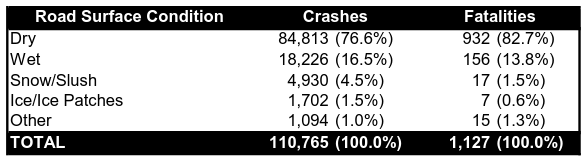
Perversely, aggressive winter road treatments with salt—beyond their documented harm to the environment, infrastructure of all kinds, and human health—also appear to make us less safe by converting icy conditions into wet ones. Not because of the treatment itself but, I believe, because it diminishes the natural traffic-calming effect of snow and ice. It shifts us from cautious drivers in slick conditions—who simply cannot drive too fast for those conditions—back into ordinary drivers on over-designed roads.
Chuck Marohn of Strong Towns has previously written about the increase in traffic injuries and fatalities that occurred during the COVID-19 pandemic, and how the actual cause of increased danger was reduced congestion and therefore greater freedom to drive at unsafe speeds on roads that were designed to prioritize speed over safety. I believe these statistics about winter driving reflect the same phenomenon. As with crashes in congested traffic, winter weather crashes, while possibly more frequent, tend to occur at slower speeds and are correspondingly less deadly.
Winter weather causes all of us to drive carefully and patiently, alert for the unexpected. It reduces the illusory margin of safety provided by wide lanes and excessive shoulders. Just as snow throws leafless trees into stark relief against a background of white, so it also exposes the dangers of conventional roadway design.
John Zollers is a jack-of-all-trades with backgrounds in ecological restoration, civil engineering, and landscape architecture from Eagleville, Pennsylvania. He is involved in his community through the Lower Providence Township "Bird Town Pennsylvania" sub-committee by assisting with the annual native plant sale, restoring the woods of Eagleville Park, and generally engaging with local officials and community members on issues near-and-dear to Strong Towns.