How Should Portland Pay for Streets?

(Source: Unsplash)
Portland, Oregon, once again, doesn’t have enough money to pay to maintain its streets, make basic safety improvements, or do things that make biking, transit and walking easier and more commonplace.
The city council is trying to come up with ideas to pay for roads, and led by Commissioner Olivia Clark, seem to have settled on the idea of a monthly household utility fee of $10 to $12 to pay for roads.
Given voter antipathy of road taxes and fees of any kind, it’s likely that “none of the above” would win in a landslide if voters were asked to decide on a multiple-choice ballot.
This same issue came up more than a decade ago when Steve Novick was transportation commissioner; he pushed for a while for a household utility fee, but in the face of opposition, ultimately decided to propose a gas tax increase, which was — surprise — approved by the voters and then renewed in second election.
But now, the gas tax again is deemed to be a political non-starter, and so the council is searching for a new gimmick to help pay for roads. There are some very good reasons they ought not to use the household fee.
One of the arguments for the household fee is a legal/political one: fees are subject to the same legal restrictions as taxes, and the city council can set fees without voter approval (which it would need for say, a gas tax increase). But there’s a rub here: many say they want to set lower fees for say, low-income households, but conditioning fees on income, rather than on actual use of service, makes them look and act a lot more like a tax than a fee.
There are some good reasons for charging fees for street use. But in my opinion, the council have overlooked the most obvious fee. Currently, the city charges nothing for vehicle storage on city streets in 90% of the city. Sure, there are meters in downtown and a few other neighborhoods, but for the most part, Portland is truly a socialist paradise — if you are a car. You get to live rent free on the city streets. Rather than sticking households with an inescapable fee, whether they have a car or not, the city should charge those who use the streets, especially for storing their cars. Whether by annual, monthly, daily or hourly permit, everyone should pay for parking.
Free Riders? Non-Residents Who Use Portland Streets Should Pay, Too.
And the interesting thing is that, as the hub of a two-and-a-half million person region, Portland’s streets are widely used by residents from other cities. A key problem with the household fee is that it is paid only by Portland residents, not by those who drive here from elsewhere. That’s especially true at rush hours, with many workers commuting into the city from surrounding jurisdictions. It turns out that most of the people who work in Multnomah County live outside the County. (We’re using Multnomah County data, because, helpfully, it’s been compiled from Census Bureau data by the Oregon Employment Department). This is 2022 — after the COVID pandemic.
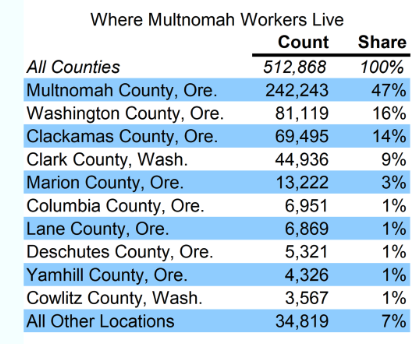
Of the more than 500,000 workers in Multnomah County, 53% of them live outside the county. Probably 80% of them (or more) drive to their jobs, which are overwhelmingly in Portland. If they live outside Multnomah County, they already pay nothing toward the county’s special vehicle registration fee, nor will they pay the monthly “utility” fee to the City of Portland, and yet they’ll be straining the capacity of city streets, chiefly by driving at peak hours.
And another thing: It’s probably a good guess that somewhere between 5% and 10% of the cars on Portland streets are registered not just outside the city of Portland, but outside the State of Oregon. Just as an example, we took a quick tour around Portland’s eastside a couple of days ago, and found cars from 22 states and the District of Columbia. Every one of these was parked on a city street, none of them paid for parking.

– Nebraska – Arkansas – Oklahoma – Texas – Louisiana – Alabama – Mississippi – Tennessee – Georgia
– North Carolina – District of Columbia – Ohio – New York
They may be visiting, or living here and delaying registering their vehicles here, but in any case, aren’t paying vehicle registration fees, like Multnomah County’s $61 annual registration fee for bridge replacement.
But out-of-staters aren’t the only free riders on Portland streets. Many cars simply haven’t bothered to renew their registrations. There are plenty of permanently parked vehicles on Portland City Streets. We may not have social housing for people, but at least we have free housing for garage-less cars on the city streets. Like dun-colored non-descript and utterly unmoving GM sedan or this 7-series BMW, apparently parked for months without moving judging from the debris underneath the car, and tags that expired in 2021 — four and a half years ago.

And finally there are those who don’t even bother to display license plates, Oregon, or others, such as this late model Toyota Camry, or this aging Volvo Wagon with no plates front or rear, and no visible temporary stickers.

While the unhoused must pay rent to stay anywhere, the un-garaged can take up space of city streets almost indefinitely for free.
Let’s Have the Users Pay
If we’re really going to charge a fee for city streets, it ought to be levied on those who actually use the city streets, and the most impactful users — in terms of space, costs, pavement damage, safety and pollution — are cars. Carless households, about a sixth of the city’s population, make far fewer demands on Portland’s streets. Clark’s proposed household fee levies taxes on city residents who don’t own cars to effectively subsidize those who live outside the city (or register vehicles outside the city). There’s nothing equitable about charging city residents to continue to allow non-residents to use city streets for free, whether they’re traveling through town or parking their vehicles.
Fees are prices, and prices send important signals to consumers about how their decisions affect the city and others. A household fee is really a tax — it’s inescapable, and inequitable; it bears no relation to how much you use the streets. It would be far fairer to insist that everyone who uses city streets to store their vehicles should pay for the privilege, and contribute to the cost of upkeep of the city’s streets. The city could sell annual passes to residents, and use its existing “Parking Kitty” app to let people buy daily, weekly or monthly parking.
Seven Rules for Paying for Streets
How, how much, and who pays for streets is a key issue for every city. From an urbanist and public finance perspective, and as a guide to thinking about which — if any — of these approaches Portland should adopt, here are my seven suggested rules for paying for streets:
1. Don’t tax houses to subsidize cars.
Despite mythology to the contrary, cars don’t come close to paying for the cost of the transportation system. The Tax Foundation estimates that only 30% of the cost of roads is covered by user fees like the gas tax. Not only do cars get a free ride when it comes to covering the cost of public services — unlike homes, they’re exempt from the property tax — but we tax houses and businesses to pay for car-related costs. Here are three quick examples: While half of storm runoff is from streets, driveways and parking lots, cars aren’t charged anything for stormwater — but houses are. A big share of the fire department’s calls involve responding to car crashes — and cars pay nothing toward fire department costs. Similarly, the police department spends a significant amount of its energy enforcing traffic laws — this cost is borne largely by property taxes — which houses pay, but cars don’t. If we need more money for streets, it ought to be charged on cars.
Adding a further charge on houses to subsidize car travel only worsens a situation in which those who don’t own cars subsidize those who do. One in seven Portland households doesn’t own a car, and because they generally have lower incomes than car owners, fees tied to housing redistribute income from the poor to the rich.
2. End socialism for private car storage in the public right of way.
Except for downtown and a few close-in neighborhoods, we allow cars to convert public property to private use for unlimited free car storage. Not asking those who use this public resource to contribute to the cost of its construction and upkeep makes no sense and ultimately subsidizes car ownership and driving. This subsidy makes traffic worse and unfortunately — but understandably — makes it harder and more expensive to build more housing in the city’s walkable, accessible neighborhoods. If, as parking expert Don Shoup has suggested, we asked those who use the streets for overnight car storage to pay for the privilege, we’d go a long way in reducing the city’s transportation budget shortfall — plus, we’d make the city more livable. We should learn from the city’s success in reforming handicapped parking that getting the prices right makes the whole system work better.
3. Reward behavior that makes the transportation system work better for everyone.
Paying for the transportation system isn’t just about raising revenue — it should be about providing strong incentives for people to live, work and travel in ways that make the transportation system work better and make the city more livable. Those who bike, walk, use transit, and who don’t own cars (or own fewer cars) actually make the street system work better for the people who do own and use cars. We ought to structure our user fee system to encourage these car-free modes of transportation, and provide a financial reward to those who drive less. The problem with a flat-household fee or an income tax is it provides no incentive for people to change their behavior in a way that creates benefits for everyone.
4. Prioritize maintenance.
There’s a very strong argument that we shouldn’t let streets deteriorate to the point where they require costly replacement. Filling potholes and periodically re-surfacing existing streets to protect the huge investment we’ve already made should always be the top priority. Sadly, this kind of routine maintenance takes a back seat to politically sexier proposals to expand capacity. We need an ironclad “fix-it-first” philosophy. Also, we need to guard against “scope creep” in maintenance. There’s a tendency, once a “repair” project gets moving, to opt for the most expensive solution (see bridges: Sellwood, Columbia River Crossing). That’s great if your project gets funded, but a few gold-plated replacements drain money that could produce much more benefit if spread widely. We need to insist on lean, cost-effective maintenance.
5. Don’t play “bait-and-switch” by bonding revenue to pay for shiny, big projects.
There’s an unfortunate and growing tendency for those in the transportation world to play bait-and-switch with maintenance needs. They’ll tell us about the big maintenance backlog to justify tax and fee increases. Then they bond two or three decades worth of future revenue to pay for a shiny new project; the Sellwood Bridge and the local share of the Portland–Milwaukie light rail have been funded largely by tying up the increase in state gas tax revenue, vehicle registration fees, and flexible federal funds for the next two decades. The state, which routinely financed construction on a pay-as-you-go basis, has also maxed out its credit card: in 2002 ODOT spent less than 2% of its state revenue on debt service; today, it spends 25%. Now it is pleading poverty on highway maintenance. Politically, this makes a huge amount of sense. You get to build the projects today, and pass the costs into the future. Unfortunately, in practice it leads to a few gold-plated projects now, while jeopardizing the financial viability of the transportation system in the long run.
6. Promote fairness through the “user pays” principle.
We all want the system to be “fair.” In the case of general taxes, we often put a priority on progressivity — that taxes ought to be geared toward ability to pay. But for something like transportation (as with water rates, sewer rates, or parking meter charges), fairness is best achieved by tying the cost to the amount of use, or what economists call the “benefit principle.” Charges tied to use are fair for two important reasons: higher income people tend to use (in this case, drive) more than others, and therefore will end up paying more. Also, charges tied to use enable people to lower the amount they pay by changing their behavior.
7. Don’t write off the gas tax yet.
There’s a widely repeated shibboleth that more fuel-efficient vehicles have made the gas tax obsolete. Despite its shortcomings as a revenue source — chiefly that it bears no relationship to the time of day or roadway that drivers use — there’s nothing wrong with the gas tax as a way to finance street maintenance that a higher tax rate wouldn’t solve. While other methods like a vehicle-miles-traveled fee make a lot of sense, the reason they’re popular with the transportation crowd is because they would be set high enough to raise more money. And there’s the rub: people are opposed to the gas tax not because of what is taxed, but because of how much they have to pay. As an incremental solution to our maintenance funding shortfall, there’s a lot to like about a higher gas tax: it requires no new administrative structure, it’s crudely proportionate to use, and it provides some incentives for better use of streets. So when very serious people gravely intone that the gas tax is “obsolete” or “politically impossible” — you should know what they’re really saying is that people simply don’t want to pay more for streets.
Transportation and urban livability are closely intertwined. Over the past few decades it has become apparent that building our cities to cater to the needs of car traffic have produced lower levels of livability. There are good reasons to believe that throwing more money at the existing system of building and operating streets will do little to make city life better. How we choose to pay for our street system can play an important role in shaping the future of our city. As Portlanders weigh the different proposals for a street fee, they should keep that thought at the top of their minds.
[[divider]]
This article was originally published, in slightly different form, on City Observatory. It is shared here with permission.
Joe Cortright is President and principal economist of Impresa, a consulting firm specializing in regional economic analysis, innovation and industry clusters. Over the past two decades he has specialized in urban economies developing the City Vitals framework with CEOs for Cities, and developing the city dividends concept.
Joe’s work casts a light on the role of knowledge-based industries in shaping regional economies. Prior to starting Impresa, Joe served for 12 years as the Executive Officer of the Oregon Legislature’s Trade and Economic Development Committee. When he’s not crunching data on cities, you’ll usually find him playing petanque, the French cousin of bocce.
%20(1).avif)
%20(1).avif)
%20(1).avif)
%20(1).avif)