We Built a Dangerous System. Then We Made a PSA About It.


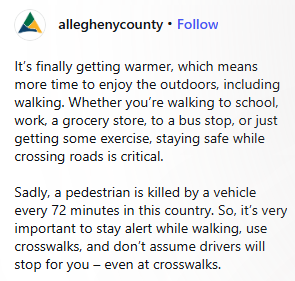
(Source: Instagram/@alleghenycounty)
A number of people sent me a public service announcement from Allegheny County, Pennsylvania, about pedestrian safety.
The video is straightforward. A person approaches a crosswalk, and the narrator runs through a series of “dos and don’ts.” In one version, the person follows the advice and arrives safely. In the other, they don’t — and are struck by a car and thrown, cartoonishly, out of frame.
The tone is light. Playful, even. The kind of thing meant to grab attention on social media.
Something about it doesn’t sit right, with me and with many others. The problem isn’t that the video tries to be funny. The problem is what it assumes.
The video caption presents a sobering statistic: a pedestrian is killed by a vehicle every 72 minutes in the United States. That’s not a small problem. That’s not a rounding error. That’s a system-level failure playing out over and over again, every single day.
And yet, the response offered here is a list of tips: Look both ways. Make eye contact. Don’t assume drivers will stop. A crosswalk is not a forcefield.
That last line is meant to be clever. It’s also revealing. What it’s really saying is this: the system is dangerous, and you need to adapt yourself to that danger.
Transportation professionals have built an environment where a person can do everything right — use a crosswalk, follow the rules, stay alert — and still be at risk of serious injury or death. They know this. They measure it. They cite the statistics.
And then they respond by telling the most at-risk people in that system to be more careful.
This is not unique to Allegheny County. In fact, it’s representative of how engineers and public works departments across the country routinely approach safety. We design wide roads that encourage speed. We prioritize vehicle throughput over every other public priority. We build intersections that are forgiving to drivers and hostile to everyone else. We clutter the roadway with signs and allow distractions to multiply.
Then, when the predictable happens — when someone is injured or killed — we treat it as a failure of individual behavior. If only the pedestrian had been more alert. If only they had made eye contact. If only they hadn’t assumed the driver would stop.
It’s a subtle but powerful shift. The responsibility moves away from the system and onto the person most exposed to its dangers.
And once you see it, you start to notice it everywhere. We don’t say: this intersection is unsafe. We say: be careful crossing here. We don’t say: this road design is failing. We say: follow these tips to stay safe. We don’t fix the system. We assign blame to others, despite being given statutory immunity from blame.
To be clear, none of this is to suggest that people shouldn’t be aware of their surroundings. Of course they should. Basic attentiveness matters. But when a system is killing someone every 72 minutes, the problem is not a lack of good advice.
The problem is the system itself.
And that’s not a mystery. We understand these systems. We know how they were built, why they behave the way they do, and what it would take to change them.
I wrote Confessions of a Recovering Engineer to explain that journey, from designing these systems the conventional way to recognizing their failures and learning how to do better. The patterns behind this video aren’t accidental. They are the predictable outcome of a profession that has prioritized speed and throughput over safety and human life.
But we don’t have to wait for that profession to change.
At Strong Towns, we’ve spent years studying real crashes through our Crash Analysis Studios — bringing together local residents, engineers, planners, and officials to understand not just what happened, but why. In our Beyond Blame report, which summarizes findings from 24 of these sessions, the conclusion is consistent: crashes are rarely the result of a single bad decision. They are also the result of multiple factors that make dangerous behavior easy and safe behavior difficult.
That’s a very different way of thinking about safety.
If you want to shift the conversation in your own community — away from blame and toward understanding — you don’t need to wait for a public works department to make a better video. You can start your own Crash Analysis Studio. We’ll help you do it.
Because real safety doesn’t come from better advice. It comes from better systems.
There are places in the world where crossing the street is not a life-threatening activity. Places where drivers expect pedestrians, where speeds are slow, and where the design of the street makes dangerous behavior difficult rather than easy.
In those places, safety is not achieved through public service announcements. It’s achieved through design. That’s what’s missing here.
A crosswalk shouldn’t need to be a forcefield.
It should just be safe.
Charles Marohn (known as “Chuck” to friends and colleagues) is the founder and president of Strong Towns and the bestselling author of “Escaping the Housing Trap: The Strong Towns Response to the Housing Crisis.” With decades of experience as a land use planner and civil engineer, Marohn is on a mission to help cities and towns become stronger and more prosperous. He spreads the Strong Towns message through in-person presentations, the Strong Towns Podcast, and his books and articles. In recognition of his efforts and impact, Planetizen named him one of the 15 Most Influential Urbanists of all time in 2017 and 2023.
%20(1).avif)
%20(1).avif)
%20(1).avif)