A City We Build Together

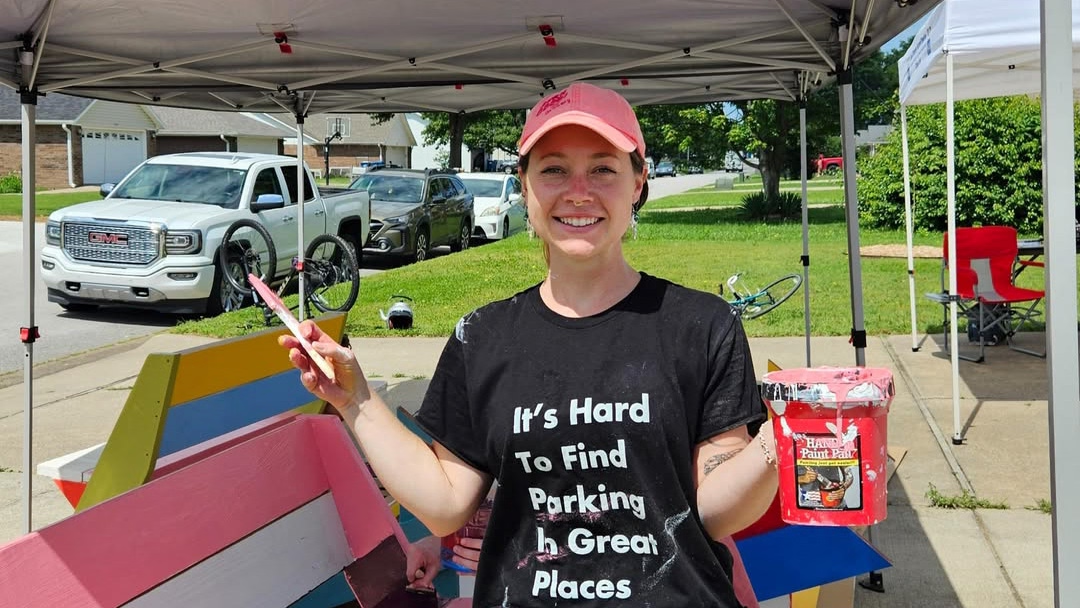
When residents of Fayetteville, AR, saw that their public transit stops lacked places to sit, they took matters into their own hands. (Source: @nwabench/Instagram)
Jane Jacobs called cities a co-creation, something we build together rather than something built for us. That insight is central to how we think about city building at Strong Towns.
When residents come to see their city as something they pay for and are owed in return, they start acting like customers. And customers don't build anything. They make demands. They file complaints. They wait for service to be delivered to them. The agency that used to belong to a neighborhood gets handed over to a bureaucracy that, over time, learns to tend to its own survival before it serves the people who fund it.
There's a related mistake, and it shows up in the way people talk about city hall. Call a city the lowest level of government and you've already decided what it's for: implementing decisions made somewhere else, absorbing whatever the state and federal governments hand down. A city treated that way stops being a place people build and becomes a delivery mechanism for policies written by people (those in so-called “higher office”) who will never live with the consequences.
The alternative isn't complicated, but it needs to be said plainly, and said often, because the habits of being a customer or a subject are easy to fall back into. A local government is the highest level of coordination for people working together to build a prosperous place. It is a co-creation, something we build together.
Without residents' guidance, local governments struggle with direction. Without local government, residents struggle with coordination.
Over the years, we've come to describe how that coordination actually happens as a four-step process. It starts with humble observation: paying attention to a place, not from a report or a spreadsheet, but by being in it. From there, someone asks what the smallest next step might be. Not a master plan, just the next thing we can do with what we have. Then someone takes that step. And then the community observes what happens, learns from it, and repeats the process.
It's a simple, yet radical, idea. Cities are too complex for anyone to fully understand, let alone plan for. The four-step process is how we learn what actually works in the face of that complexity, one step at a time.
The Next Smallest Step
Becky DeClerk spent weeks riding buses around Northwest Arkansas. She was a doctoral student studying accessible transportation at the University of Arkansas for Medical Sciences, and her research meant more than reading ridership data or mapping routes. It meant getting on the bus and staying on it, stop after stop, the way an actual rider would.
This is the first step: humble observation.
She observed that at most stops there was nowhere to sit. Riders waited in the grass, on the curb, in the dirt next to the trash cans. Becky waited there, too. More than any specific stop, she remembers the feeling. Unprotected from the heat or the rain, watching cars pass, she felt worthless.
"I am a privileged abled-bodied person,” she told me. “I am in grad school. I've got a job. I've got a family that loves me. Why do I have this worthless feeling right now?”
She found herself wondering what those same minutes told someone who was already struggling. Someone disabled, or isolated, or barely getting by. "I am sitting on the ground and I'm watching people pass me. And I'm watching people watch me sit on the ground," she said. She didn’t want others to feel that way.
And so she took the second step: she asked herself what the next smallest thing she could do to address this struggle. People needed a place to sit.
Then, Becky took the third step. She started building benches.
Or, more accurately, she joined with others to build benches. Her husband has a small woodworking shop in their garage. Through Fayetteville Strong, the Strong Towns Local Conversation, she found other people who wanted to help. One person had a skill saw. Others brought enthusiasm. Becky organized a woodworking workshop at her house where participants paid $250 to learn the basics of building benches. Each registration funded three benches, and nearly every bench built that day was donated to bus stops around Northwest Arkansas.
So they kept going. Twenty-six benches, hand-painted, a little different from each other, went out to bus stops across the region. Each one told the neighbor who sat down that somebody in Fayetteville had noticed something small and wrong, and had gone and fixed it.
The city didn't build the benches. It didn't have to. It just had to pay attention to a resident who was pointing the way.
The City Responds
If you've been reading Strong Towns for a while, you probably think you know what happened next. We've shared plenty of stories about residents painting crosswalks, building benches, planting flowers, or making other small improvements to the places they love. Too often, those stories end with a city crew removing the work or a code enforcement officer explaining why it can't stay.
When Fayetteville Mayor Molly Rawn learned what Becky and her volunteers were doing, she gave them an award.
"We did give them that certificate," she told me. "That is a very, very important and much loved award in the city."
During her campaign, Rawn had talked about the need for better bus stops. Once she was elected, she asked city staff to develop a long-term plan for permanent benches and shelters, and they did. City staff began working through designs, funding, and implementation, the way city government is supposed to work. But every day on her drive home, she still passed people standing beside busy roads with nowhere to sit. She understood Becky's motivation.
"You don't want a bench in two to four years," she said. "You want a bench now."
Rawn never saw Becky's benches as competition with the plan her staff was building. Instead, she recognized that the benches filled the gap between the immediate need and the years it would take the city's own plan to catch up. "That doesn't threaten me," she said. "I'm excited by that. I'm energized by it."
Then she said the most important thing: "We each have a role to play."
A Co-Creation
Becky never asked the city for anything. She never filed a request, waited on a committee, or treated Fayetteville as something owed to her. And Mayor Rawn never treated the benches as a threat to her authority, or a problem for Public Works to clean up. Between them, neither one was acting like a customer, and neither one was acting like a subject.
This is what it means to build a place together.
I asked Mayor Rawn what she'd tell other mayors who get nervous when residents start acting outside the formal process.
"I understand your nervousness," she said. "But what I would challenge other mayors to do is embrace that. Here you have a group of people that saw a problem and wanted to fix it. That doesn't threaten me... We can have both. We can have long-term, dedicated funding and more permanent infrastructure, and then also, in the meantime, have this."
I asked Becky the same kind of question: what would she tell someone trying to improve their own community? She didn't talk about fighting city hall. She talked about compassion.
While doing her research, she'd adopted what she called a posture of "radical compassion." Instead of assuming city officials didn't care, she tried to understand the constraints they were working under. "I can expect our cities and our transit companies to do these things," she told me, "but I have to kind of take that back whenever I'm looking at what they have to work with."
Imagine the places we can build when neighbors practice radical compassion, taking ownership of their neighborhoods and pointing the way toward a more prosperous place. Then imagine local governments with the confidence to pick up that work, adding coordination, permanence, and momentum instead of resistance. That's what it means to build a city together, to practice a Strong Towns approach.
Somewhere in Northwest Arkansas right now, someone is sitting on one of those 26 benches, waiting for their bus with a little more dignity than they had before. That is the award.
[[divider]]
A special thanks to Strong Towns member Aaron Caldwell for bringing this to all our attention in the Commons. We’ve been discussing it there for a while, just like we discuss all my columns (and a lot more).
Charles Marohn (known as “Chuck” to friends and colleagues) is the founder and president of Strong Towns and the bestselling author of “Escaping the Housing Trap: The Strong Towns Response to the Housing Crisis.” With decades of experience as a land use planner and civil engineer, Marohn is on a mission to help cities and towns become stronger and more prosperous. He spreads the Strong Towns message through in-person presentations, the Strong Towns Podcast, and his books and articles. In recognition of his efforts and impact, Planetizen named him one of the 15 Most Influential Urbanists of all time in 2017 and 2023.
.avif)
%20(1).avif)
%20(1).avif)
%20(1).avif)