The Highest Form of Public Engagement Isn’t a Meeting
%20(1).avif)
When cities talk about public engagement, they usually mean a meeting.
A conference room at city hall is reserved for a weekday evening. Notices go out in the mail and are posted on the city’s website. Drawings are printed and mounted on foam board and the design team prepares a presentation. Residents are invited to react, offer feedback, and help shape a decision before anything is built.
This process feels orderly. It feels fair because the community is invited to attend. It feels like participation, even when only a handful of people show up.
But it rests on a flawed assumption: that engagement must be completed before action can begin.
And there's a reason cities cling to this model which has little to do with genuine participation. Public meetings are risk management. They give agencies something to point to later: "The public had every opportunity to provide input," or, "This design reflects what we heard through our engagement process." The meeting was never meant to change the outcome. It was meant to protect the decision-maker.
That's not engagement. That's preemptive deflection.
And it fails in a very specific way. When engagement is treated as a gate, something to clear before action can begin, we end up asking people to do something genuinely difficult: interpret technical proposals and predict how they will function in real life. We show residents plans, cross-sections, and traffic models. We ask them to evaluate tradeoffs and form opinions about designs they have never experienced.
Even professionals struggle with this. For everyone else, it means translating abstract information into lived reality, and most people don't think in diagrams or design standards. They think in habits and experiences: how they drive to work, where they cross the street, how their kids get to school.
So the feedback we get is predictable. Cautious. Reactive. It centers on fear of change not because people oppose improvement, but because they genuinely cannot picture what's being proposed.
We call this engagement. But what is really happening is theater.
People understand places by using them
Engineering drawings are written in a language that must be learned the way you learn Latin or Greek, requiring years of deliberate study. We must recognize that a set of construction plans for a street is a technical and legal document: precise, exacting, and purpose-built to translate a concept into instructions a contractor can execute. That is exactly what it should be. But it is not how anyone understands their community.
When we place those technical drawings in front of residents and ask for meaningful feedback, we are asking people to become fluent in a language they've never spoken.
People don't experience their neighborhood through plan views and cross-sections. They experience it by walking to school, pulling out of a driveway, waiting to cross a busy street. That knowledge is real, it is local, and it is exactly what technical drawings cannot capture. But our engagement process assigns these experiences no formal value.
Cities can shift from merely theater to meaningful action
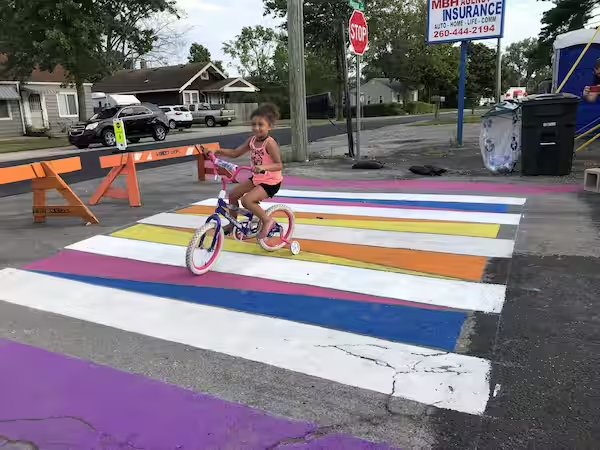
Instead of asking residents to imagine how a street might function via large-scale plans or a PowerPoint presentation, cities can show residents quickly, cheaply, and in the real world. Cities can temporarily narrow a lane with cones. They can extend curbs and shorten a crossing with paint. They can transform a center turn lane into a temporary median with simple barriers. These aren't permanent decisions. They're tests and very small bets that invite a fundamentally different kind of public participation.
People can engage and provide real-time feedback by driving the street. Walking across it. Navigating it on a bike. They experience the change in context, at real speeds, with real constraints. They don't need to interpret a drawing because they no longer have to imagine the outcome.
This produces a kind of understanding no meeting can replicate.
It also changes who gets to participate. Engagement is no longer limited to those who can attend a Tuesday night session or feel comfortable speaking in a public forum. It includes anyone who uses the street by simply asking them to do their everyday activities. The feedback that comes back is grounded in something real: This feels safer. This is confusing. This slows traffic too much. This makes crossing easier.
The conversation stops being about what might happen. It becomes about what is happening.
For technical professionals, this reframes the entire problem
The hardest part of building public trust isn’t explaining your work. It’s giving people a genuine stake in it. Most residents don’t distrust engineers or planners. They distrust abstractions. They distrust decisions that feel finished before anyone asks them. And they’ve learned through eight decades of practice that their input at a public meeting rarely changes anything. That’s not cynicism. That’s pattern recognition.
Temporary interventions break that pattern. When a city makes a small, reversible change and invites the public to experience it, the message is fundamentally different: "We don’t have this figured out yet. Help us learn." That posture is disarming. It builds credibility precisely because it doesn’t claim certainty.
When residents are treated as co-investigators rather than an audience, their relationship to the work changes entirely. They’re not being told what the data means. They’re helping figure it out. That shared process of discovery builds the kind of trust that no polished slide deck ever could.
This is incremental learning in its most practical form
Small, reversible changes let cities move faster and learn in real time. If something doesn’t work, adjust it. If it does, refine and expand it. Technical expertise still matters but it’s no longer the only lens through which decisions get made. Local knowledge becomes equally important. Residents aren’t being asked to become engineers. They’re contributing what they already know through direct observation and daily use.
Over time, this builds something durable: shared understanding.
By the time a city moves toward a permanent design, the dynamic has fundamentally changed. People aren’t reacting to an abstract proposal. They’ve already lived through the tradeoffs. They’ve seen what worked and what didn’t. The conversation is no longer speculative; it's grounded in something real that residents and professionals experienced together.
At that point, engagement isn’t about convincing anyone. It’s about moving forward with what was already learned together. The most meaningful public engagement doesn’t happen in a meeting room. It happens on the street in our daily activities and in the shared work of trying to understand it.
If we want better outcomes and more trust, we need to stop treating engagement as a prerequisite to action. Done right, making change carefully and incrementally is the engagement. The meeting was never the point. The street always was.
Edward Erfurt is the Chief Technical Advisor at Strong Towns. He is a trained architect and passionate urban designer with over 20 years of public- and private-sector experience focused on the management, design, and successful implementation of development and placemaking projects that enrich the tapestry of place. He believes in community-focused processes that are founded on diverse viewpoints, a concern for equity, and guided through time-tested, traditional town-planning principles and development patterns that result in sustainable growth with the community character embraced by the communities which he serves.
%20(1).avif)
.avif)
%20(1).avif)