What Street Design Has to Do With the Housing Shortage
.avif)
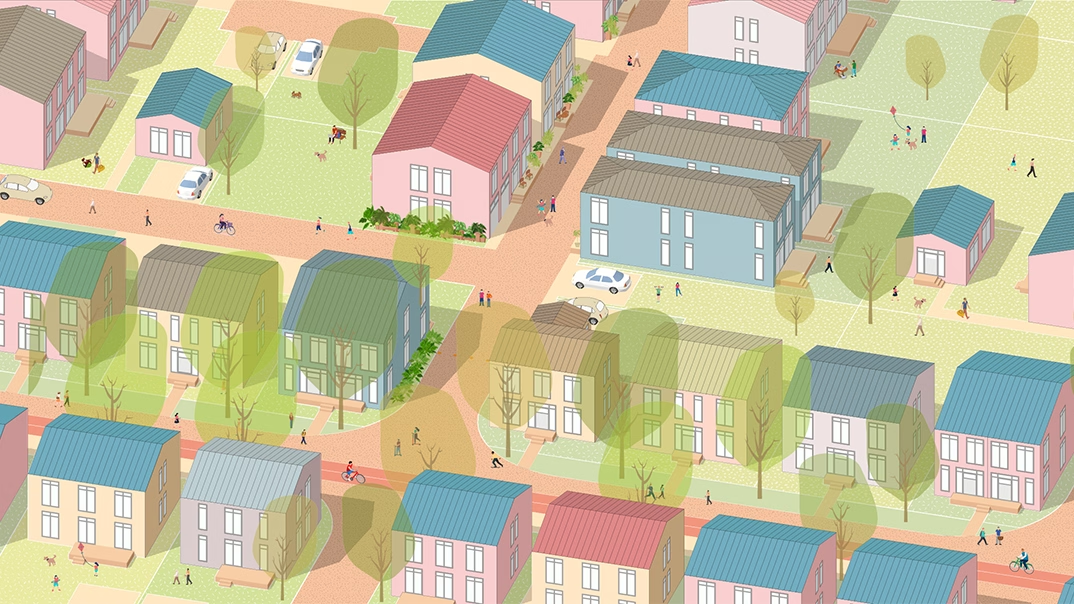
Across North America, the conversation about the housing shortage usually revolves around zoning. Should cities allow duplexes? Triplexes? Taller buildings?
Those debates matter. But after working on suburban and smaller town development projects, I’ve become convinced that another factor shapes how much housing we build: the way we design streets. Before anything gets built, the street network already determines how the land will function.
Many cities are working hard to address housing shortages, and zoning reform is an important part of that effort. But focusing only on zoning can overlook another factor that impacts how neighborhoods develop. Engineering standards (especially street layouts) influence what can happen on a site long before buildings are designed. Reviewing these patterns may open up additional opportunities for communities seeking to accommodate more housing while building stronger places.
It’s something most people rarely think about, not even industry professionals. Yet it has an immense effect on the structure and productivity of our communities.
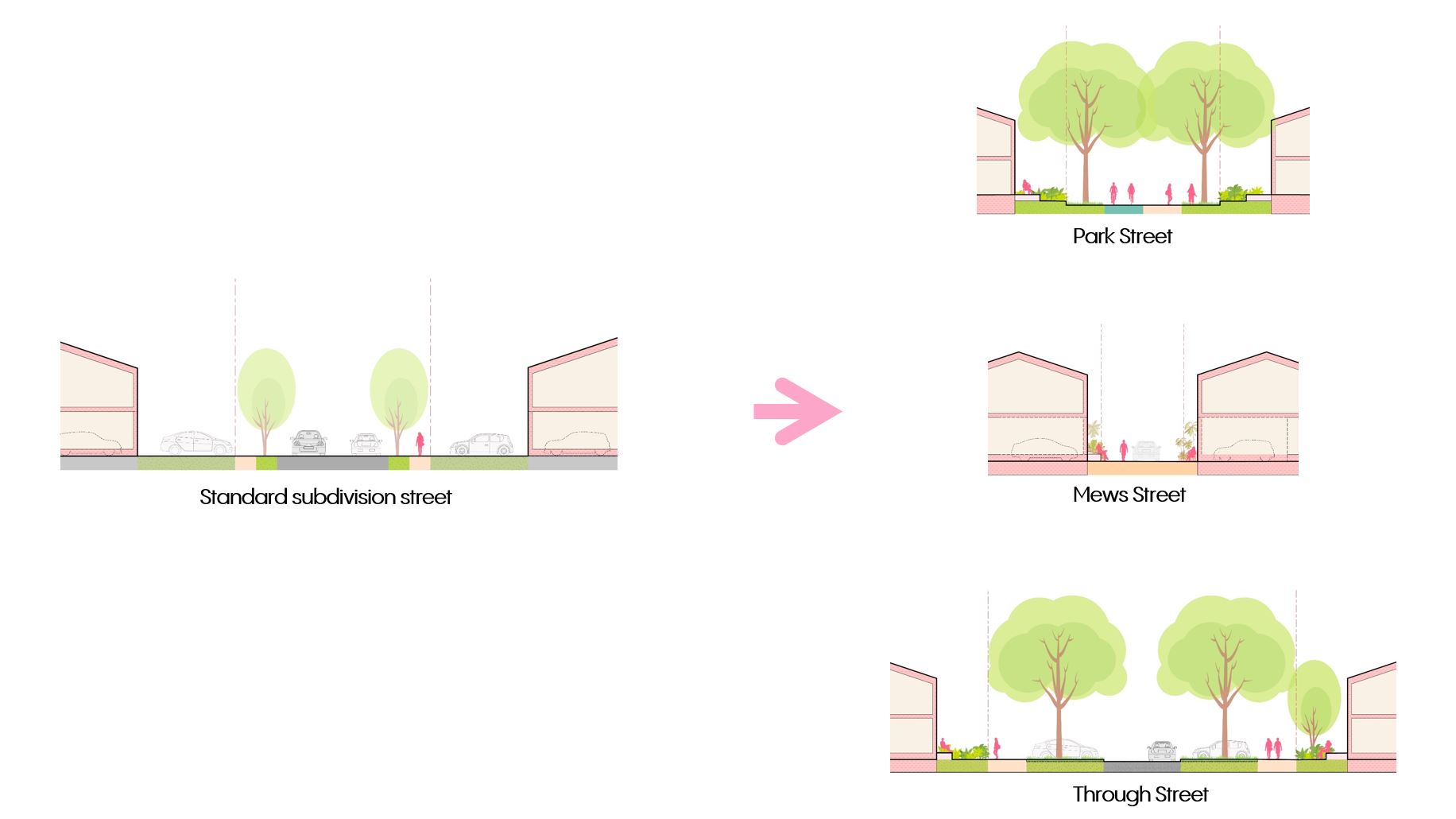
In one of Smart Density’s recent projects in a community an hour away from Ottawa, we tested a different approach by seeing what happens when the street network is designed differently from the outset. Instead of the typical 65-foot-wide streets the standards ask for, the plan reduces the street width by 45% to achieve compact streets. The streets are short and serve a limited number of homes, allowing for not only a tighter form, but a different character altogether.
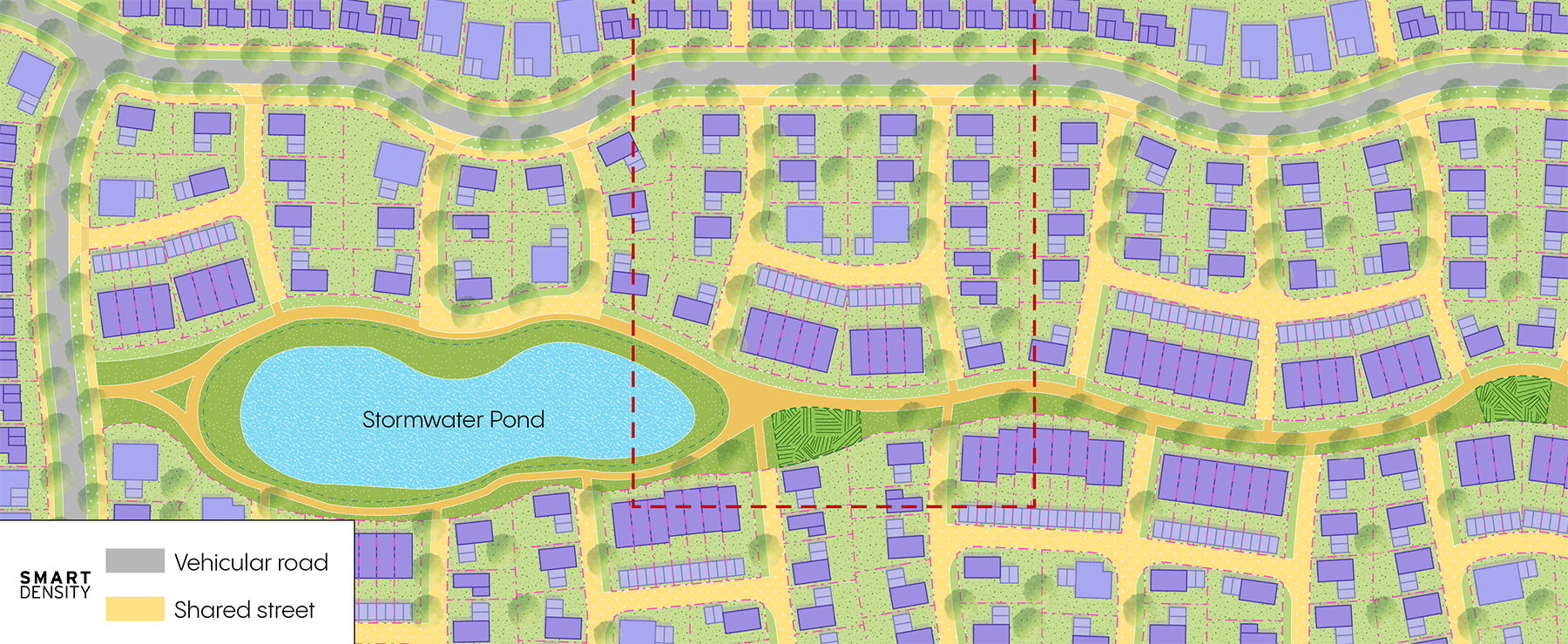
This approach reduced the amount of land dedicated to pavement and freed up more space for homes, green corridors, and shared amenities like a central pedestrian spine and stormwater features integrated into the landscape. The conventional subdivision results in three to five homes per acre, whereas here we achieved six homes per acre, all created without changing the fundamental suburban program of detached homes and car access.
This kind of result isn’t unique to one project: it reflects a broader pattern in how street design shapes development outcomes.
The Street Pattern Sets the Rules
In many new suburban developments, the pattern has become predictable: wide streets and frequent cul-de-sacs. These choices feel normal because they’ve been standard practice for decades, yet they largely determine the outcome of any new neighborhood. When streets take up large amounts of space, blocks stretch longer than necessary, and connections between streets are limited, a substantial share of developable land ends up dedicated to asphalt rather than homes, open space, or other productive uses.
In other words, the layout itself limits how much housing can exist there.
A Pattern That Became Standard
The typical suburban street pattern we see today was not always inevitable. Many older neighborhoods were built according to a different logic: streets were narrower, blocks were shorter, and the street network connected more easily to surrounding areas. This structure allowed those places to evolve gradually over time. As communities grew, they were able to add homes, small shops, and even apartment buildings in ways that responded to changing needs. Because the underlying street framework was flexible, the neighborhood could adapt incrementally. By contrast, much modern suburban development follows a single, predetermined pattern that is largely fixed once construction is complete, leaving little room for future change or gradual evolution.
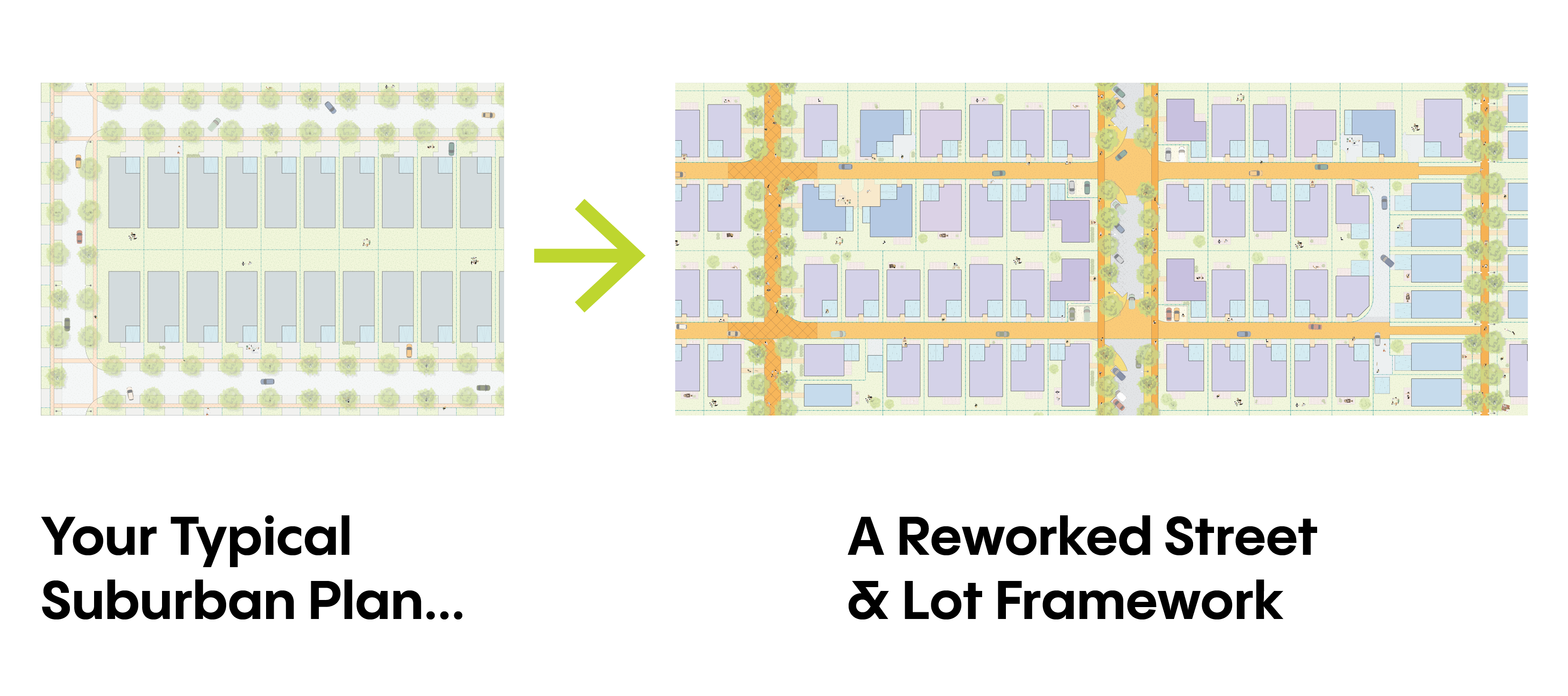
Changing these outcomes requires questioning the street framework itself. Choices about street width, block length, and the degree of connectivity between streets fundamentally influence how land is divided and what a neighborhood can become over time. When these elements are designed more intentionally, through narrower streets and shorter blocks the same site can accommodate more homes while also creating places that are easier to walk through. The objective is not to pursue density for its own sake, but to use land more effectively and build neighborhoods that function better for residents.
In many cases, the standards we build today are not the result of unavoidable engineering requirements but of design choices that prioritize the convenience and movement of cars. Over time, those assumptions have simply become embedded in engineering standards, producing streets that are significantly larger than what is actually needed to support the functioning of a neighborhood.
What is surprising, once you start looking closely at municipal street standards, is that many of them are not strictly required by the technical constraints we often assume. Street widths today are frequently justified by references to fire access, snow removal, or underground infrastructure, yet those systems typically function well within far more compact street dimensions. In practice, many municipalities already operate safely with narrower streets in older neighborhoods, suggesting these standards reflect convention as much as necessity.
Why Street Design Deserves More Attention
The Strong Towns approach emphasizes building places that are financially resilient and capable of adapting over time, and street design plays an important role in that outcome. The structure of the street network influences how much land is devoted to infrastructure and how much can support homes, businesses, and everyday activity. When a neighborhood is organized around wide roads and disconnected patterns, it commits significant public resources to infrastructure that must be maintained for decades. When the same land supports more homes, services, and activity, that public investment can generate greater long-term value for the community. In this sense, the street network is not a transportation system; it is also part of the economic framework that shapes how a neighborhood performs over time.
Beyond just efficiency and housing capacity, the character of the neighborhood is also shaped by this approach. More compact streets naturally slow down movement and bring buildings, trees, and people closer together. This creates a stronger sense of enclosure and a more human-scaled public realm, where the street feels like a shared space. With less land devoted to asphalt, there is more room for landscaping, frontages, and informal social interaction, all of which contribute to a neighborhood that feels more comfortable and walkable.
The street network determines not only how much land is available for homes and businesses, but also how much infrastructure a city is responsible for maintaining over time. When large portions of a site are dedicated to wide roads and inefficient layouts, municipalities inherit long-term obligations for pavement, utilities, and servicing (often without a proportional increase in tax base). At the same time, less land remains available for productive uses that generate value. A more compact and connected street framework changes that, reducing the amount of infrastructure required while increasing the share of land that supports homes, businesses, and everyday activity. In that sense, street design is not just a physical decision; it is a financial one that shapes how a neighborhood performs over time.
If we accept that suburban growth will continue, and it will, then the question is not whether to build suburbs, but how we build them. The patterns we rely on today are not inevitable, and they come with long-term consequences. Street design may seem like a technical detail, but it sets the foundation for how a neighborhood functions, and how it evolves. If we want places that remain adaptable, productive, and financially resilient over time, the conversation about housing must begin not only with buildings and zoning, but with the streets that shape them.
Naama Blonder is an architect, urban planner and urban designer. She has a bold vision: to change what good housing can and should look like in North America today; with that in mind, she co-founded Smart Density in 2017. Her work has received numerous awards including the prestigious Ontario Association of Architects’ Best Emerging Practice Award for 2022, the BILD Professional Service Award 2026, the Ontario Professional Planning Institute Award for Public Education in 2024 and was a finalist of Royal Bank of Canada's Women of Influence in 2023.
%20(1).avif)
%20(1).avif)
%20(1).avif)
%20(1).avif)