Advocates Across The State Convene to Un-stroad Louisiana

%20(1).avif)
%20(1).avif)
%20(1).avif)
%20(1).avif)
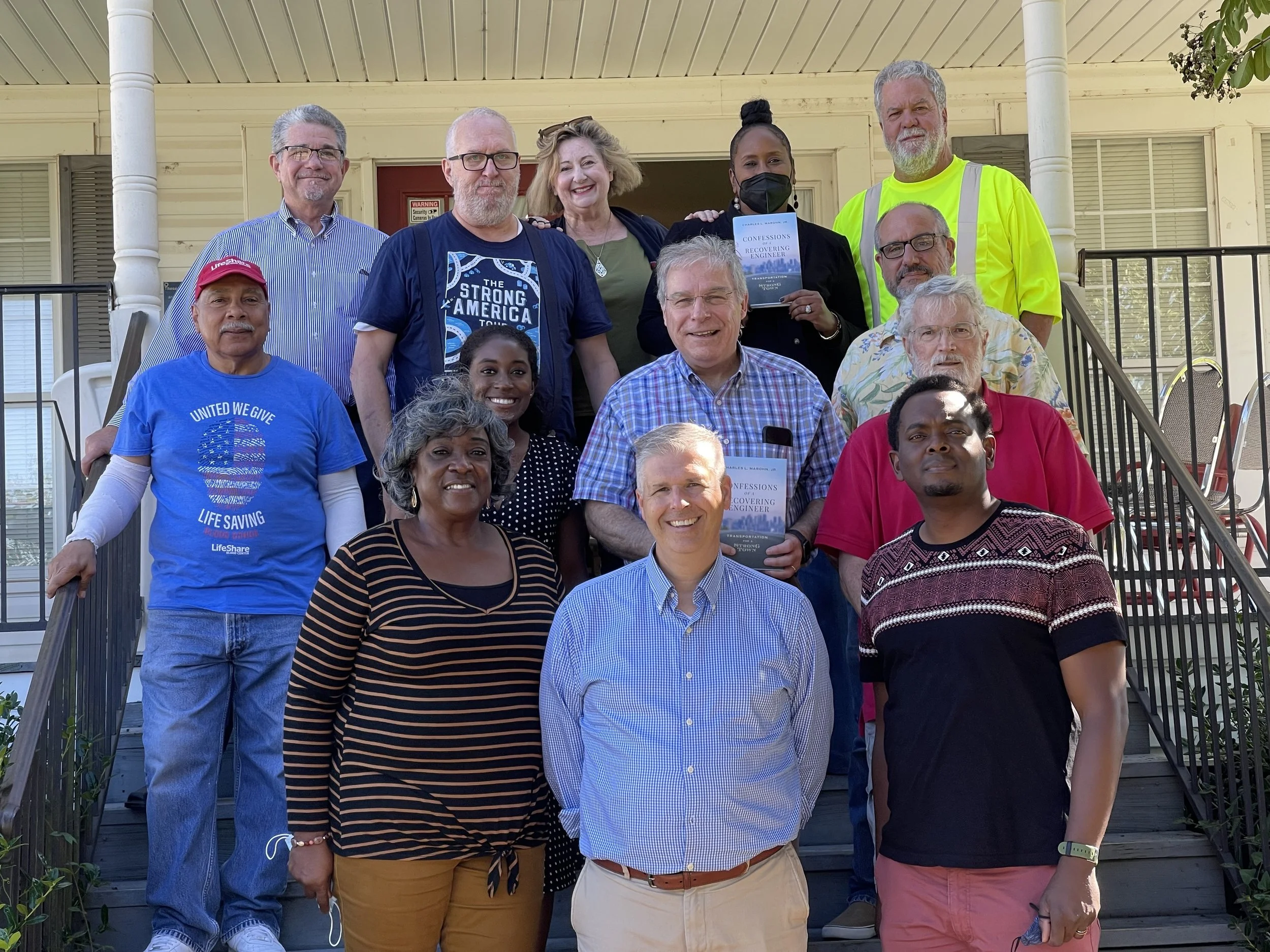
“A city is only as strong as its weakest neighborhood.” These words form a core tenet for Allendale Strong, a “learning and doing community” in Shreveport, Louisiana which mobilized in opposition to the highway that has haunted its neighborhood for years. Now, nearly a decade after it was founded by Dorothy Wiley, Allendale Strong is coordinating with peer groups across the state of Louisiana to challenge the current development pattern. They’re referring to themselves as the 4 Corners Coalition (4CC) and ultimately, their goal is to “un-stroad Louisiana.”
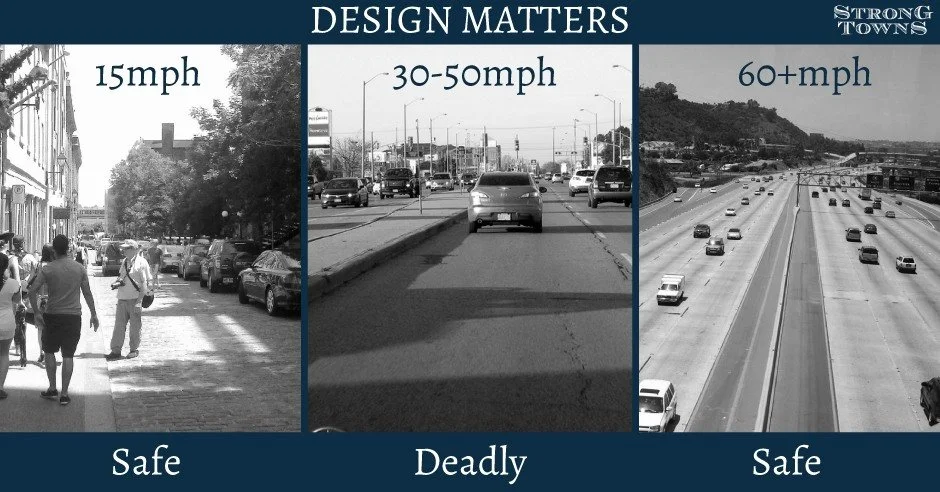
“I grew up along a stroad,” remarked Nick Lanata, a Baton Rouge-based Strong Towns member and data scientist part of the 4CC. He’s referring to the term coined by Strong Towns President Chuck Marohn 2013 to describe street-road hybrids that “fail spectacularly at being either.” Lanata not only brings his first-hand experience living adjacent to a multi-lane thoroughfare but a data-centric approach to the statewide coalition. By interpreting numbers and correlations, he wants to enhance the argument for why stroads are not only dangerous–statistically, they have exponentially higher crash ratios than streets or highways–but also financially unproductive.
“We can’t just convert stroads into streets or roads,” Lanata concedes. “There needs to be a holistic conversion into a more productive development pattern. If our goal is to reconnect communities, we need to change the land-use around these stroads. It’s going to be hard, but “unstroading” requires that holistic approach.”
The members of 4CC admit their mission is Sisyphean, but that’s why they began meeting in the first place. “We realized we could really benefit from connecting with other cities,” said Strong Towns member and Allendale Strong organizer Kim Mitchell, noting that often local initiatives are going up against state-wide bureaucracies and agencies. He was right. “We each bring different strengths – from knowing how to manage social media to having a background in advocacy.”
Currently, the Four Corners Coalition includes advocates from Shreveport, New Orleans, Baton Rouge, and Lafayette. Their collaboration is only in its second month but they’re already exploring ways to influence state legislators. “We want them to think differently,” commented Mitchell, who pointed out the pressure legislators can put on the Department of Transportation.
For the 4CC, thinking differently involves upending the current body of underlying values that dictates not only what infrastructure projects are pursued, but how they’re pursued. It’s crucial for the coalition that initiatives to improve the built environment not only involve citizen input, but be citizen-led. In fact, Lanata and Mitchell stopped short of celebrating an auspicious street redesign in Baton Rouge pioneered by the DOT for this reason. “These [complete streets] projects reflect a better set of standards, but they’re still defined by engineering values,” the latter clarified.
Without addressing and ultimately shifting this set of values, they worry that municipal staff and state legislators will continue prioritizing new projects at the expense of a growing maintenance backlog. “The state of our infrastructure, our bridges especially, is bad,” said Lanata. “You obviously can’t afford what you’ve built,” Mitchell added, echoing a core Strong Towns axiom.
In fact, Louisiana was central to Strong Towns’ flagship study of the “growth ponzi scheme,” which details the ever-increasing rates of growth necessary to sustain the accumulation of local governments’ long-term liabilities. Members of the coalition have endured the consequent financial insolvency first-hand, witnessing historic neighborhoods collapse despite multi-billion dollar investments. “Invest in healing neighborhoods first and you’ll get more done for a billion dollars,” recommended Mitchell. That’s exactly what the 4 Corners Coalition is championing.
Recently, they collectively composed and submitted a letter to the editor aimed at dispelling the notion that a highway will usher in prosperity. “Claiborne should serve as a warning to all who think the extension of I-49 will bring prosperity rather than destruction,” they wrote, referring to the Claiborne Expressway, locally dubbed “The Monster.”
This week, the data analytics firm Urban3 will present its research on Shreveport. In the meantime, the group will continue convening virtually on Thursdays not only to strategize the “un-stroading” of Louisiana but to learn from one another.
- Visit the Allendale Strong website: https://allendalestrong.org/
- Visit the 4 Corners Coalition landing page: https://allendalestrong.org/4corners/
- Read “Shreveport's Highway Emperor’s New Clothes” by Kim Mitchell
Asia (pronounced “ah-sha”) Mieleszko’s career defies easy categorization—from researching Ukrainian folk traditions to covering infrastructure policy, from performing on the world’s biggest stages to the most cramped basements. At heart, she’s a storyteller, driven by curiosity about how people and places become what they are.
While at Strong Towns, Asia paired analytical rigor with empathy to examine the forces shaping our built environment. As host of Stacked Against Us, she guided listeners through the labyrinth of housing, finance, and local governance, revealing both the systems constraining communities and the openings for meaningful action.
Off the clock, Asia can be found behind a camera, playing the accordion, or riding the rails across the country, always curious about the places and people along the way.