Breaking News: Grassroots Bench Builders Score a Win in Bay Area

%20(1).avif)

.avif)
%20(1).avif)
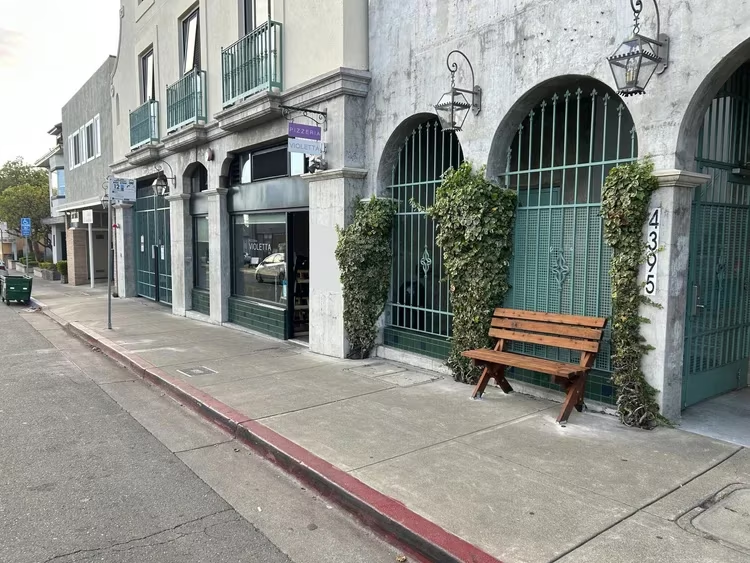
Picture an elderly rider, groceries in hand, waiting for the bus with nowhere to sit. Now imagine that scene repeating itself at stop after stop across the Bay Area.
For years, transit riders have been overlooked, their most basic needs unmet. So community members took it upon themselves to offer a little comfort—and a little dignity—by building and placing benches where none existed.
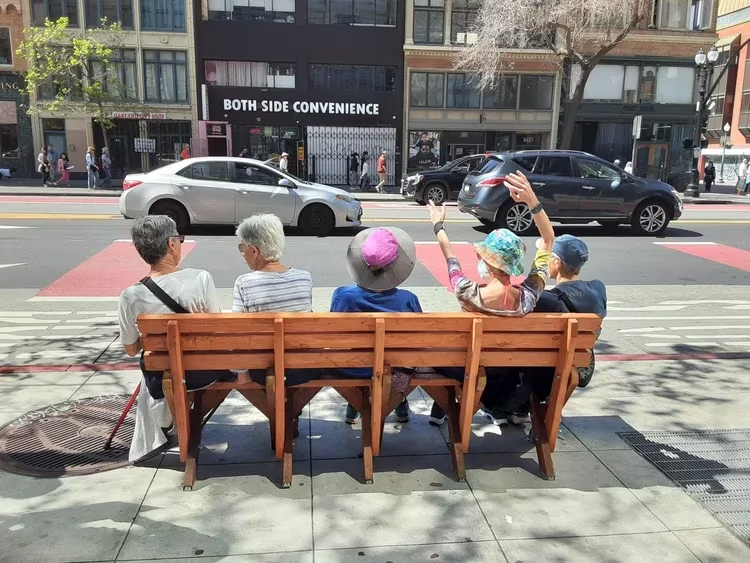
And in late May, the City of Richmond became the first to formally legitimize that grassroots effort. In a unanimous vote, Richmond City Council approved a new permitting process that allows residents to install benches at bus stops that currently lack them.
“This basic act of community care has been in a legal gray area,” wrote Sam Greenberg, a transit advocate who helped develop the legislation with Carter Lavin of the Transbay Coalition. “Without opposition, Richmond City Council just voted to establish a permitting process to allow members of the public to do something simple: place benches they built at bus stops.”
The push for legalization follows the success of the SFBA Bench Collective, a volunteer-led initiative founded by Darrell Owens and Mingwei Samuel. Frustrated by the lack of seating across high-ridership corridors, the group has built and installed more than 75 benches throughout the East Bay, each one compliant with ADA and AC Transit guidelines. At roughly $70 in materials per bench, the effort has demonstrated just how far community-led infrastructure can go—with or without city support.
Richmond’s new permitting process is the first formal recognition of this ethos—and could open the door for more organized, legally sanctioned improvements.
“Cities have lots of competing budgetary needs, so bus riders get the short end of the stick,” Lavin told SFGATE earlier this year. “If community-led bench efforts like SFBA Bench Collective can install dozens of benches while operating in this quasi-legal space, imagine how much they can do if it were fully legalized?”
Owens has long said that the ultimate goal isn’t to be the East Bay’s bench supplier—it’s to pressure cities to take transit riders seriously. “The goal is to push local governments to provide seating for its transit riders,” he told SFGATE, “and the benches call attention to that.”
Now Richmond has said: We’re listening. Keep going.
Asia (pronounced “ah-sha”) Mieleszko’s career defies easy categorization—from researching Ukrainian folk traditions to covering infrastructure policy, from performing on the world’s biggest stages to the most cramped basements. At heart, she’s a storyteller, driven by curiosity about how people and places become what they are.
While at Strong Towns, Asia paired analytical rigor with empathy to examine the forces shaping our built environment. As host of Stacked Against Us, she guided listeners through the labyrinth of housing, finance, and local governance, revealing both the systems constraining communities and the openings for meaningful action.
Off the clock, Asia can be found behind a camera, playing the accordion, or riding the rails across the country, always curious about the places and people along the way.