Maryland’s Quick-Build Projects Are a Model for Every State DOT

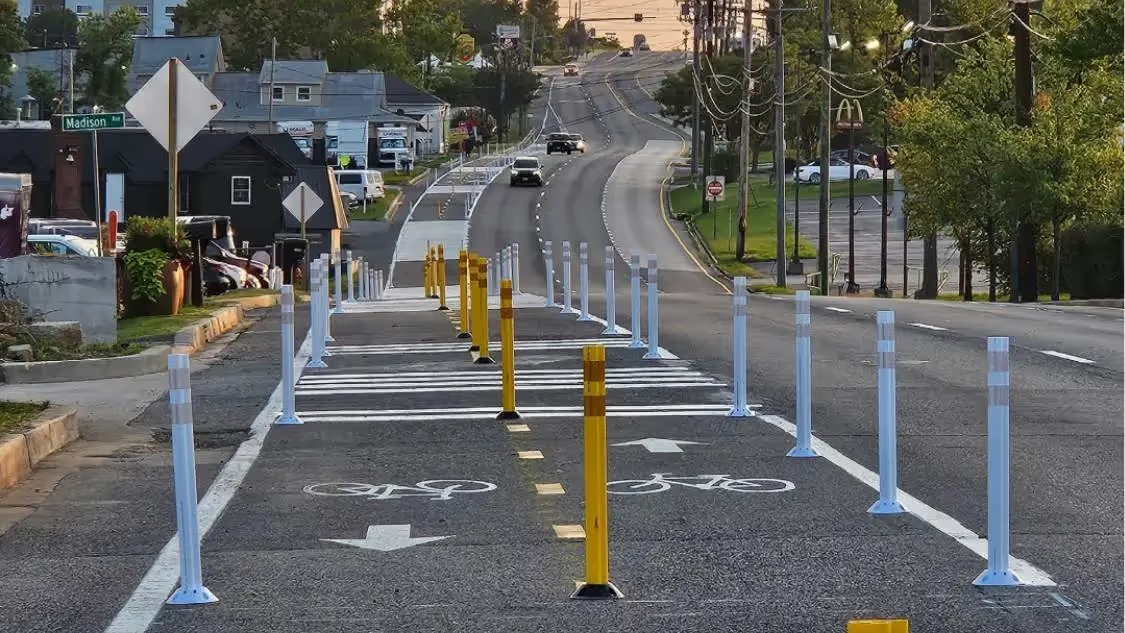
A multi-use path built through Maryland DOT’s quick-build program. (Source: Maryland Department of Transportation.)
%20(1).avif)
.avif)
%20(1).avif)
City and state transportation officials face a difficult situation. Traffic deaths are staggeringly high, and evidence is mounting that the design of roadways plays a large part in that. Applying highway design standards to urban areas — places where people live, work, go to school, and generally exist outside of cars — is disastrous. This puts transportation officials between a rock and a hard place: The current standards and systems clearly aren’t working, but those are the tools they’ve been given. How do you make things better when your tools created the problem in the first place?
If you’re the Maryland Department of Transportation (MDOT), you start building yourself a new toolbox.
In 2024, MDOT worked with Smart Growth America to launch the Complete Streets Leadership Academy, a program that helps “local jurisdictions and state DOTs to work together to install quick-build demonstration projects on state-owned routes.”
MDOT worked with three communities to create quick-build projects in dangerous locations. All three saw immediate safety improvements. One community saw a 90% decrease in the number of people exceeding the speed limit by 20 mph, as well as a 15% drop in average top speeds. Not only that, but traffic volumes actually increased by 20%, proving that safer design is better for everyone — including drivers.
Now, MDOT is scaling up its program. It plans to install quick-build projects in six communities this summer. The projects will remain in place until the fall, giving the local and state teams time to evaluate their effects on safety and determine next steps.
How They Did It
MDOT’s program flips the status quo on its head in several ways:
1. Projects Don’t Rely on Federal Funding
State DOT projects frequently run into the millions of dollars in cost and are backed by federal funding. Instead, MDOT focused on cost-effective designs, and materials were purchased by the participating cities with the help of grants from Smart Growth America. On average, the projects cost $19,000.
2. Projects Are Completed Quickly
State DOT projects often take years or even decades to complete. Meanwhile, MDOT selected communities, worked with local officials to design quick-build projects, and completed project installation in three months. The department’s report on the program offers some insight into how this speed was achieved:
- Collaboration. Participants worked across jurisdictions and districts throughout the program, and members of program leadership were easily accessible. This responsiveness and lack of silos helped participants problem-solve quickly.
- Flexibility. When they encountered an obstacle, local and state participants were willing to pivot to new ideas. For example, when they couldn’t get paint trucks to install the projects, participants didn’t let that stop or delay them. Instead, they switched to using tape and other materials to complete the installation.
- Deadlines. MDOT knew it wanted to study the effects of the quick-build projects for at least three months. That way, locals could get used to them and MDOT could collect data in several different ways. The plan was for the projects to remain in place until November at the latest, so participants were forced to get the design and installation process done quickly.
3. Projects Respect Local Context
Often, state DOT projects ignore the context of a city or town. That’s how kids end up having to cross a highway to reach their school. Instead of assuming the same project would work for every community, MDOT created “tailor-made, specific solutions that respond to specific local needs,” as State Highway Administrator Will Pines put it. Here’s how they did it:
- Humility. MDOT worked closely with local officials to identify the locations and projects best suited for each community. When local officials pushed back against its suggestions, MDOT listened and adjusted its plans to better meet local needs — humbly accepting that the local officials knew their area best.
- Direct Observation. MDOT participants conducted walk audits during the program. This is an important method of humbly observing where people struggle so you can actually address those struggles in an effective way. These audits were used to both inform the design of the quick-build projects and to evaluate the effect of the projects after installation.
What Comes Next?
State DOTs are often known for being unresponsive, unstoppable forces that prefer building highways over listening to communities’ needs. Maryland is flipping the script with a responsive, localized approach that focuses on meeting communities’ needs immediately. This is a model that all state DOTs can and should adopt. City officials can also look to this program for inspiration on how to handle streets they have direct control over.
To learn more about safe street design and quick-build projects, read the Beyond Blame report. And if you’re a city or state official who’d like to implement this kind of response in your own place, get in touch with us here. We’d be thrilled to help.
Mya Riley is the Email & Lifecycle Lead at Strong Towns. She’s passionate about learning new things and sharing knowledge with others. In the past, that passion informed her work as a copywriter and researcher for an educational organization. Now, it’s drawn her to Strong Towns and its nonpartisan, ground-level approach to improving communities through education and civic engagement.
In her free time, Mya enjoys game nights with her friends and writing fantasy and crime fiction. You can usually find her going down a Wikipedia rabbit hole, and she’s always ready with a fun fact about any topic.