The Sanctuary
.avif)

Picture you are coming through a smaller opening into a larger chamber. The thick masonry walls speak to a level of engineering and craftsmanship you feel someone likely spent their lifetime mastering and you could never achieve. Light comes through obscured glass, meant to remind you of the natural world, but also to remind you that you are somewhere set apart from it.
The art on the walls shows the world outside as it should be, not necessarily as it currently is. The lighting is low and deliberate, and your footsteps echo throughout, causing a kind of self-conscious reflection and gratitude for the space. Air begins to bellow through pipes behind you, and the sound registers to you as life itself.
Are you imagining yourself in a church sanctuary, or a doomsday bunker? Because the description above could apply to both.
In this issue, I want to focus on what our vision of a home should be, and using the work of two prominent sociologists, and the analogy above, show how we’ve gone wrong.
Where the Magic Happens
I’m pretty sure my first para-social relationship was with a rapper I’d never meet, standing in a garage with cars he didn’t own, inviting me to an indoor bowling alley in an adjacent room. It was "MTV Cribs."
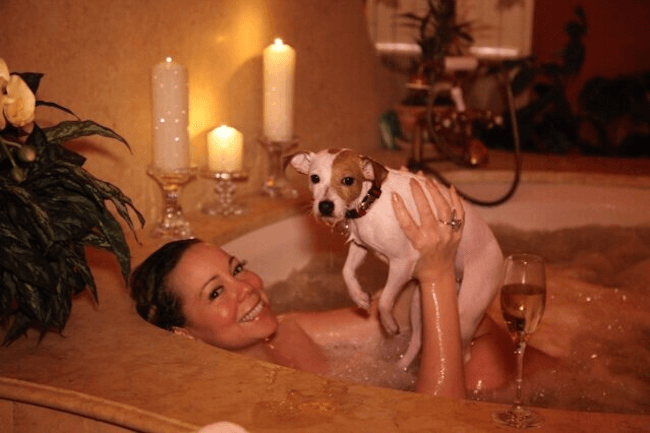
Here, celebrities showed us the height of convenience as pools were able to be both indoor and outdoor, houses backed up to airstrips, and the ability to encounter everything you need to live a life in one space. This is a sort of “home as sanctuary.” An ultimate escape we find ourselves longing for. And it was bullshit. Not just because it was full of lies (50 Cent didn’t own the Ferraris in the garage), but because the whole premise is bunk.
The more you watch it, the more you realize that every amazing feature is itself a kind of hedge against the risk of having to go out into public. Having a bowling alley isn’t just about convenience. It’s antiseptic, in the best and worst sense of the word. You don’t have to be bothered by other people, people with their own free will, their own bad timing, their own capacity to inconvenience you in ways both minor and profound.
It’s become clear to me that our dream of the perfect home is really just a dream of opting out. We want small, self-sufficient worlds with little reason to leave, little reason to bump into anyone we didn’t already plan to.
Like terrariums built to pocket a piece of nature, we’re building homes meant to pocket the city itself. But here’s the thing about cities, and about nature too: they don’t pocket.
Where the Magic ACTUALLY Happens
Two sociologists are becoming increasingly relevant. The first is Ray Oldenburg, who brought the term “third places” into the public imagination. He saw a decline in social interaction and pointed to the dwindling public environments needed to facilitate it. He was diagnosing the hardware of the problem: we need places that are neither home nor work.
The second is Robert Putnam, who popularized the term “social capital,” the value we derive from human interaction. He documented the decline of social engagement from the 1960s through the 1990s and tied it directly to the rise of television and personal entertainment. If Oldenburg is about the hardware, Putnam is about the software: the interactions themselves.
But both point to a real problem: public life is facing a sort of decline, and I think how you view your home tells you what you think of public life.
Back to the Bunker
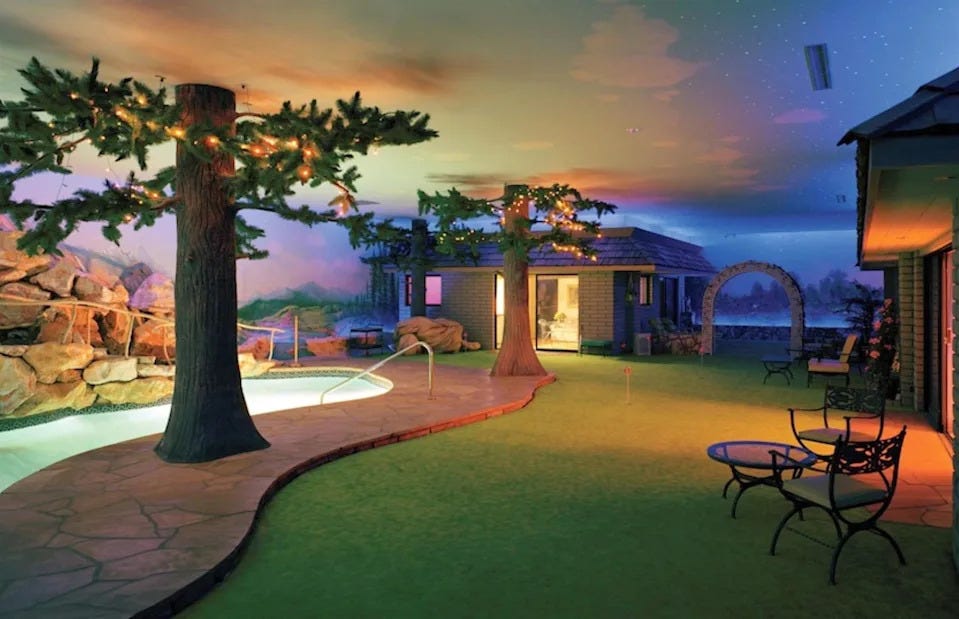
There is a 1970s Nevada house that showed up in a Zillow listing, complete with a paradise-themed bunker underneath it. It is fascinating in the way you cannot look away from a highway crash; it is equally amazing and awful.
But you can see the vision of the person who built it. They believed in a cruel enough world to require an ultimate escape, but wanted to maintain the feeling of a good one. The fact that it is a bunker, an extreme piece of architecture, makes the absurdity so apparent. You cannot escape the world and retain it at the same time.
The Gilded Age Is Boring, TBH
And this is our vision of the home in America right now. The better the home, the more amenities that keep us from having to leave it. Never mind that those amenities exist outside in a grander form, or that the best versions of them come with human interaction. We have built above-ground bunkers that treat the world as something to escape.
I watch the show "The Gilded Age," thanks to my friend Bernice and a lingering crush I have on Carrie Coon (my wife knows). In it, a new money family tries to break into the upper echelons of established American high society. But all I can think about is how prison-like the houses are, especially for women, whose main activity is to call on someone in another house, or attend the opera.
But the best a home can do is mimic a snapshot of culture. It cannot create it. Yes, perhaps the air is clean, but it is also recycled and stale. Our homes, in being isolated from the messiness of the outside world, are also isolated from its wonder. They need constant programming to feel alive, and if you have friends and can throw parties, they will fill with life.
But life pulses differently in those big celebrity houses. They may be full, but the emptiness must feel particularly cavernous when the people leave. And then a question begs to be answered: where do we expect to find the friends to fill our homes?
Putnam and Oldenburg
And this is the lesson of Oldenburg and Putnam: what good is an empty home? And how can we meet people to fill it if there is no good place to meet them? I think they are both right, and together they describe a kind of dysbiosis, a mutually destructive whirlpool created by two negative forces running at the same time.
We have an isolated built environment that is skeptical of the outside world. Our public life diminishes and becomes more hostile, a little in reality but a lot in our imagination. And so we retreat into private life and begin to glorify the retreat itself.
We see our homes as sanctuaries when they are, in fact, bunkers. Some are nicer and more palatable than others, but all reinforce the belief that the good life is a private one, where people, like a Netflix queue, should be available on demand and exactly as wanted. But people do not work that way.
Sanctuaries are different from bunkers in that, even when they offer rest, their mission is a better world. They send their people out into it. Their architecture points toward an outside that, though imperfect, is worth engaging. Bunkers wait for the air to clear, and those who invest heavily in them are counting on someone else to do the work.
Home and a False Dichotomy
Please do not misread what I am saying. You can invest heavily in your home and love it as a place of respite. But since the core of this analogy is a church, let me use a theological example.
There was an Orthodox priest who identified a damaging dichotomy within the Christian church: it had separated the world into the secular and the sacred, despising one and embracing the other. His name was Alexander Schmemann, and he argued that what we call sacred, communion, the Eucharist, exists to serve what we call secular. He pointed to Jesus giving himself for the life of the world, not for the life of the church alone.
In the same way, we have created a public and private dichotomy. I am not arguing that one does not exist, but that the worth of our private lives is found in their ability to affect others publicly. But we must also realize every good thing that enters our home enters it as a result of a society.
The recipes you cook, the music you play, the art on your walls — all of it incubated in cities and melting pots. These places are often messy, smelly, and perceived as dangerous. But human interaction, and the places that facilitate it, are responsible for every last thing you have chosen to bring into your home. Our private spaces are not in competition with great public spaces, they are created and made better by them.
Our homes are diminished when they exist only for us, and they are only made better by the existence of a thriving public life. Our homes are not only for our lives. They are for the life of the world.
[[divider]]
This article was originally published, in slightly different form, on The Happy Urbanist. It is shared here with permission. You can hear more from Jon Jon Wesolowski soon at the Strong Towns National Gathering.
Jon Jon Wesolowski is an avid urbanist who enjoys decoding what makes a space great. Across his two TikTok channels, his videos discussing urbanism and Chattanooga have garnered more than 3.2 million likes and 325k followers. He recently returned from spending seven months abroad, exploring cities and documenting what makes spaces great. He is excited to bring those ideas back to Chattanooga in tactical ways.
%20(1).avif)
%20(1).avif)
%20(1).avif)
.avif)
