Make Caring Cool Again
.avif)
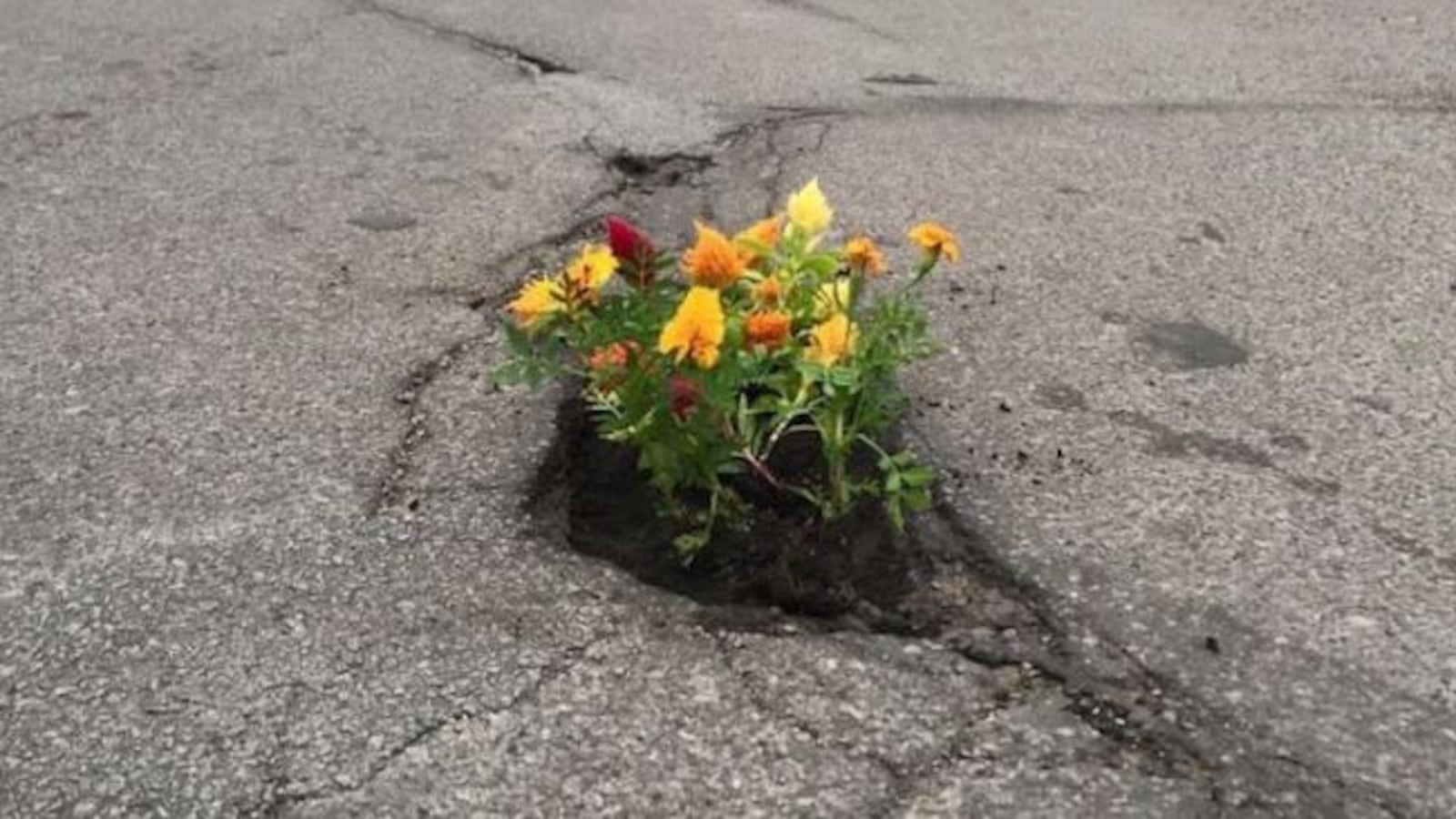
When someone asks what I do, I usually don’t lead with the fact that I’m a stay-at-home dad. I should, but I usually don’t. I guess I just worry that this part of my work is boring. Getting the kids up. Doing laundry. Washing the dishes. Fixing our janky doorknobs again (thanks, Freddie, for the heads-up on Loctite). I figure people are more interested in the new stuff I’m working on, outside of all my daily routines. Maintenance and care can seem boring and Sisyphean, especially in a culture that seems to celebrate scale and novelty over the mundane. And yes, care work is often female-coded and thus devalued by society.
Local governments are also primarily concerned with maintenance and care. The school system does the hard daily work of educating kids. Public safety spends far more of its time preventing bad stuff from happening than responding heroically when it does. And public works spends most of its time and money fixing and maintaining the infrastructure we have. A normal day at school, an incident-free public event, or a road without potholes doesn’t generate a lot of clicks. Of course, the absence of any of these things does. That’s part of negativity bias, amplified by the awful incentives of online media and social media.
The suburban experiment has left towns like my town of Fairhaven, Massachusetts, with increasingly expensive, aging infrastructure and fewer resources with which to maintain it. This is a thorny challenge that our town is not alone in facing. Recent debates over a proposed tax override have often focused on prevailing on the state to provide more funding to help the town balance its budget or on cutting staffing and services in order to make ends meet. Both approaches will leave our town more fragile financially. According to Fairhaven’s most up-to-date audited financials (FY24), 40% of the town’s revenue comes from state or federal aid. That’s high! And the higher that percentage goes, the more our town’s fate is at the whim of wildly unpredictable forces far beyond our control. Likewise, making cuts to our schools or eliminating lifeguards from our beaches can reduce the quality of life and subsequently tax revenue for the town over the long term.
There’s no easy way to navigate the financial straits that the suburban experiment has led us to. And I’m not suggesting my town forgo the debate over hard tradeoffs in the near term. But I’d also like us to start embracing the reality: our infrastructure is only getting older and more expensive, and without a way to generate more resources at the local level, our future override debates will make this one seem quaint. On the revenue side, the town can try to generate more resources over the short term by raising taxes. That’s if a tax override can pass a town-wide vote. And regardless of whether you support raising taxes, you have to agree that this is only a band-aid. That’s why I’d like to see us all more focused on how we can add to the tax rolls by thickening our current neighborhoods. By allowing our existing neighborhoods to grow by the next increment, we ensure additional revenue for the town without adding to the infrastructure that the town is on the hook to maintain.
The other side of the broken equation is our infrastructure. At the very least, we need to be extremely careful about adding to the infrastructure that must be maintained. Likewise, wherever possible, the town should be looking to shrink the amount of infrastructure it has to maintain for the long term. Walking the dogs on a side street this morning, I came across a small pothole that the town had recently filled. The pothole was on a street that’s only traveled by a couple of residents, on a part of the street where no one parks or drives. Don’t get me wrong, I greatly appreciate that the town is addressing potholes! But doing it on this spot is like spending time ironing a shirt that hasn’t been worn in a couple of years. As I’ve written previously, asphalt is expensive to maintain. There are many spots like the one I noticed today where, over time, curbs could be brought out, and expensive asphalt could be replaced by cheaper-to-maintain materials like dirt. In many cases, extending tree buffers and even installing rain gardens also reduce costs associated with wastewater treatment as well as flood mitigation. And, of course, it’s well documented that drivers slow down and streets are safer when lane widths are reduced.
I don’t envy our city officials and elected leaders having to make tough decisions this budget season. In many ways, they’re sorting out the mess made by decision-makers long dead — town officials who proudly cut ribbons on shiny new projects that seemed like a good idea at the time. And I have tremendous respect for the work our local government does in taking care of this gem of a town. It’s because of this respect that I want our town to be able to do its vital work from a place of financial stability, knowing that the resources it has will grow faster than its liabilities.
[[divider]]
This article was originally published, in slightly different form, on StrongHaven, a Substack run by Strong Towns member Will Gardner. It is shared here with permission.
Will Gardner is a social entrepreneur and the founder of SouthCoast Places for People, a movement of people working to make Greater New Bedford more vibrant and connected by supporting awesome neighbors.
%20(1).avif)
%20(1).avif)
%20(1).avif)
%20(1).avif)