Where Do We Start?
.avif)
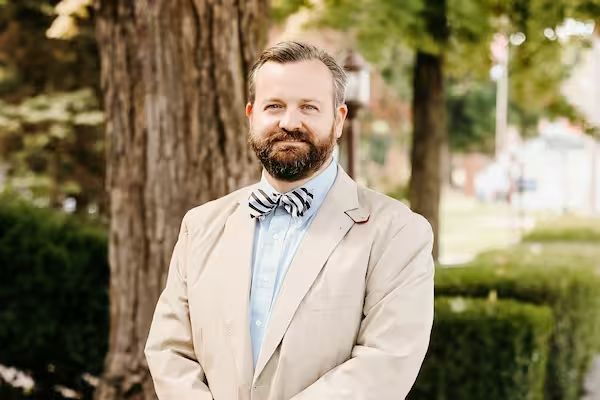
The author (right) joins with Strong Towns member Bill Price for a housing presentation in Rochester, NY. (Source: LinkedIn/Community Design Rochester)
%20(1).avif)
%20(1).avif)
%20(1).avif)
%20(1).avif)
When Bill Price joined Strong Towns as a member and later participated in the Strong Towns Accelerator Program, he wasn’t looking for a silver bullet.
Like many local leaders, he already understood the challenges facing his community. As Board President of the Community Design Center Rochester, he spent his time thinking about the future of Rochester, New York, and the difficult questions surrounding transportation, housing, and neighborhood development.
The problem wasn’t a lack of ideas. The problem was figuring out what to do next.
Bill and Community Design Center Rochester Executive Director Dawn Noto entered the Strong Towns Accelerator through the Confessions of a Recovering Engineer course. The program focused on transportation, an issue that resonated in Rochester. The city had already removed a downtown freeway and reconnected neighborhoods that had been divided for generations. Yet that success revealed a new challenge: once a major victory is achieved, where do you go from there?
Through the Accelerator, Bill and Dawn encountered a different way of approaching local problems. Rather than searching for a comprehensive solution, they learned to start with a clearly defined struggle, bring together the people closest to it, and identify the next smallest step.
A year later, they applied those lessons to a different challenge: housing.
Like many communities, Rochester faces a shortage of homes. But Bill and Dawn recognized that the city wasn’t lacking organizations, advocates, developers, or neighborhood leaders willing to help. What it lacked was a shared framework for moving forward together.
Drawing on ideas from the Accelerator and the Housing-Ready approach, they convened dozens of organizations working on housing issues across Rochester. Instead of debating competing solutions, participants focused on identifying the obstacles they were encountering and the struggles they were hearing throughout the community.
The result wasn’t a master plan that would sit on a shelf. It was something more practical that could result in action.
Together, the group identified four areas where coordinated action could make a meaningful difference: creating pattern books and pre-approved building plans, developing a stronger economic narrative for housing, expanding opportunities for incremental development, and streamlining permitting through a faster approval process.
Those conversations eventually led to a community housing lecture series hosted by the Community Design Center Rochester. Strong Towns participated as a keynote speaker, but the most important work happened afterward. Local leaders stayed for a four-hour workshop focused on identifying concrete next steps within each of the four focus areas.
The conversation shifted from discussing the housing crisis to determining what each group could do next.
That shift captures something important about how Strong Towns works.
Many communities do not suffer from a lack of caring people. They suffer from a lack of connection, coordination, and confidence about where to begin. Programs like the Strong Towns Accelerator exist to help local leaders navigate that complexity, connect with peers, and discover practical next steps that build momentum over time.
As a Strong Towns member, Bill helped bring those lessons home to Rochester.
The goal was never to solve housing issues overnight. The goal was to help his community take the next prudent step.
And then the next one after that, and the next one after that.
That’s how strong towns are built.
Edward Erfurt is the Chief Technical Advisor at Strong Towns. He is a trained architect and passionate urban designer with over 20 years of public- and private-sector experience focused on the management, design, and successful implementation of development and placemaking projects that enrich the tapestry of place. He believes in community-focused processes that are founded on diverse viewpoints, a concern for equity, and guided through time-tested, traditional town-planning principles and development patterns that result in sustainable growth with the community character embraced by the communities which he serves.