A Better Comprehensive Plan Begins With a Better Question

(Source: Town of Smithfield)
%20(1).avif)
%20(1).avif)
%20(1).avif)
%20(1).avif)
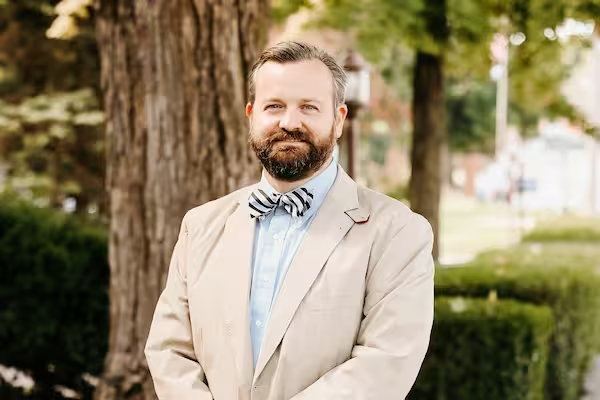
When Strong Towns member Gregory Guertin began updating the comprehensive plan for Smithfield, Rhode Island, he wasn't worried about writing the document. He was worried about asking the wrong question.
Like planning departments across the country, Smithfield could have followed a familiar script for public engagement. They could have started by sending out flyers for a weeknight meeting at city hall inviting residents to share what they want to see over the next 20 years. When a handful of residents arrive and sign in at the meeting, they are handed a stack of sticky dots or notecards. After a presentation forecasting the future of their community, the audience is then asked to use their dots or notecards to share their thoughts.
Gregory had seen this pattern play out in surrounding communities and he knew exactly what would happen. The meeting would produce a list of projects, priorities, and competing interests. It would also miss something essential.
It wouldn't explain why people love Smithfield.
For Gregory, that mattered.
As Smithfield's Director of Planning & Economic Development, and as someone who grew up there, with both his and his wife's families deeply rooted in the community, this wasn't simply another planning exercise. Smithfield, founded in 1730, is a place with a long memory. Its identity isn't found in zoning districts, future land use maps, or transportation plans. It's found in the stories people tell about growing up there, raising families there, and caring for the town across generations.
Gregory believed the town's future should begin there.
Strong Towns was invited to share Strong Towns 101 at the Comprehensive Plan Kick-Off Meeting, and Gregory had shared with me in advance the questions he was going to ask his community. When I started my talk, I shared the innovative approach Smithfield was taking to this process. Gregory didn't feel that way about it. He wasn't trying to be clever. He was trying to make sure the plan started somewhere deeper than preconceived solutions or the usual arguments over what should get built next. Smithfield carries a lot of history. It felt right to start with what people already treasure and let everything else grow from there.
He realized that a planning process for a town founded nearly 300 years ago shouldn't begin by asking people what they wanted built next. It should begin by asking what was already worth preserving.
So Gregory asked a different question. Instead of asking residents what they wanted, he invited them to tell a story: "Tell us about a moment, place, or experience in Smithfield that shaped how you feel about this town."
It was a simple question, and it completely changed the conversation.
Neighbors who might never have spoken at a traditional public hearing began sharing memories of favorite places, family traditions, everyday routines, and experiences that made Smithfield feel like home. Those stories uncovered something no survey or dot exercise ever could. Beneath dozens of individual memories were values the community already held in common: community, strong schools, open space, and the distinct character of Smithfield's villages.
Then came the harder part.
Working together, each table turned those values into principles. Then Gregory asked the question that mattered most: when a town can't have everything, what should it lean toward?
The answers surprised him. Nearly every table arrived at the same place. Money.
How do you support great schools while respecting what taxpayers can reasonably afford? How do you preserve open space while recognizing the pressures of growth? How do you protect village character without pretending difficult tradeoffs don't exist?
One table distilled its thinking into a simple truth: "Once it's gone, it is gone forever."
Another table captured an idea Gregory recognized immediately from the Strong Towns presentation earlier that evening: "Start little, takes time."
He even noticed another familiar phrase appear in the worksheets.
Someone had written "stroads," carefully placed in quotation marks, as if trying out a new word for the first time.
Those weren't policy recommendations. They were signs that something deeper had happened.
Residents weren't simply reacting to proposals. They were beginning to develop a shared language for thinking about their community and the difficult choices that lie ahead. The conversation had shifted from debating projects to discovering the values that should guide every future decision.
The comprehensive plan that emerges from this process will almost certainly look different from the one it replaces. More importantly, it will be rooted in something deeper than policy recommendations. It will reflect the lived experiences, shared values, and long-term stewardship of the people who call Smithfield home.
That's what a Strong Towns approach looks like in practice. It can't be handed to a community as a blueprint. It can't be prescribed as a one-size-fits-all solution. The Strong Towns approach is about helping local leaders find the confidence to ask better questions and create the conditions for their communities to shape their own future.
Gregory didn't set out to write a different comprehensive plan. He set out to help Smithfield discover what it already knew about itself.
Smithfield is still early in this process. The document itself, its zoning districts, its land use maps, its transportation plans, hasn't been written yet. But the foundation has. It's sitting on worksheets full of stories about villages, schools, open space, and what people are willing to give up to protect them. A town that starts there, with what it already knows about itself, is giving itself the best chance to get the rest right.
Edward Erfurt is the Chief Technical Advisor at Strong Towns. He is a trained architect and passionate urban designer with over 20 years of public- and private-sector experience focused on the management, design, and successful implementation of development and placemaking projects that enrich the tapestry of place. He believes in community-focused processes that are founded on diverse viewpoints, a concern for equity, and guided through time-tested, traditional town-planning principles and development patterns that result in sustainable growth with the community character embraced by the communities which he serves.