If a Highway Agency Stops Pretending to Care About Streets, Does It Make a Sound?
.avif)
.avif)
Recently the Federal Highway Administration (FHWA) proudly deleted five countermeasures from its Proven Safety Countermeasures list, cutting it from 28 to 23. Bike lanes and road diets came out of the pedestrian section. The entire Speed Management category, all three items, was erased. The reaction from safety advocates was immediate and grim: lifesaving tools stripped away, safety undermined, projects put at risk.
Here is the old philosophy riddle. If a tree falls in a forest and no one is there to hear it, does it make a sound? I want to ask a less poetic version. If a federal webpage changes, and street safety in your town was never actually contingent on that webpage, did anything happen?
The answer depends entirely on whether people were relying on federal authorities to hear the tree fall for them.
From my very brief look into the abyss of social media, both sides are treating this as a policy earthquake. The Secretary gets to look like he is fighting “woke” policy. Advocates get to look like they are defending lifesaving science. It is a satisfying culture war for everyone involved, and it is being fought over a content management system edit. All of this while the actual levers of street safety sit exactly where they sat last month.
These usually are municipal decisions that made by local authorities; the same people I see shopping at my grocery store. The federal government does not, and hopefully will never, make these decisions. What the federal authorities offered was a piece of institutional cover (just for the past few years) that a risk-averse city engineer could point to when a resident asked why the road was being narrowed. “It wasn’t my idea,” the city engineer could cry in response to blowback, “The federal safety countermeasures made me do it!”
I think one could argue that cover was useful in opening the door to things like road diets. But, a city that justified its road diet by citing a federal one-pager, rather than by citing the three people hit on that corridor last year, built its safety case with borrowed authority. Borrowed authority can be repossessed.
In fairness, none of this means the change are without actual consequences. It came the same week the department redirected $1.73 billion away from what the secretary called “DEI bike lanes,” wrapped in rhetoric about roads being “hostile to cars.” Read together, that is a real signal, and I fear risk-averse state DOTs will react to it. Some projects that would have survived will now quietly die. That is a bad thing, and I am not going to pretend otherwise. But if a signal from Washington is enough to kill a local street safety project, the project was standing on a fragile foundation. I think the answer has to be to move onto a stronger foundation. Also, I believe this episode exposes something structural, too. Federal authorities have almost no skin in the game when it comes to safety on your local roads. They do not drive them, do not answer for them, and do not pay the price when they fail by killing residents. It is one more reason to support ending the Highway Trust Fund.
Now let us look at a blessing in disguise: what was actually cut. The whole Speed Management focus area is gone. Every countermeasure whose job is to get drivers to slow down disappeared, while every countermeasure that assumes cars will keep moving fast, the median barriers and rumble strips and turn lanes, survived untouched.
This is an unusually honest self-description of the FHWA. Think I am wrong? Read the name of the agency again. The Federal Highway Administration. It is in the highway business. Highways are for moving vehicles at speed between places, and on a genuine highway that is exactly right. You do not want pedestrians, you do not want cross traffic, you want throughput and you want it delivered safely at fifty plus miles per hour.
Asking a highway agency to keep speeds down is like me asking an all-you-can-eat buffet to help me lose weight. The incentives run one direction, and it is not toward fitting my swimsuit this summer.
For the walking and biking crowd, this clarifies the obvious: the highway people were never our people and they never will be. That is not a scandal. It is a division of labor we should welcome, because the mingling of objectives is arguably what is killing people.
I think we can all agree that one of the major issues is the stroad. This is the ruinous hybrid: five lanes wide, forty-five miles per hour, an unprotected turn lane, lined with driveways and storefronts and bus stops and the occasional terrified pedestrian who wishes they didn’t have to walk there.
In my own region, there is a reason people keep dying along 71B, the stroad running through Northwest Arkansas, while a busy downtown street like West Avenue (as recently featured by JonJon the Happy Urbanist) sees nothing close to the same carnage. The images below make the contrast plain. Guess which one is managed by the Arkansas DOT and was originally built with federal funds?

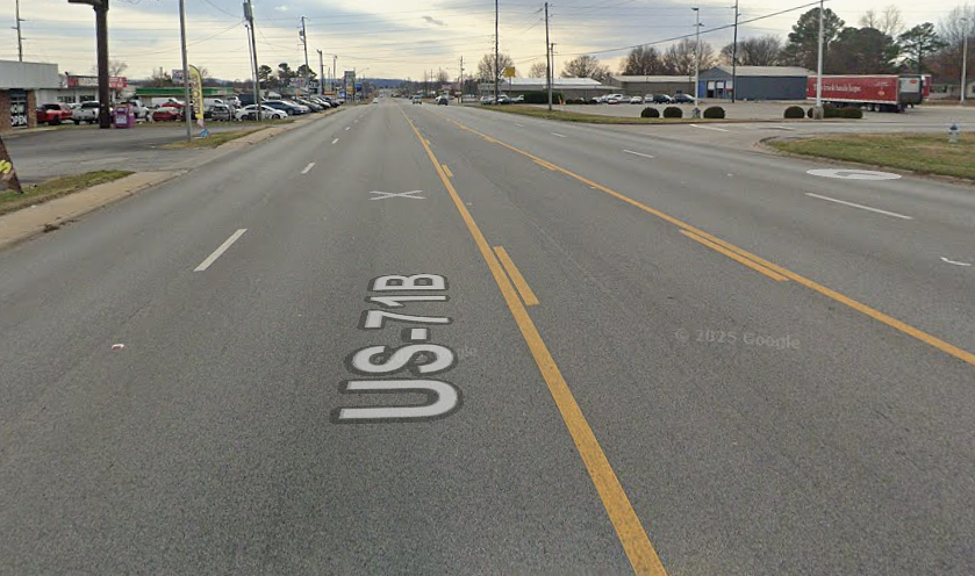
The stroad fails at both jobs. It is too slow and interrupted to move cars efficiently, and too fast and hostile to function as a place. I consider it the worst compromise in American infrastructure and one most Americans encounter daily.
Now, if you’ll allow me to be fanboy and vastly oversimplify for a moment, let me show my preferred alternative. The Dutch, whose roads kill people at a fraction of our rate, rejected this compromise decades ago. Their design philosophy insists that a road do one thing, and the driver always knows which type of road one they are on. A highway moves you at speed and keeps the driveways and crosswalks off it. A neighborhood street is built for people and tells you so the moment you enter it. What kills people, and stresses out drivers, is the stroad in between that pretends to be both. For the Dutch, there is no in-between where functions mix because that is considered a common cause of deadly accidents. Notably this is not an anti-car policy. Instead, monofunctionality is the whole game.
So I say let the Federal Highway Administration be a highway administration. Let it care about throughput and median barriers and safe operation at speed, and let it stop maintaining a list that blurred the line between what it does and what a local government does. The blur was never our friend. I’d argue the stroad is the blur made physical!
I’ll gladly take the clarity. The federal government just informed all of us, by omission, that slowing cars down on your streets is not its job. So, I say let’s address this in local government. Let’s build the argument out of your own place by naming the corridors with the crashes and the streets the kids can't cross. Local facts don't answer to a change in federal mood. That is a fight you can eventually win at your own city council, on the strength of your own local data, and no one in Washington can delete it.
Lastly, do you still want to defy Washington like me? Paint a crosswalk. Put out a planter. Narrow a lane with a few cones. Nothing rattles a bully at the top like people quietly proving they never needed him or his brittle authority.
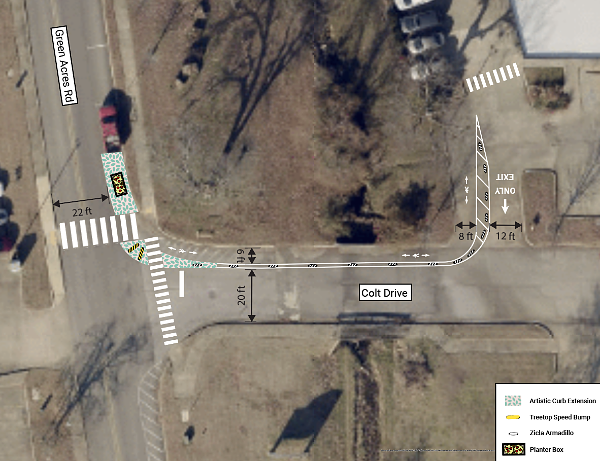
I felt inspired to do more. So I am working to make one street in my city a little be safer for our children. and I are working with a local Montessori school on a tactical urbanism project (image below). If you want to push back and make your streets safer, I’d encourage you to find something similar to do in your community.
[[divider]]
This article was originally posted in the Strong Towns Commons, a place where Strong Towns members gather to share and discuss ideas. Join us there to continue the conversation on this piece!
Aaron Caldwell is a biostatistics professor in public health based in Fayetteville, Arkansas. His work has taught him how deeply the built environment shapes community health, and how sound municipal finance is what sustains the investments needed to improve it. In his free time, he is a member of Fayetteville Strong, where he advocates for responsible fiscal policies, safer streets, and incremental housing policies.
%20(1).avif)
%20(1).avif)
%20(1).avif)