New Zealand Is Taking Infrastructure Seriously

.avif)
Wellington, New Zealand. (Source: Phil Whitehouse/Wikimedia Commons)
When I recorded a short video from Wellington, I was trying to stay out of the wind and mostly failing, which felt appropriate. Of course, it was also raining, which also felt appropriate. That's New Zealand: volcanic rock, steep hillsides, narrow coastlines, earthquake risk, heavy rains, wind coming at you from every direction. I love it.
The place is stunning because it is dramatic. There is a kind of honesty that comes from building where the margin for error is visibly thin. Infrastructure in New Zealand is not cheap, and there is no reason to pretend it should be. If you are going to build roads, pipes, bridges, tunnels, ports, rail lines, and water systems in a place like that, it is going to cost real money. The geography will not flatter your spreadsheet. And that was true way before we messed with New Zealand’s oil supply.
One of the premises of their National Infrastructure Plan is that the country already spends a remarkably high share of its economy on infrastructure, far more than what we are accustomed to in the United States. Some of that is the cost of being who they are and where they are: a relatively small country, physically isolated, with difficult terrain and serious exposure to natural hazards. Some of it is a national choice.
The problem the plan is wrestling with is one every infrastructure system eventually faces: the wants are real, the needs are legitimate, and the money to fulfill them all does not exist. New Zealand can point to housing shortages, aging water systems, strained ports, roads that have outlasted their design life, and communities that feel left behind by decades of underinvestment. Every one of those claims has merit. Taken together, they add up to more than any honest budget can accommodate.
In the United States, that kind of spending figure would become the opening bid in an argument for spending even more. Every sector has its backlog, every region has its case, and every project has a constituency ready to explain why theirs is the exception. Anyone who has spent time around infrastructure politics knows how this works. The needs get added together, the total gets declared a crisis, the American Society of Civil Engineers issues it a bad letter grade, and the conversation turns to how to find more money — federal, state, borrowed, deferred, someone else's problem eventually.
New Zealand's plan does something more disciplined and, quite frankly, more Strong Towns. It starts with the recognition that the country is already spending a lot and that this number is not going to rise indefinitely. There are schools to fund. Hospitals to operate. Other national priorities that do not disappear just because a bridge needs repair or a rail line needs investment. Infrastructure matters enormously, but it is not the only thing a society must do.
The second premise of the plan will be familiar to Strong Towns readers: New Zealand needs to renew what it has already built. In the United States, we usually call this maintenance, a word that sounds modest, technical, and faintly uninspiring. The New Zealand term is better: renewal. It captures the obligation more honestly.
These systems were built with public money, political promises, and an expectation that future generations would be able to depend on them. Renewal is not simply patching the old thing so it lasts a little longer. It is honoring a commitment.
That commitment is where the New Zealand consensus becomes important. When I was there, and in the conversations I have had since, I did not get the sense that renewal-first was a fringe idea being advanced by one party or one faction. There was disagreement over projects, priorities, funding mechanisms, planning reforms, and the familiar tensions that show up anywhere people are trying to make hard choices with limited resources. But the basic premise seemed to have crossed a threshold.
Renewal comes first. You take care of what you have already built before you make new promises.
In the United States, the renewal-first idea is not actually controversial at the local level. Talk to most city councils, most neighborhood groups, most local officials trying to balance a budget, and you will find broad agreement: fix what we have before we build something new.
Unfortunately, that consensus doesn't survive the trip to a state capital, let alone Washington DC. State and federal governments have spent decades building inducement structures — grant programs, matching funds, ribbon-cutting opportunities — that systematically reward expansion over renewal. The money that flows down from above is simply not designated for that purpose. Federal and state governments largely fund growth, not stewardship.
What New Zealand has managed to build, at the national level, is exactly what the inducement structure in the United States prevents: a framework that makes renewal a prior commitment rather than a competing interest.
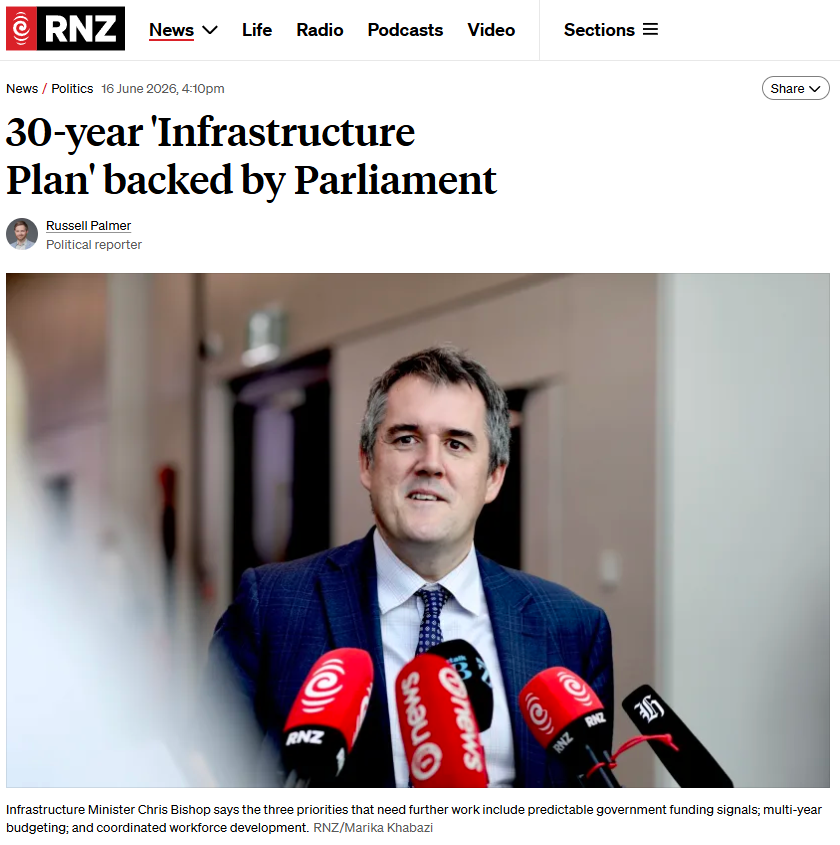
Broad parliamentary support for the National Infrastructure Plan is the evidence of that. The government adopted the plan, accepting nearly all of its recommendations. Labour and the Greens did not simply stand aside; they wrote forewords. They expressed support for the long-term approach, even while reserving disagreements over particular policies.
That is not unanimity, and it should not be mistaken for it. There are real divisions in New Zealand politics, including over transportation, environmental policy, planning reform, and the role of private capital. But there is a difference between disagreement inside a shared framework and disagreement over whether a framework should exist at all.
The credit here belongs to New Zealanders: to Geoff Cooper and the team at Te Waihanga, to the ministers and members willing to engage the work seriously, to local officials and technical professionals who have been living with these challenges for years. These are serious people doing important work, building common ground by naming the challenges clearly, being direct about the capacity to address them, and genuine about being in it together.
New Zealand still has hard decisions ahead. Consensus on a plan does not repair a bridge, renew a pipe, or train the workforce needed to do the work. The proof will be in the details, and some of those details are already controversial. That is how it should be.
When I was in Wellington, standing in the wind and rain, I found myself deeply grateful to be there. Not because New Zealand has solved infrastructure. Nobody has. I was grateful because I was watching a country take the problem seriously, with a level of maturity and shared purpose that we should all learn from. A country that has acknowledged limits without surrendering ambition. That has elevated renewal without abandoning the future.
If you are looking for direction on what comes after the age of expansion, pay attention to New Zealand. They are showing us what it looks like to begin.
[[divider]]
I really love what they have done in New Zealand and, while I recognize that this will be difficult to pull of here in the U.S. in the near term, I think any state can reasonably copy this approach right now. And, maybe someday we can do this nationally — I think it would be as popular here as it is there. What do you think? Join us in the Strong Towns Commons to discuss this with me and other members of the movement.
Charles Marohn (known as “Chuck” to friends and colleagues) is the founder and president of Strong Towns and the bestselling author of “Escaping the Housing Trap: The Strong Towns Response to the Housing Crisis.” With decades of experience as a land use planner and civil engineer, Marohn is on a mission to help cities and towns become stronger and more prosperous. He spreads the Strong Towns message through in-person presentations, the Strong Towns Podcast, and his books and articles. In recognition of his efforts and impact, Planetizen named him one of the 15 Most Influential Urbanists of all time in 2017 and 2023.
%20(1).avif)
%20(1).avif)
%20(1).avif)
%20(1).avif)
.jpg)