State Preemption Should Help Cities Become Better Cities

.avif)
The site of a 185-unit development that was denied by local government in Napa County, CA. What role should state government play in this situation?
America needs more housing that is affordable. There are a lot of theories about how we get there. I’m going to focus on two today — both emerging from blue states — that reveal very different ideas about what a market for housing looks like, what local government’s role in that market should be, and how to be a nation that produces affordable housing.
The first comes from Massachusetts, where a campaign called Legalize Starter Homes has gathered enough signatures to put a statewide zoning reform on the ballot this November. If voters approve it, a single-family home could be built on any residentially zoned property with at least 5,000 square feet of land, 50 feet of street frontage, and access to public water and sewer.
The second comes from California, where Nolan Gray, Senior Director of Legislation and Research at California YIMBY, recently reacted to the denial of a proposed 185-unit apartment development in Napa County. The property had been designated by the state as a housing opportunity site, but it sits outside the local sanitation district and would need an extension of sewer service before it could be developed. The Napa County Local Agency Formation Commission (LAFCO), the local body responsible for approving that expansion, unanimously rejected the request.
Gray responded on X: “The Napa County LAFCO just denied a desperately-needed 185-unit development, on a derelict site that has been designated by the state as a housing opportunity site for seven years. We will be investigating how state law needs to change to avoid such circumstances.”
Both of these approaches look to state law to address a shortage of housing. Both begin with the belief that local decision making can stand in the way of getting homes built. Yet, they reflect very different ideas about what is preventing housing from being built, what a functioning housing market should look like, and what role state government should play in getting cities unstuck.
A Compact for Change
I was invited, along with my friend Joe Minicozzi of Urban3, to speak at Cape Cod, Massachusetts, a number of years ago to a group that was advocating for a new sewer system. They wanted the federal government to pay for a large portion of it. They also wanted to maintain their existing low-density development pattern. I remember being a bit incredulous, and probably a little impatient, as I explained that these two desires did not reconcile. A sewer system is urban infrastructure. It is expensive to build, but it is also expensive to maintain and replace. If you want that urban infrastructure while insisting on suburban levels of development, someone else has to make up the difference. My question to them was: Who? Who should be taxed to subsidize a sewer system for one of the wealthiest zip codes in the country? Point to that place on the map.
The Legalize Starter Homes initiative in Massachusetts approaches this problem from the other direction. If a community has already made the investment in public water and sewer, and has presumably committed itself to maintaining that infrastructure indefinitely, the initiative says it cannot require a single-family home to have more than 5,000 square feet of land or 50 feet of street frontage. It doesn’t eliminate local zoning. Communities can still regulate things like setbacks, building height, open space and short-term rentals. It simply makes it legal to build a modest home on a modest lot anywhere the infrastructure to support that home already exists.
There is nothing radical about a 5,000-square-foot lot. A 50-foot by 100-foot lot is the basic building block of many of America’s most beloved neighborhoods. In fact, it is the dimensions of my own home in Brainerd, Minnesota!
What is radical, at least by today’s standards, is allowing that pattern to emerge again. In many Massachusetts communities, minimum lot sizes make it illegal to build this way. The result is not only fewer homes but more expensive homes, as builders who must acquire more land have an incentive to build larger houses to justify the cost.
Most people can agree in the abstract that Massachusetts needs more housing, just as most people can agree that starter homes should be legal to build. The problem comes when that abstract agreement is translated into an actual home on an actual lot. We need more housing, just not here. We need starter homes, just not next door to me. Multiply that response across thousands of neighborhoods and a broadly shared desire for more housing becomes a system that produces very little of it.
The Massachusetts initiative creates a kind of compact. If you live in a place served by public water and sewer, you are already part of a collective investment. Your neighbors have helped pay for the infrastructure that serves you, just as you have helped pay for the infrastructure that serves them. In return, everyone accepts a base level of change necessary to make that investment work. Nobody is required to subdivide their property or build another home, but nobody gets to use local zoning to prevent everyone else from doing so.
This is how state preemption can get cities unstuck.
The Work of Local Government
The situation in Napa is very different. Here, the local government was not being asked whether it would allow more homes on land already served by urban infrastructure. It was being asked whether to extend that infrastructure beyond its existing boundary so that 185 apartments could be built on a five-acre site adjacent to Skyline Wilderness Park.
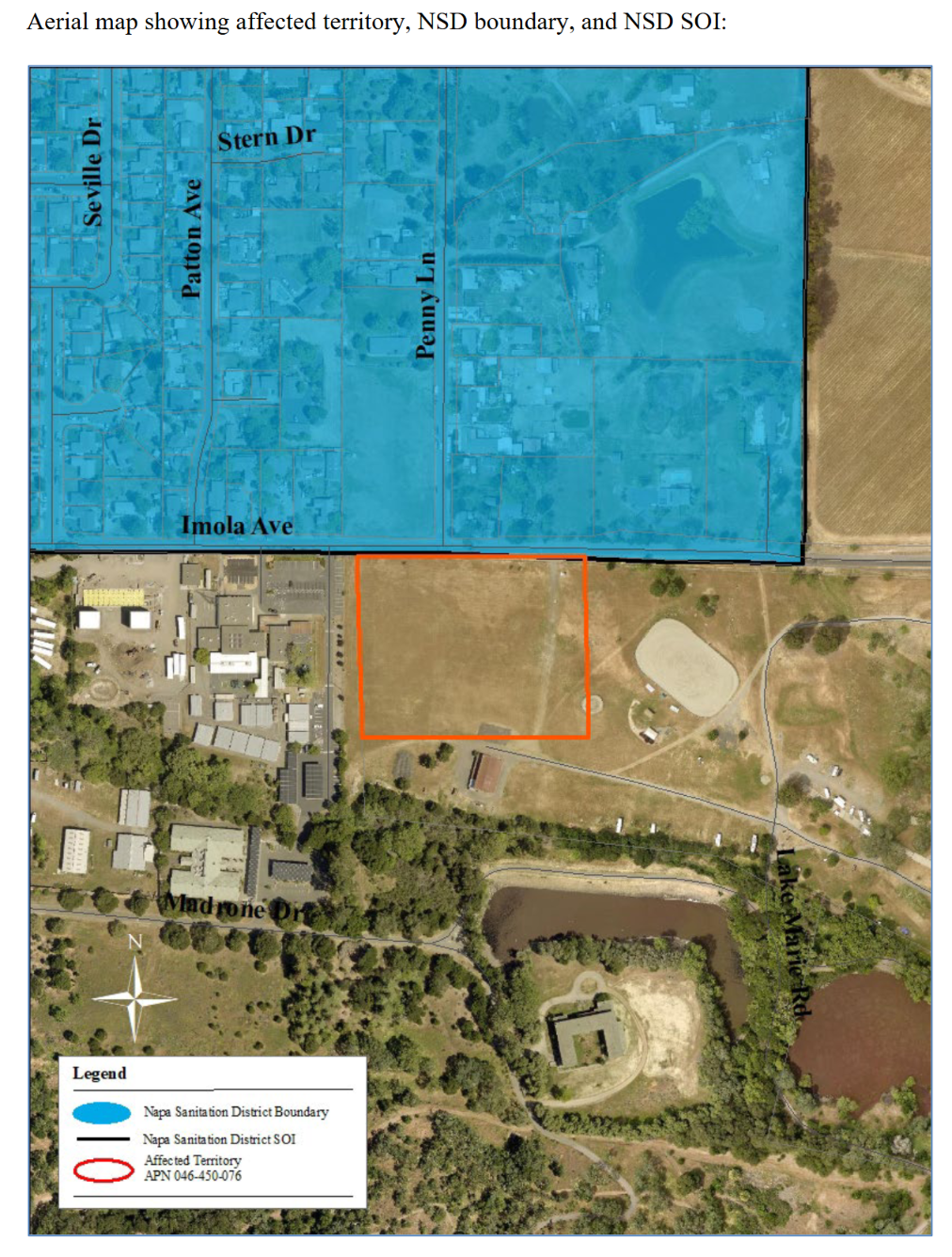
There were good reasons to say yes. Napa needs more housing, including affordable housing. The state had identified the property as a housing opportunity site, and the sanitation district had the capacity to treat the additional sewage. There were also good reasons to say no. The property sits outside Napa's existing urban boundaries, including the city's rural urban limit and the sanitation district's service area. Building the apartments would require extending sewer service beyond that boundary to make the development possible.
This balancing of competing priorities is what LAFCO was created to do. California law directs these commissions to encourage orderly growth while discouraging urban sprawl, preserving open space and agricultural land, and providing government services efficiently. Housing is explicitly part of that mandate, too. The job is not to maximize any one of these things. It is to weigh them against each other based on local conditions.
Napa's own policies make those tradeoffs even more explicit. The county calls for “orderly, city-centered growth” while preserving agricultural land, along with adequate infrastructure, vibrant city centers, sufficient housing, and protection of natural resources. LAFCO's policy discourages extending urban utilities and services to vacant or underdeveloped land where infill development is more appropriate. In reviewing this particular site, staff noted that it was outside Napa's rural urban limit and sphere of influence and specifically concluded — obviously — that it was not infill.
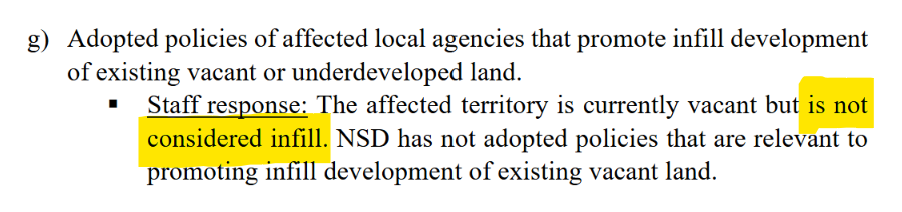
Faced with these competing objectives, LAFCO staff recommended denial. The commission ultimately agreed. Gray's response was to announce that California YIMBY would investigate “how state law needs to change to avoid such circumstances.”
This is how state preemption merely substitutes state discretion for local discretion.
Getting Cities Unstuck
I’m not a cheerleader for state preemption, but I recognize that it is sometimes necessary. Local governments can get stuck. A rule that has been on the books for decades, that people have come to count on, is sometimes impossible to change. This is how you get a system where everyone can agree that starter homes should be legal while collectively maintaining rules that make them nearly impossible to build.
The question is what the state does when that happens.
Massachusetts uses state power to break a local logjam. It takes away the ability of local governments to prohibit one very normal form of development, but it doesn't decide where the new homes will go, who will build them, or how many will be built. Those decisions are dispersed among thousands of property owners, builders, lenders, buyers, and communities.
It establishes a simple, reasonable baseline where the collective infrastructure is already in place, then leaves thousands of local decisions to happen within that framework.
Cities are at their best when they function in this way, like an ecosystem, where housing, transportation, infrastructure, businesses, public finance, neighborhoods and the natural environment all interact. Local government exists, in part, to navigate the tradeoffs between them.
State preemption is sometimes necessary to get that ecosystem unstuck. The Massachusetts initiative would do this by establishing a reasonable limit: if a community has made the collective investment in water and sewer, it must allow a modest home to be built on a modest lot. The state creates room for the city to evolve without dictating what that evolution must look like.
We need more housing that is affordable. We also need financially sound cities, productive infrastructure, viable neighborhoods, and places capable of adapting over time. We don't have to choose between these things. Cities that function like ecosystems can produce all of them.
And state preemption, where it is used, should help them do that.
[[divider]]
Do you have thoughts on state preemption? Join us in the Commons to continue this discussion with Chuck and other Strong Towns members!
Charles Marohn (known as “Chuck” to friends and colleagues) is the founder and president of Strong Towns and the bestselling author of “Escaping the Housing Trap: The Strong Towns Response to the Housing Crisis.” With decades of experience as a land use planner and civil engineer, Marohn is on a mission to help cities and towns become stronger and more prosperous. He spreads the Strong Towns message through in-person presentations, the Strong Towns Podcast, and his books and articles. In recognition of his efforts and impact, Planetizen named him one of the 15 Most Influential Urbanists of all time in 2017 and 2023.
%20(1).avif)
%20(1).avif)
%20(1).avif)
%20(1).avif)