Can We Feel Bad for the Drivers Who Kill Pedestrians?
%20(1).avif)
.avif)
(Source: Tim Foster/Unsplash)
The pedestrian reportedly was crossing the roadway and walked into the path of the Nissan. After striking the pedestrian the driver of the Nissan went to the Walgreens, parked his car, and walked back to speak to police... There were no signs of impairment on behalf of the driver. There was evidence of alcohol involvement on the part of the pedestrian.
This is the official police report of a pedestrian death in December 2025 in Nashville, Tennessee, on Haywood Lane, and it’s a typical example of its genre. These reports are often dismal, framed in every way possible to explain away the human being who died. Was the pedestrian wearing dark clothes? Was the pedestrian crossing outside a marked crosswalk?* Even better, was the pedestrian drunk?*
It seems as if authorities will do anything they can to explain away the pedestrian’s death, and the first step is often a premature exoneration of the driver. Perhaps the driver was distracted by any number of things — their phone, of course, but also skipping to the next song, taking a sip of their drink, or something interesting outside the car. Perhaps they were speeding. Perhaps they simply looked away at the wrong moment.
But none of those possibilities explains why Haywood Lane has repeatedly produced death.
Exceedingly few drivers see any kind of charge or fine after hitting a person outside a car, even when that person dies. It’s difficult to say how many people receive any kind of legal repercussions when they kill someone with a car, because we don’t even keep national statistics on this. Hell, there aren’t even local statistics to go off. We are so inured to traffic violence that we decline to even note how often drivers are held responsible when they kill someone.
One of the few places I could find actual information on how many drivers are held criminally liable comes from a 2022 New Yorker article titled “When Cars Kills Pedestrians.” They write:
Eric Gonzalez, the Brooklyn District Attorney ... believes that police officers are too ready to imagine that they could have been the driver in a collision with a pedestrian or cyclist. Yet, even when investigations are rigorous, less than two per cent of city crashes in which the drivers are sober result in criminal charges—despite a law on the books in New York City for the past eight years that makes killing or injuring a pedestrian or cyclist who has the right-of-way a criminal misdemeanor.
Less than two percent. Killing someone with a car remains one of the few ways to take a human life and often face no criminal consequences. I’d love to tell you whether New York City is especially lenient with drivers who kill people, but again — we don’t even keep tabs on this nationally.
There can be no greater indictment of our apathy toward human life than how lightly we take pedestrian and cyclist deaths. The fact that someone can die on our streets and there are no repercussions — and often no changes made to the place where they died — should shame all of us.
The question becomes: how do we create a culture that values human life? How do we cultivate the kind of moral imagination that refuses to accept these deaths as inevitable?
The Limits of Carceral Solutions
The first and easiest impulse is to want criminal liability for these deaths, including prison time. This is the primary tool we have for reckoning with unjust, untimely deaths. It is a blunt instrument, more of a bludgeon than anything else, that attempts to assure ourselves we are civilized people who believe human life matters.
But this blunt tool is limited in its ability to create shalom — the Hebrew word we usually translate as “peace,” but which means more than the absence of conflict. It means something more like wholeness. Seeking shalom, wanting a place made whole, after a driver kills someone would ultimately look like making sure that no one else dies in the same place.
Individual responsibility is real; drivers have a duty to operate a piece of heavy machinery safely. Some crashes involve recklessness, intoxication, or conscious disregard for human life, and those deserve criminal consequences.
But most fatal crashes are not like that. They happen when ordinary people make ordinary mistakes on roads engineered to make those mistakes deadly.
We know where pedestrian and cyclist deaths happen. We know that wider roads encourage faster driving. We know that faster driving dramatically increases the likelihood that a pedestrian will die when struck. These deaths are not randomly distributed throughout our cities. They occur in the same predictable places, over and over again.
If these are deaths by design, then our streets aren’t just designed to cause deaths; they are also designed to create killers.
Every fatal crash leaves two lives permanently altered: the person who died, and the person who now has to live with having taken another person’s life.
The Moral Injury of Fatal Crashes
I’ve often felt bad for the drivers who kill someone. I say this with some chagrin, because I don’t think it’s a particularly popular stance among urbanists. But when I see pedestrians in my city killed on the same roads again and again, I think there are sometimes two victims. There is always the one who died, and sometimes — there is the driver. I think about the 21-year-old driver who killed someone last December. How he was driving on a road that invited speed, that normalized speed, that had already claimed lives before. I wonder whether, sitting in that Walgreens parking lot waiting for police, he was sickened by what had just happened. I wonder how it has changed his life.
I think about how I drive on roads like that, too. I think about how devastated I would be if one day I caused someone harm while simply going about my daily life.
This is not to absolve the driver. Without a doubt, drivers bear responsibility when they kill another human being, even if the victim was crossing imperfectly or cycling imperfectly. When someone sits behind the steering wheel, they bear an immense responsibility.
But when a driver causes someone’s death — even when they were at fault — they can also suffer profound harm. What does it do to a person who was simply living within a transportation system exactly as it was designed, who now must bear the responsibility of having killed another person?
This kind of harm is what therapists and pastoral caregivers call moral injury.
The Moral Injury Project from Syracuse University defines moral injury as “the damage done to one’s conscience or moral compass when that person perpetrates, witnesses, or fails to prevent acts that transgress one’s own moral beliefs, values, or ethical codes of conduct.” We associate it with combat veterans, but our road design makes it relevant to tens of thousands of civilians every year.
Tens of thousands of people bearing moral injury because we couldn’t be bothered to change the way we build our streets.
And my heart breaks for them, even when they are at fault. When writing this, I searched and searched for people talking about their experience of being at fault in a fatal crash, and I found nothing. But they are there, and I believe many of them must feel immense shame and heartbreak. Bryan Stevenson wrote in his incredible book Just Mercy:
Each of us is more than the worst thing we’ve ever done … An absence of compassion can corrupt the decency of a community, a state, a nation. Fear and anger can make us vindictive and abusive, unjust and unfair, until we all suffer from the absence of mercy and we condemn ourselves as much as we victimize others. . . we all need mercy, we all need justice, and — perhaps — we all need some measure of unmerited grace.
I don’t want to live in a society where we are defined by our worst moments; I want to live in a culture where we seek shalom for our communities, and where we work together to make sure small misjudgements do not become fatal ones.
If we want to create real shalom on our streets, the final answer cannot simply be carceral. Jailing individuals will not prevent new, unwilling killers from being minted tomorrow. The deeper question is who bears responsibility for creating the conditions that made these deaths so predictable in the first place.
The Time We Got It Right: Turturro v. New York City
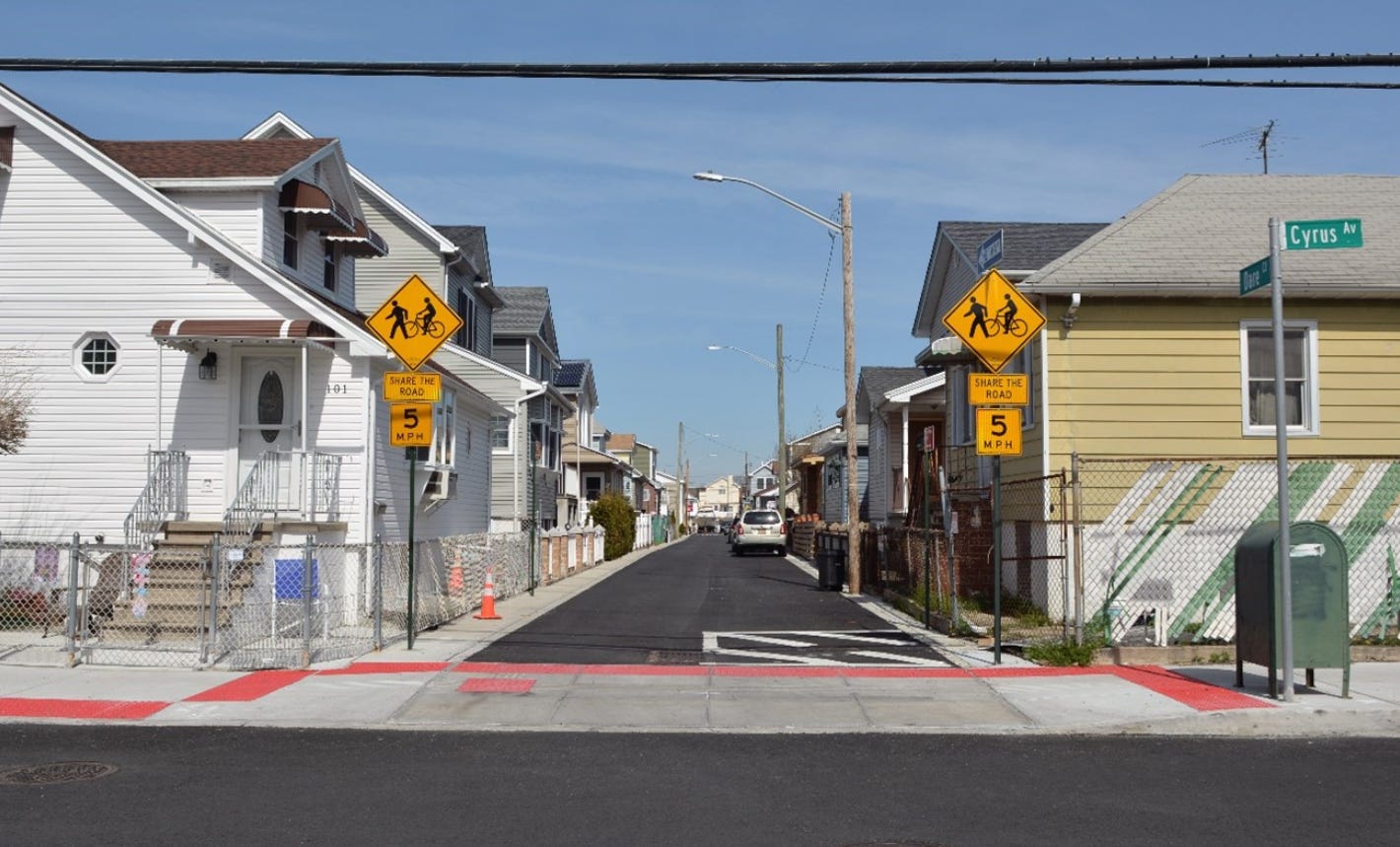
In 2004, 12-year-old Anthony Turturro was attempting to cross the street on his bicycle, when he was struck by a man named Louis Pascarella, who was driving at least 54 mph — more than double the speed limit. Miraculously, Anthony beat the odds and survived the crash, but suffered significant brain damage that left him permanently disabled.
The family sued both the driver and the city, and their case made it to the Court of Appeals, New York State’s highest court. In a 6–1 decision, the Court determined that New York City could be considered negligent for its inaction. Officials had received numerous complaints about unsafe driving and speeding on the street where Anthony was hit, but had done nothing. More than 10 years after Anthony was struck, the City was ordered to implement traffic-calming measures and the family was awarded a $20-million settlement.
The court recognized something we too often refuse to acknowledge: responsibility does not end with the person behind the wheel. It also belongs to those who knew a road was dangerous and chose not to fix it. This lawsuit, where a municipality was held responsible for their dangerous inaction, should be a model for how we view responsibility for fatal crashes all over the country.
I think back to the pedestrian killed in December on Haywood Lane. He was the third person killed on that road in 2025.
I think about the young driver sitting in a Walgreens parking lot, who had driven on that road exactly as it had been designed to be driven, and who now has to live with his victim’s death.
And then I think about everyone who already knew Haywood Lane was dangerous. The engineers who designed it. The officials who reviewed crash reports. The agencies that maintained it. The commissions that refuse to take real action.*** The government that allowed it to remain unchanged after the first death, and then after the second.
Only one group had the power to ensure there would never be a third. They still have the power to ensure there isn’t a death this year.
*The nearest marked crosswalk is more than a quarter mile away, and every intersection is a legal place for a pedestrian to cross in Tennessee, unless otherwise noted.
**Last I checked, it’s perfectly legal—and even much preferred—for a drunk person to walk instead of drive.
***Lookin’ at you, Traffic & Parking Commission. T&P lowered the speed limit from 40 mph to 35 mph: not enough to prevent another pedestrian death on this road.
[[divider]]
This article was originally published, in slightly different form, on Jesus Urbanist. It is shared here with permission.
Rev. Robin L. Owen is a Lutheran pastor and community organizer based in Nashville, Tennessee. She writes about the intersections of theology and urbanism on her Substack, Jesus Urbanist. She is the cofounder of To Nashville With Love, a guerilla urbanist bench-building project which started in 2025, and has since placed over 100 benches in protest to hostile architecture. She currently works as the executive director of Cosecha Community Development.
%20(1).avif)
.avif)
%20(1).avif)