The Missing Village: How to Build Neighborhoods Where Kids Thrive
%20(1).avif)
.avif)
There is a specific pattern that has come to mark childhood across America.
Youth move between two worlds: organized activities and glowing screens. For more affluent children, the calendar is often packed with sports, lessons, and enrichment. For those with fewer resources, there are fewer structured opportunities and screens may fill more of the gaps. Different childhoods, but with one thing increasingly in common: less time spent growing up with other kids in the front yards, playgrounds, and living rooms of their neighborhood.
Free play has given way to structured activities and screens. Parents are more reluctant to let children roam as previous generations did. Hours once spent inventing games, settling disputes, and taking small risks have largely disappeared.
This observation is one of the defining paradoxes of modern childhood. We’ve invested generously in our kids — more money, more activities, more education, and more supervision than perhaps any generation in history. Yet anxiety, depression, loneliness, addiction, social isolation, and failure to launch have all moved in the wrong direction.
We debate social media, anxiety, loneliness, and delayed adulthood as separate problems. But they are all connected. At their root is the steady disappearance of a neighborhood-focused childhood — and with it, one of the most powerful environments for developing resilient, connected, and capable young people.

The Youth Crisis Didn’t Appear Overnight
The statistics are now familiar. Anxiety and depression have risen dramatically. Loneliness has become commonplace. More young adults struggle to transition into independent adulthood. Even economic mobility increasingly depends on the strength of a child’s social networks.
The underlying shifts tell an equally important story. In the 1970s, roughly half of American high school seniors reported seeing friends almost every day. By 2017, fewer than a quarter did. Many young adults say they lack meaning or purpose, or feel that they simply “don’t matter” to others. One-third of American adolescents received prescription medication, counseling, or other treatment for their mental health.
These challenges are often treated as separate problems, but they point to a common developmental gap.
Smartphones intensified many of these trends, but they did not create them. The deeper shift began earlier, as neighborhood play, roaming, and informal supervision steadily disappeared. Streets emptied of the everyday interactions through which children learned trust, cooperation, responsibility, independence, and mutual reliance. As Jonathan Haidt has argued, this erosion of local community helped usher in the “phone-based childhood.” And as Freya India observes, many young people now grow up “trying very hard not to be vulnerable and get hurt,” treating others as distractions rather than meaningful companions.
We didn’t only lose neighborhood play. We lost one of childhood’s primary classrooms.
Neighborhoods once supplied many of the everyday experiences through which children became healthy adults. They created friendships across ages and daily opportunities to practice responsibility, resilience, and belonging. They also surrounded children with trusted adults beyond parents and teachers — neighbors, shopkeepers, coaches, and family friends who knew their names, noticed how they were doing, offered encouragement or correction, and expanded the circle of adults invested in their lives.
When those experiences disappear, every institution downstream is forced to compensate. Schools are asked to teach character. Therapists are asked to provide belonging. Sports become substitutes for community. Parents carry more of the developmental burden than any family can sustain. And screens become the default social world. The pandemic compounded this dynamic — further separating young people from friends, activities, and the everyday face-to-face interactions that had already been disappearing.

Neighborhoods Built the Skills Children Need to Thrive
A child who knows six adults on the block has multiple sources of encouragement, accountability, correction, and opportunity. A teenager who spends time with younger children develops responsibility and leadership organically. Parents who know one another notice changes in children’s behavior long before a teacher, counselor, or principal ever would.
Just as importantly, neighborhoods naturally created the experiences through which youth developed confidence and independence. Kids settled arguments, negotiated pickup games, took risks, recovered from mistakes, and learned when to lead and when to follow. This knowledge did not come from organized lessons. It simply developed when children spent time together without adults directing every interaction.
Those everyday experiences produced four things that today’s youth increasingly lack:
- Belonging: Children know they are part of something larger than themselves.
- Mentorship: Kids are shaped by multiple trusted adults beyond their parents.
- Accountability: Young people make better decisions when they are known by their community.
- Opportunity: Relationships open doors that systems alone cannot, helping narrow inequalities.
These advantages compound over years, yielding children with confidence, teenagers ready to take healthy risks, and young adults entering college or work already accustomed to navigating diverse relationships.
Technology changed childhood, but did not change what young people need most. When neighborhoods are weak, screens become the easiest place to find friendship, identity, entertainment, and belonging. When neighborhoods are strong, youth have something more durable to compete for their attention.

If We Want Healthier Youth, We Need Neighborhoods That Raise Them
The goal isn’t simply friendlier neighborhoods in which people live isolated in their individual homes. We need neighborhoods designed to make childhood visible again — places where children regularly build independence, belonging, responsibility, and relationships with trusted adults.
Communities can:
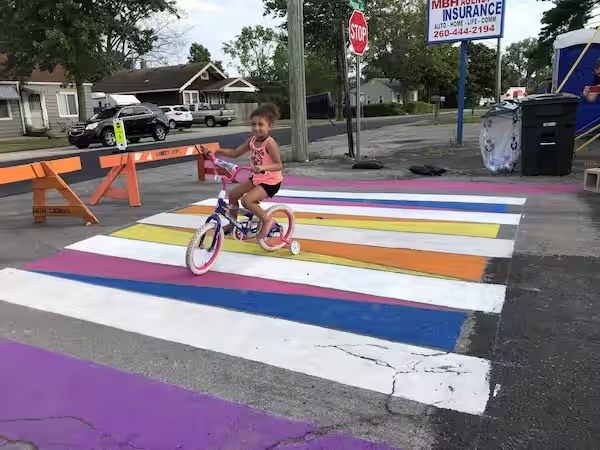
- Make independent mobility possible. Create neighborhoods where children can easily walk, bike, and gather without every outing requiring a car ride or adult supervision.
- Encourage child independence. Make it normal for kids to walk to school, ride to the park, visit the library, or stop at the neighborhood store on their own as they mature.
- Make neighborhood play the default. Create regular opportunities for young people to spend unstructured time together, not only in organized events.
- Reconnect generations. Design spaces and activities where children regularly interact with older adults and younger kids to foster mentoring relationships.
I see what this can look like almost every day in my own neighborhood. Children have enough freedom to ride their bikes to the park, stop at the corner store, knock on friends’ doors, and play together across ages. Parents know one another, local businesses welcome kids, and neighbors look out for the kids on the street. It isn’t perfect, but it’s close enough to remind me that the kind of childhood many of us remember hasn’t disappeared everywhere. Where neighborhoods make room for it, children naturally flourish.
Families can:
- Choose neighborhood over programming when possible, leaving time for children to simply play with other kids.
- Know the adults your kids know, and help your kids know the adults you trust.
- Give young people increasing independence, allowing them to solve problems, take manageable risks, and build confidence.
- Create a front-yard culture. Spend more time where neighbors naturally encounter one another instead of retreating indoors or into private backyards.
None of these actions replace good parenting, schools, or mental health care. They restore something those institutions cannot create on their own: a web of everyday relationships through which youth become resilient adults.
Raising Children Is a Neighborhood Project
For decades, we’ve searched for solutions in schools, mental health care, technology policy, and youth programs.
We have overlooked one of the most powerful youth development strategies we have: neighborhoods.
If we want the next generation to flourish, we should ask a broader question: not only whether kids have good schools and responsible parents, but whether they have a neighborhood where they can belong, contribute, explore, and be known.
Do children in your neighborhood know adults beyond their own family?
Do they have younger children who look up to them and older children they aspire to become?
Do they have places to play, opportunities to take small risks, and neighbors who would notice if they were struggling?
Rebuilding neighborhood life won’t eliminate every youth challenge, but it may do something more important: restore the developmental environment that helped prevent many of those challenges from emerging in the first place.
The work of rebuilding neighborhoods isn’t separate from the work of helping young people flourish. It is the heart of the work.
[[divider]]
This article was originally published, in slightly different form, on Flourishing Neighborhoods. It is shared here with permission.
Seth D. Kaplan is the founder of Flourishing Neighborhoods, a national platform dedicated to strengthening neighborhoods, expanding opportunity, and rebuilding social connection and trust. He is a Professorial Lecturer at the Paul H. Nitze School of Advanced International Studies (SAIS) at Johns Hopkins University and the author of "Fragile Neighborhoods: Repairing American Society, One Zip Code at a Time." Drawing on decades of work on fragile states and social cohesion, Kaplan focuses on how strengthening place-based communities can reduce inequality, rebuild social fabric, and improve how cities and towns work.
%20(1).avif)
.avif)
%20(1).avif)