What Are We Asking the Flowers To Do?

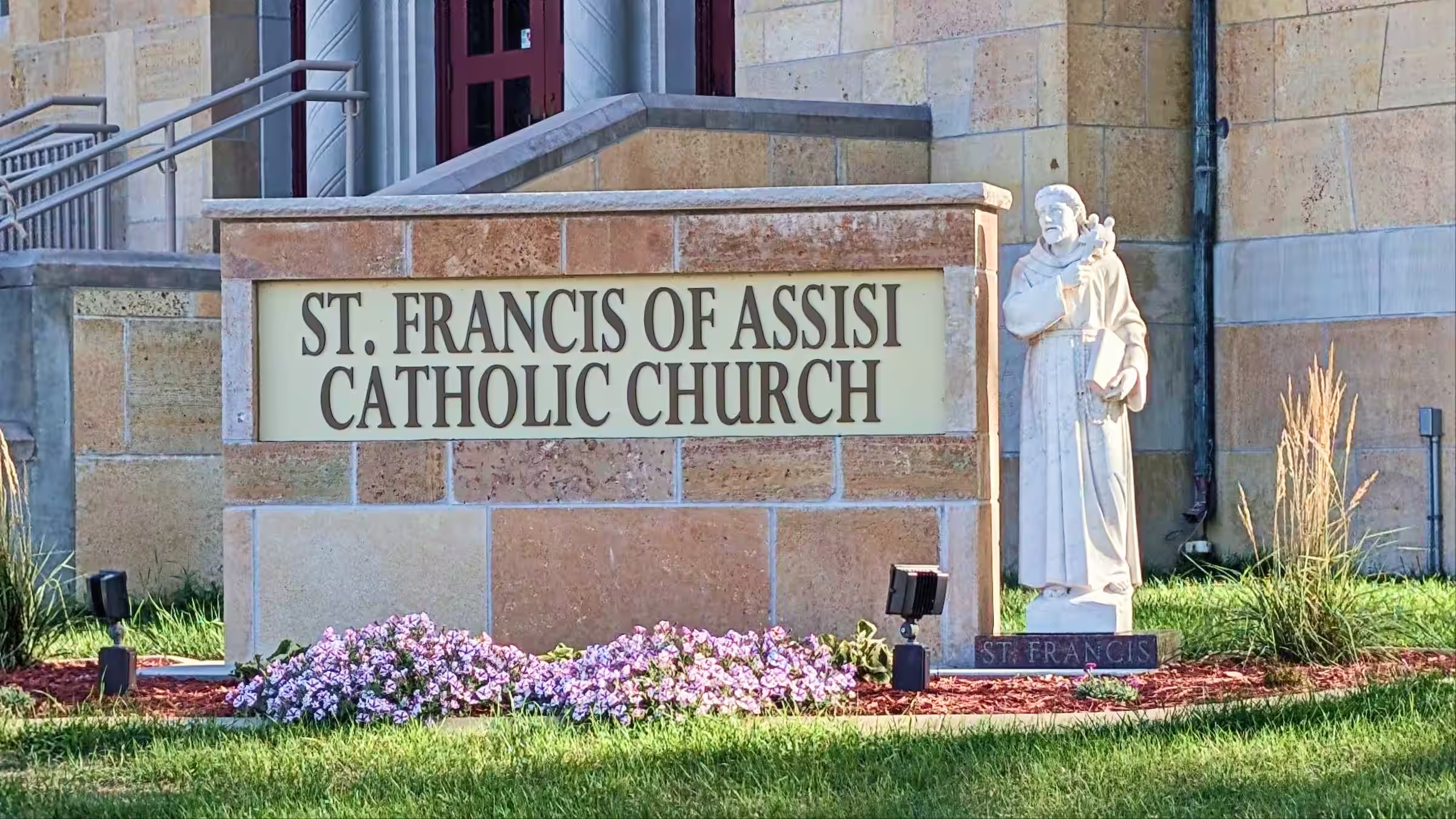
My wife and I were out walking the dog, Gryffindor, as we do most evenings. The loop we do together generally takes us past our church, which has been undergoing a lot of construction in recent years. This past summer, it was the rectory, which was replaced with a newer building. I wish I could say I’m a fan, but I’m not.
Without going into that — I already have enough years scheduled in Purgatory — I’d like to answer a question my wife had for me. It really wasn’t a question but, like someone who has been married for 31 years, I’m going to make it into one and then pretend that it was. As I was pointing out and expressing mild irritation at the landscaping choices around the buildings, she asked me:
You keep calling things “suburban landscaping.” What do you mean by that?
Of course, this is more than a fair question. I wasn’t using any technical terms, but I had slipped into shorthand that even my wife found confusing. That’s a problem because she is — obviously — very intelligent and perceptive and already somewhat familiar with this stuff because she’s had to listen to me talk about it for many decades on walks just like this one.
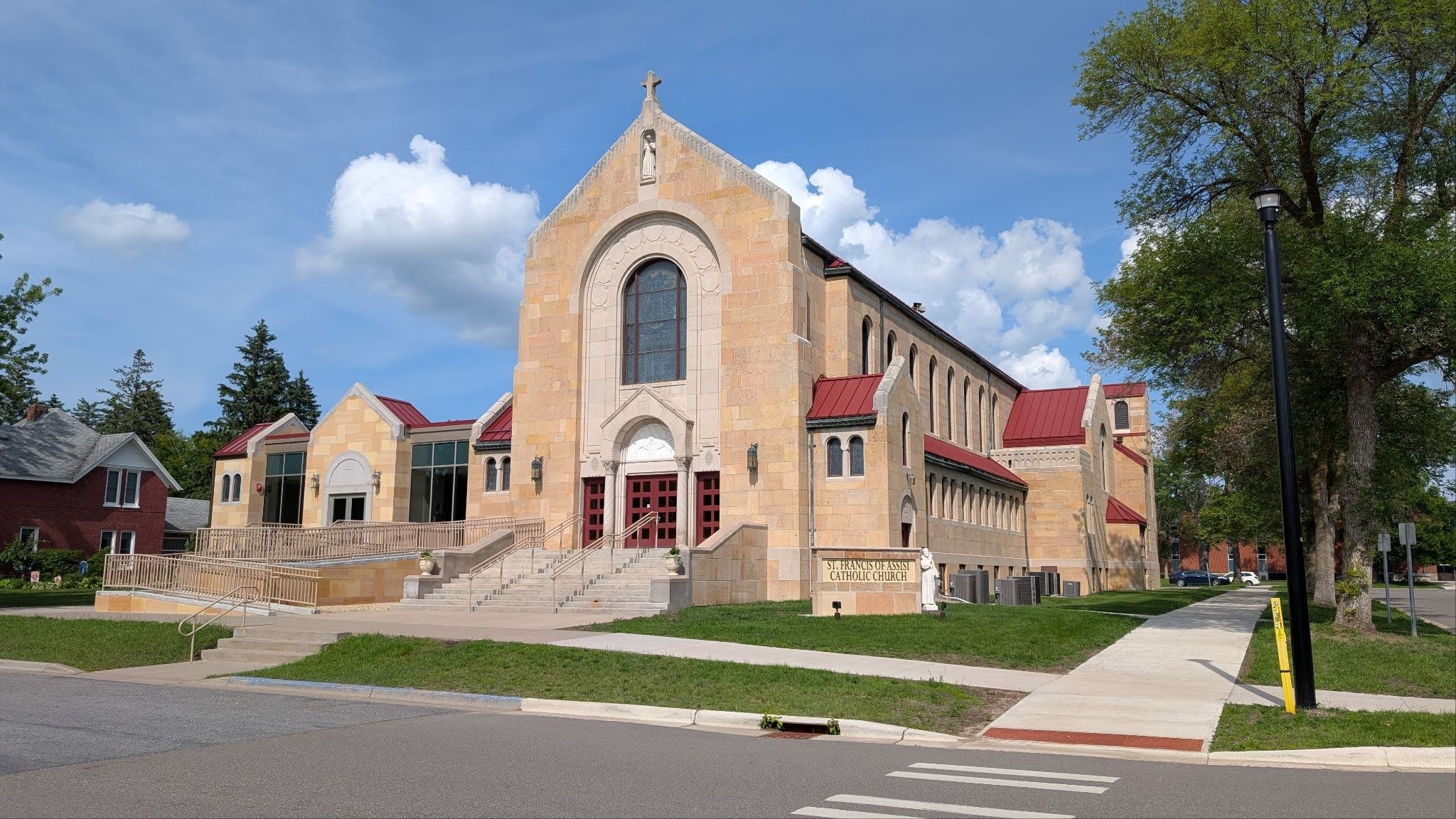
So, let me start with what we were looking at. This is our church, St. Francis of Assisi in Brainerd, Minnesota.
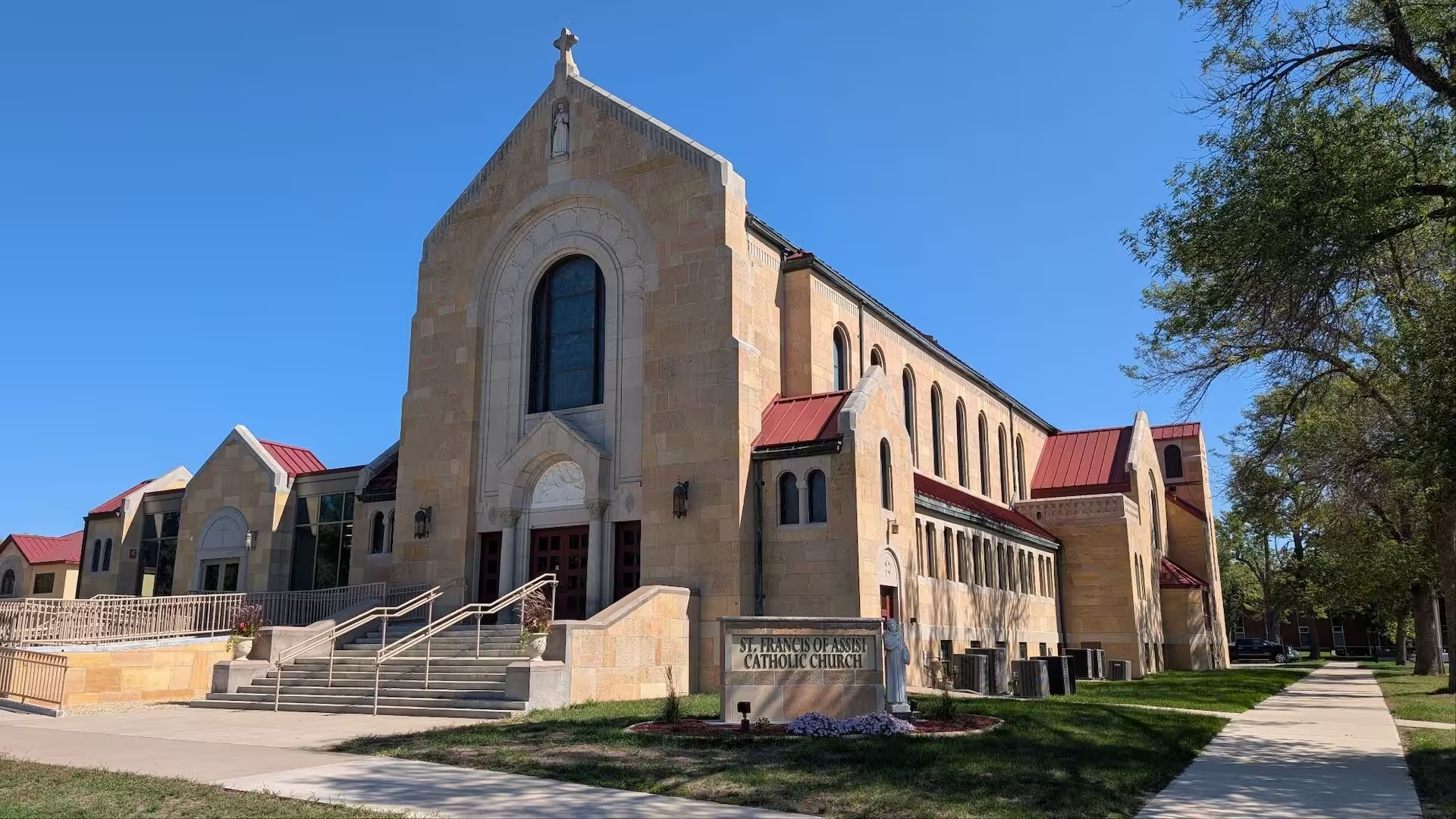
If you look closely, you can see the flowers planted in front of the newish sign. That is what my wife was commenting on and what I casually referred to as “suburban” in character. Here’s a closer look.
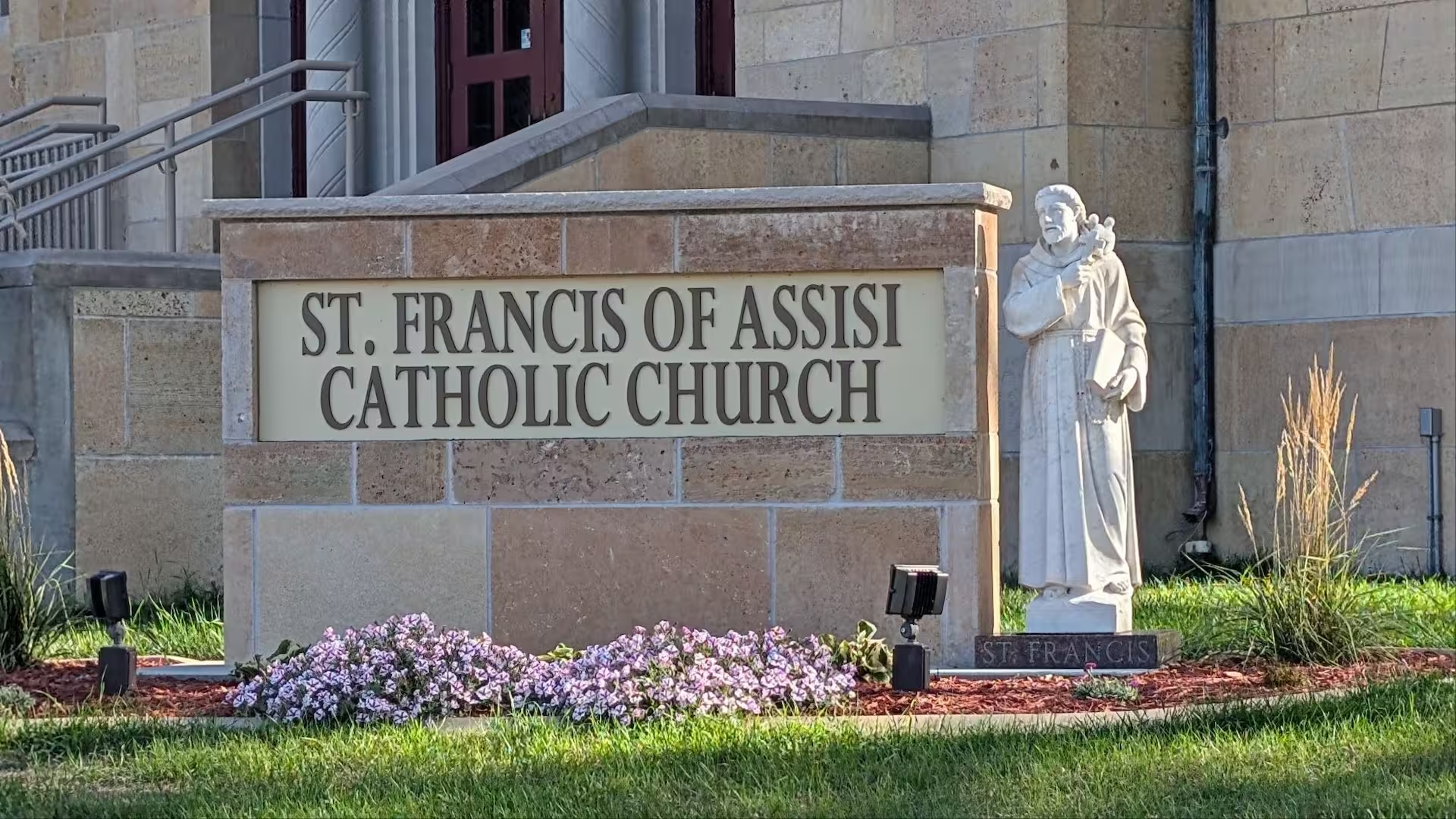
Since we can only go back so far before everything becomes muddled in the decades of dialogue typical of a happy marriage, the statement that prompted this particular discussion was my wife commenting that, perhaps, amid my grumblings, I could acknowledge that the flowers in front of the sign were nice. “Suburban” was my shorthand for resisting that suggestion.
Let me state what I should have said: Of course, you are right. The flowers are nice.
They are, and not just because my role as husband prompts me to say so. But my comment wasn’t about the quality of the flowers. It was more about what they were being asked to do, which is where my reaction of “suburban” came from. Let me elaborate.
I’ve previously written about the ice dispensing machine that the city permitted along South Sixth Street, our main north/south corridor through the city. When the project was approved, I noted that the planning commission’s discussion was about how to “defensively shield the neighborhood from such a negative use.” When the ice machine was finally installed, I pointed to the required “screening,” which I described as “the token shrubs and ornamental trees that we pretend will someday hide this abomination from view.” Here’s the ice machine today, along with the screening.
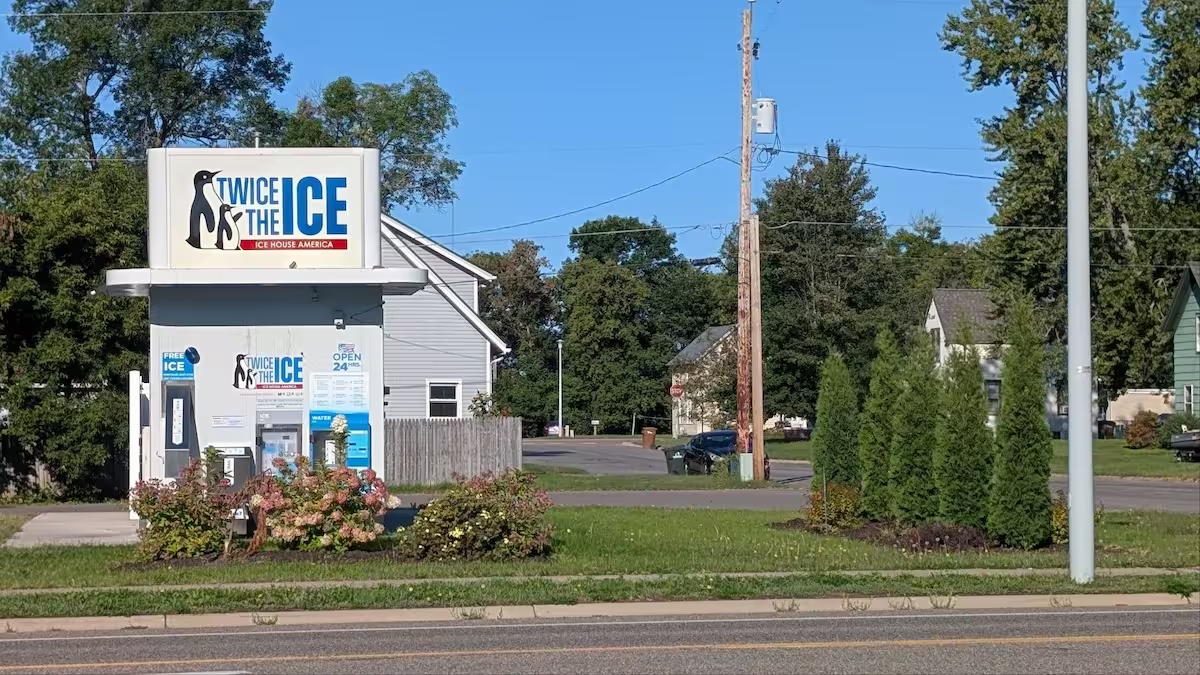
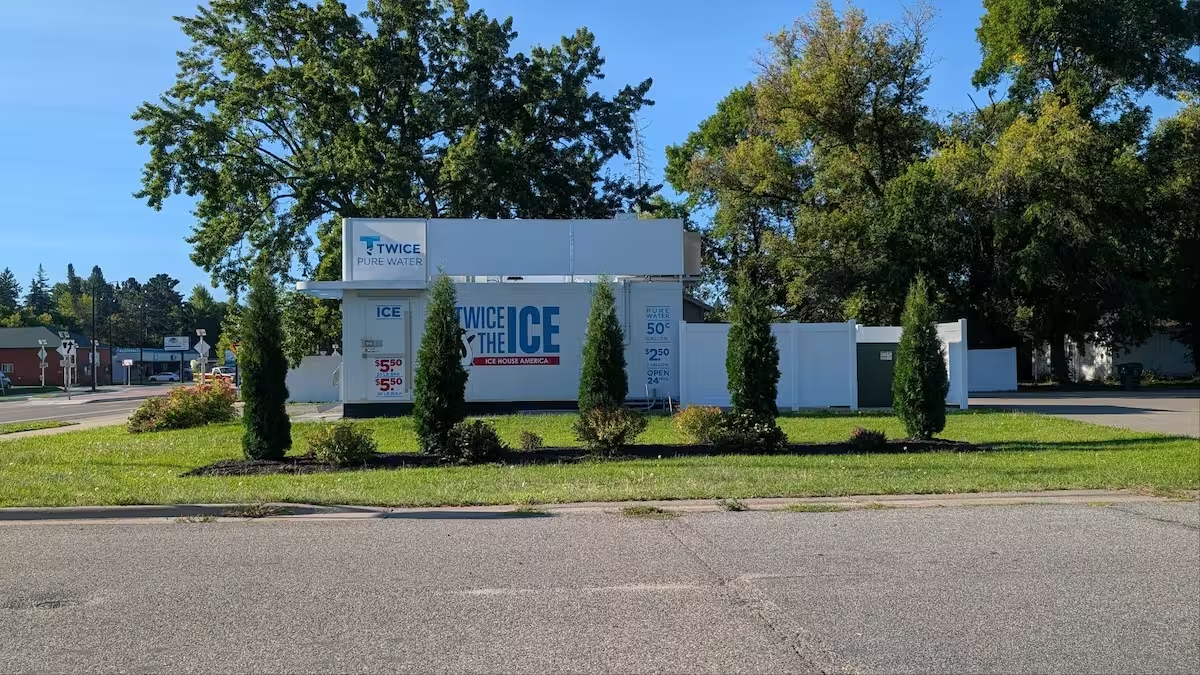
This is a familiar use of landscaping in the suburban development pattern. We arrange the site the way we want it, creating things we don’t particularly want to look at, and then ask the landscaping to cover them up. Jim Kunstler calls this a “nature band-aid.” I can think of no better way to describe it.
The nature band-aid is the dominant form of landscaping with auto-oriented development. It takes spaces that are wasted, empty, unpleasant to look at, or uncomfortable to walk by, and it uses a touch of greenery to make those spaces feel less bad. Not good. Just less bad.
Here’s the parking lot for the hospital near my house. It is either full of cars during the day or desolate and lit up like the DMZ at night, so nobody really wants to look at this. It’s also uncomfortable to walk next to. Thus, the nature band-aid, or what I described as suburban landscaping.
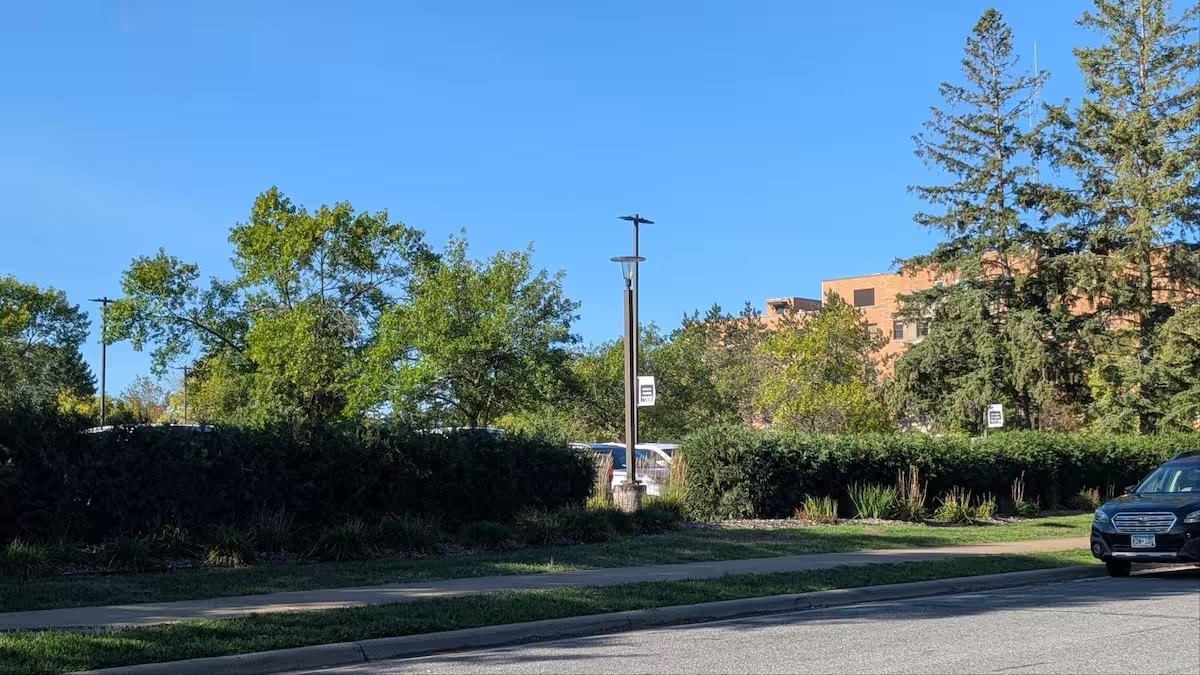
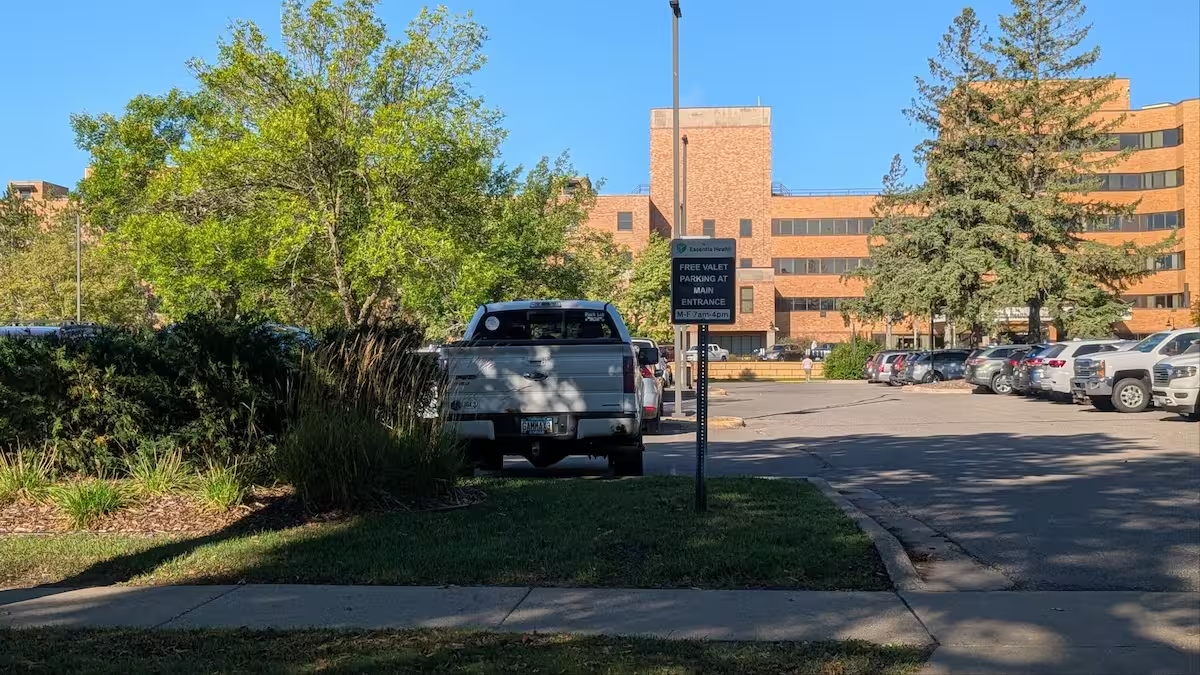
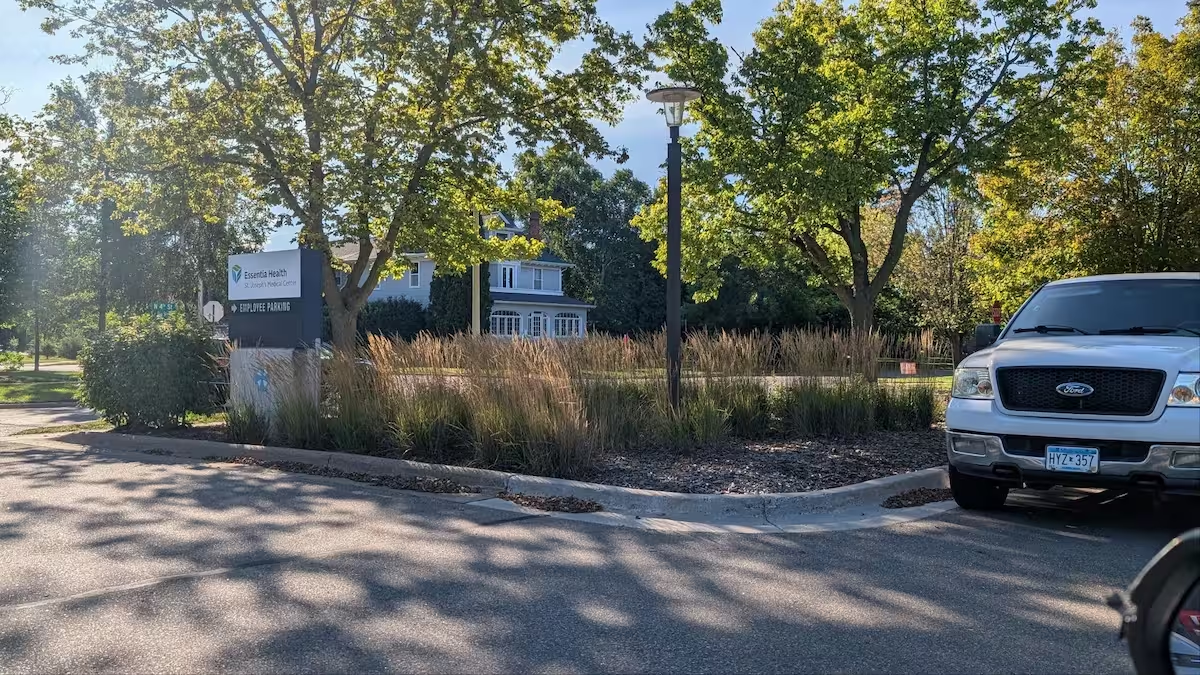
I’ll note that this landscaping is doing what it’s being asked to do. It is taking a really unpleasant space and making it slightly less unpleasant. Less bad. I’d rather have the nature band-aid than not, but I’d much prefer to not have the negative space. A parking lot lined with modest buildings — homes and maybe even some commercial space scaled to the neighborhood — would not only dramatically improve the tax base but help repair the surrounding neighborhood.
Another example from the neighborhood is the former Thrifty White pharmacy, which I argued for changes to, and then voted against, when I was on the city’s planning commission. I say “former” because the store is now closed and vacant. No surprise.
My main objection to the plan was the building placement. They proposed, and were given permission to, move the building back from the corner and then far enough back from the street to provide a drive-through. This is standard auto-oriented design: start with the building and transportation, and only then deal with the empty, negative space you created. The result is an awkward building surrounded by an abundance of parking.
The nature band-aid provided to the neighborhood for this bad design was some trees and shrubs. The trees have actually grown to the point that they’re probably dampening the unnecessary light being cast off, but the ground-level stuff isn’t much of a band-aid. It’s unpleasant to walk past, but there aren’t a lot of people doing that.
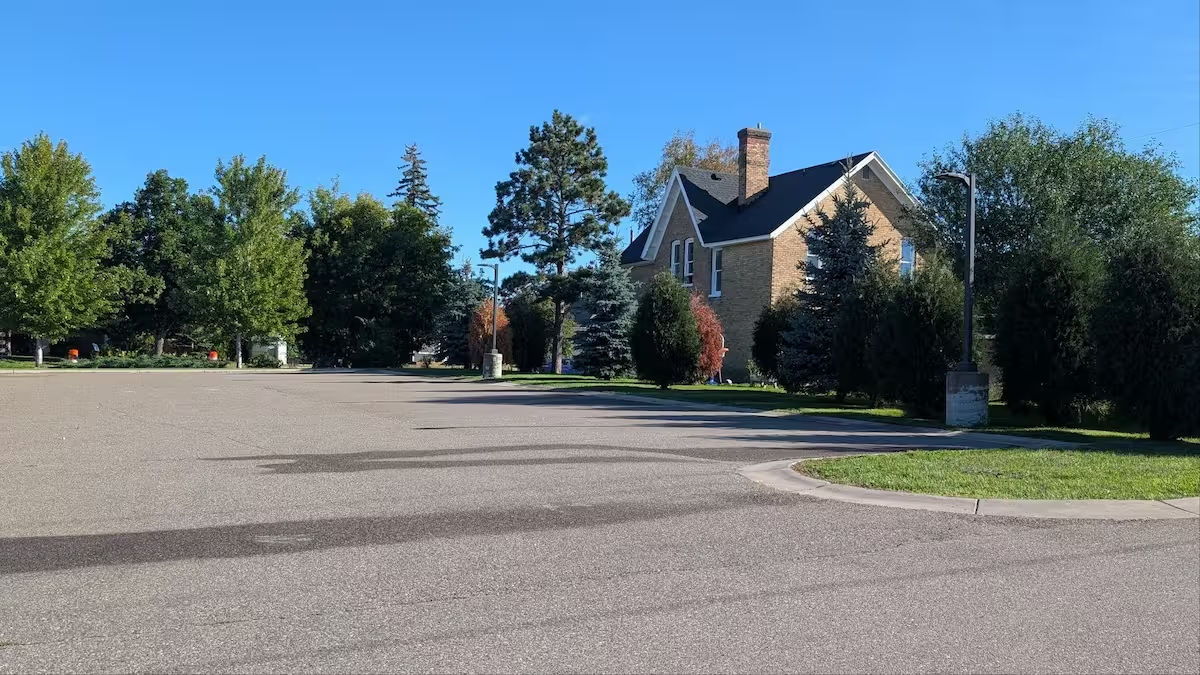
Here is that band-aid as viewed from the street.
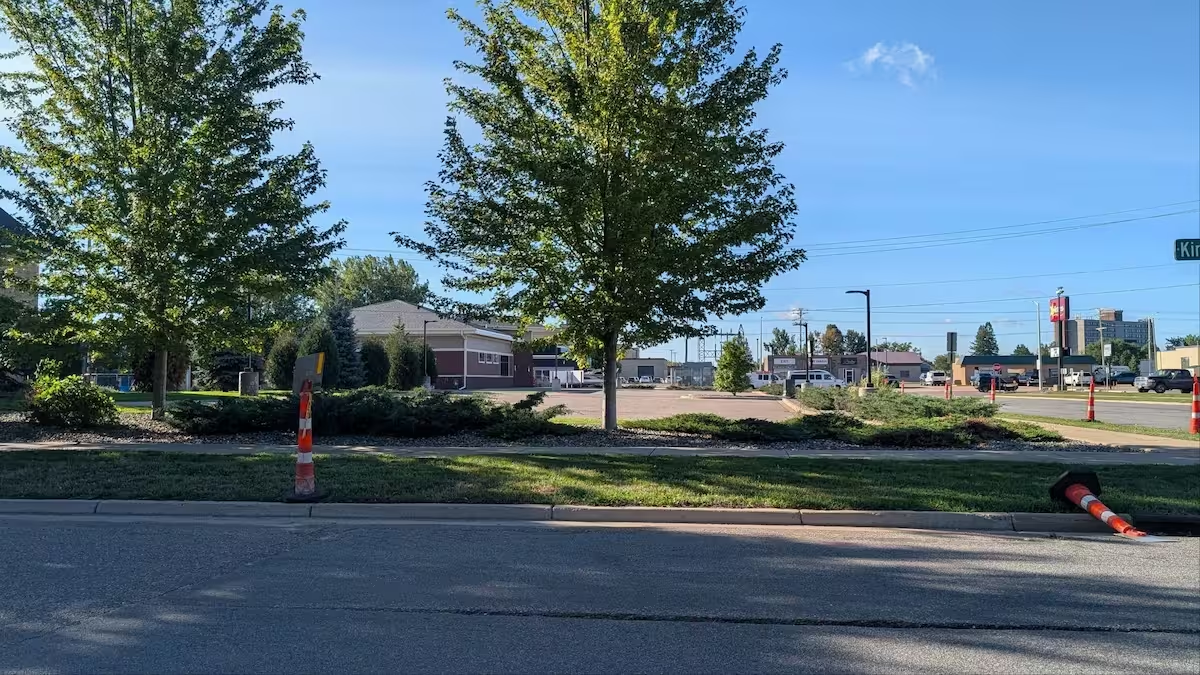
The school district did this as well, when they turned each neighborhood school into a “campus” design. I attended Lowell Elementary — as my mother did before me and my daughters did after. Throughout that entire time, it was a neighborhood school that addressed the surrounding properties the way a good urban school does, no screening or nature band-aid necessary. Nobody wanted one; the school was gorgeous.
The new design is…not so much. The architects moved the entrance to face a newly constructed parking lot, turning the school’s metaphorical back to the neighborhood. This was done — you guessed it — after considering the building and transportation priorities. A nature band-aid was applied to make it all look not-so-bad.
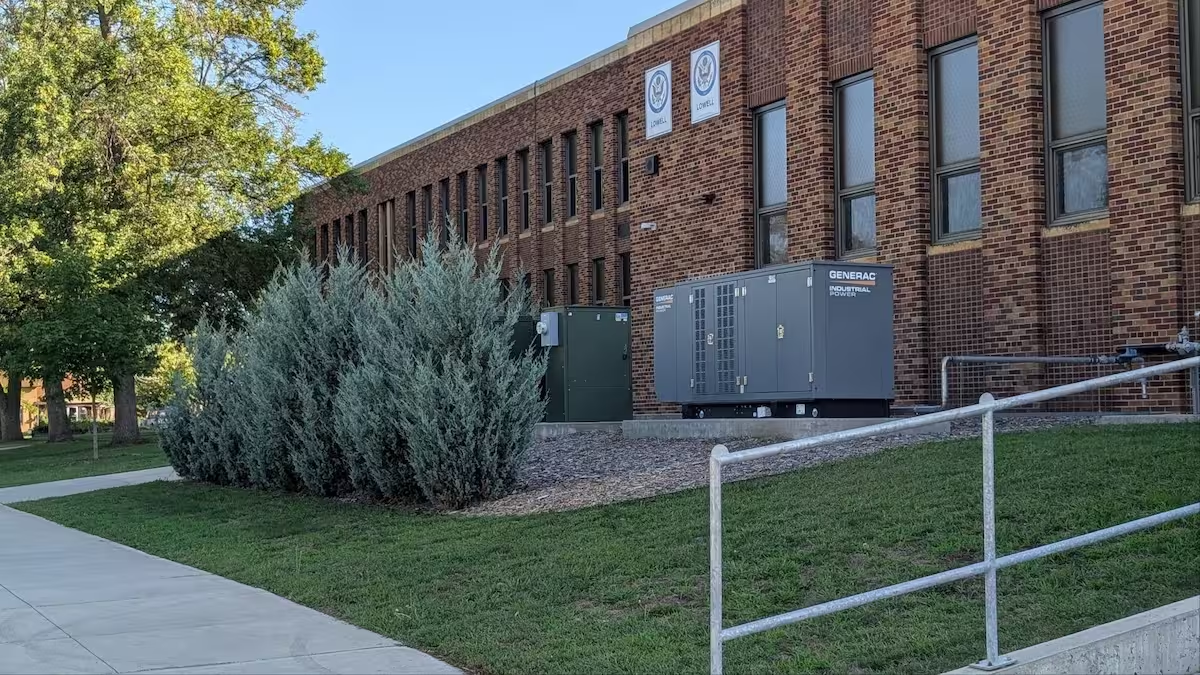
The homes next to the campus’s new parking lot and stormwater ditch got their own nature band-aid. It’s less bad than if there were no row of shrubs.
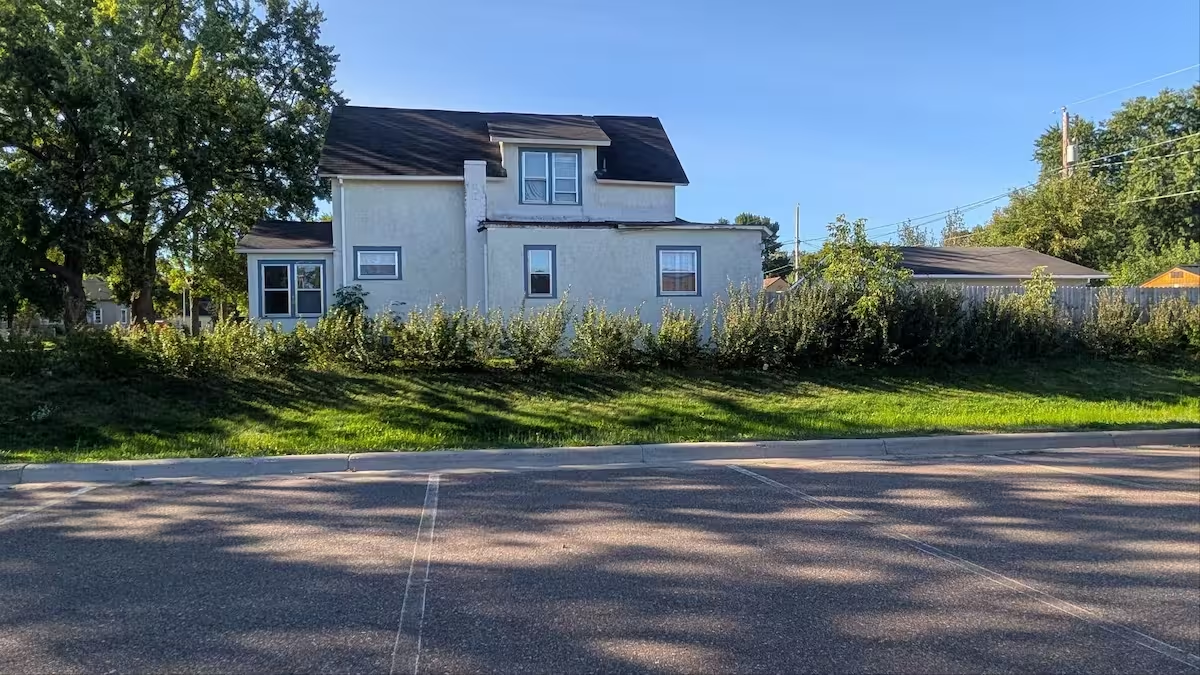
Most people are numb to this. It’s all around us, so it seems normal and sometimes even beautiful. It’s like our built environment is a terrible boss; a kind word every now and then feels noteworthy simply by contrast. When my wife points out the flowers, she’s pointing out something real. The flowers are nice. I just want us to expect more.
So, let me contrast all of these nature band-aids with great urban form. Where suburban site design is a function of transportation access and structure requirements, great urban development is about defining space.
Think of a traditional main street. The buildings are not objects scattered around the site. They line up along the sidewalk and, together with the buildings across the street, create an outdoor room. The buildings are the walls. The street and sidewalk are the floor. Everything works together to define the space that people occupy. Here we can see that in my downtown (this is a photo from February 2025).
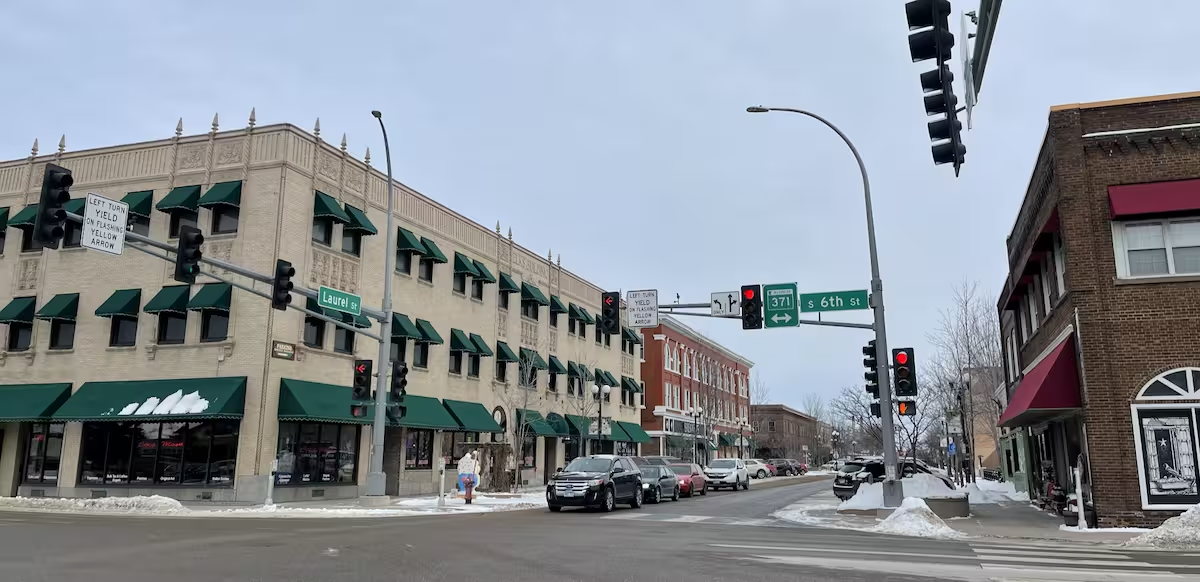
There is a lot of empty space in suburban development, but the problem isn’t merely that the space is empty. The problem is that nobody really designed the space. We designed the building. We designed the parking lot. We designed the drive-through and the stormwater system. The space left over is simply what remains. That's what I mean by negative space. Landscaping is then brought in to soften that leftover space.
In a traditional urban setting, the space itself is the thing being designed. Buildings define it, but so do walls, fences, trees, hedges, and other landscaping. Instead of being a band-aid applied after everything else has been decided, the landscaping becomes one of the tools used to create the space.
This next street is in Northeast Brainerd, right next to Lowell School. It used to have a streetcar running down it. The buildings line up to create that strong definition. The trees were then placed in the boulevard to again define the space in a very powerful way. This is one of the most beautiful streets in the city even though it's deeply neglected, an afterthought for people commuting to and from the school.
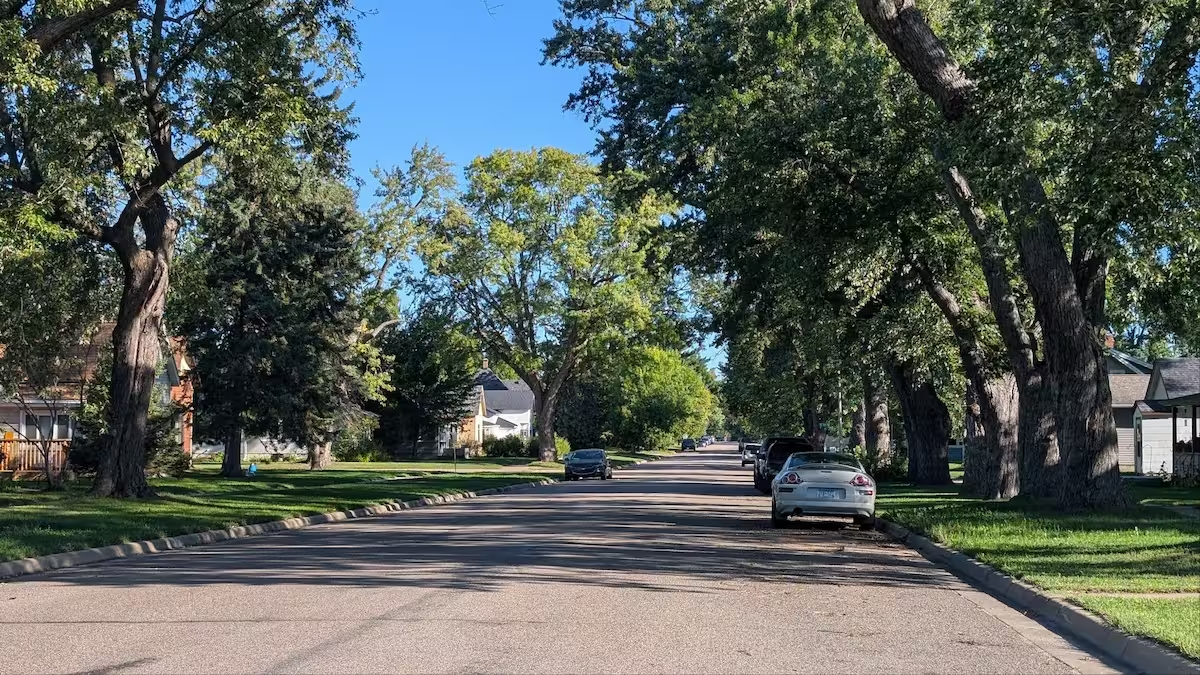
Notice how the buildings line up on one side and the mature trees define the space on the other side. This is a really comfortable street to walk down. It's a beautiful street to drive or bike on. With a little bit of TLC, this would be one of the most valuable streets in the entire city. And, yes, it is common to have some landscaping soften the foundations and the front of the houses — a nature band-aid, to be consistent — but it's not covering up empty, useless space. It's accentuating what has been built.
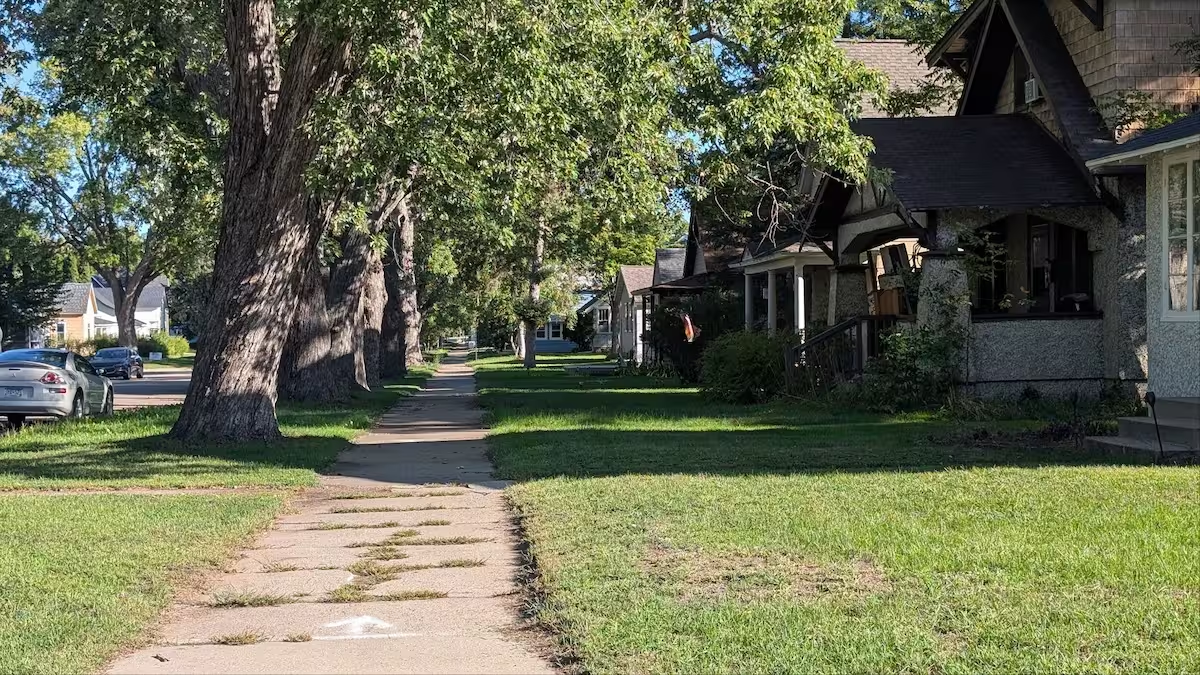
A block up the street from my church is St. Paul’s Episcopal, another church built at a time when good urban form was broadly understood — it was the way things were built — and we weren’t culturally numbed by nature band-aids. I love the way this church sits on the site and really defines this corner. It’s a strong building, honorable and respectful.
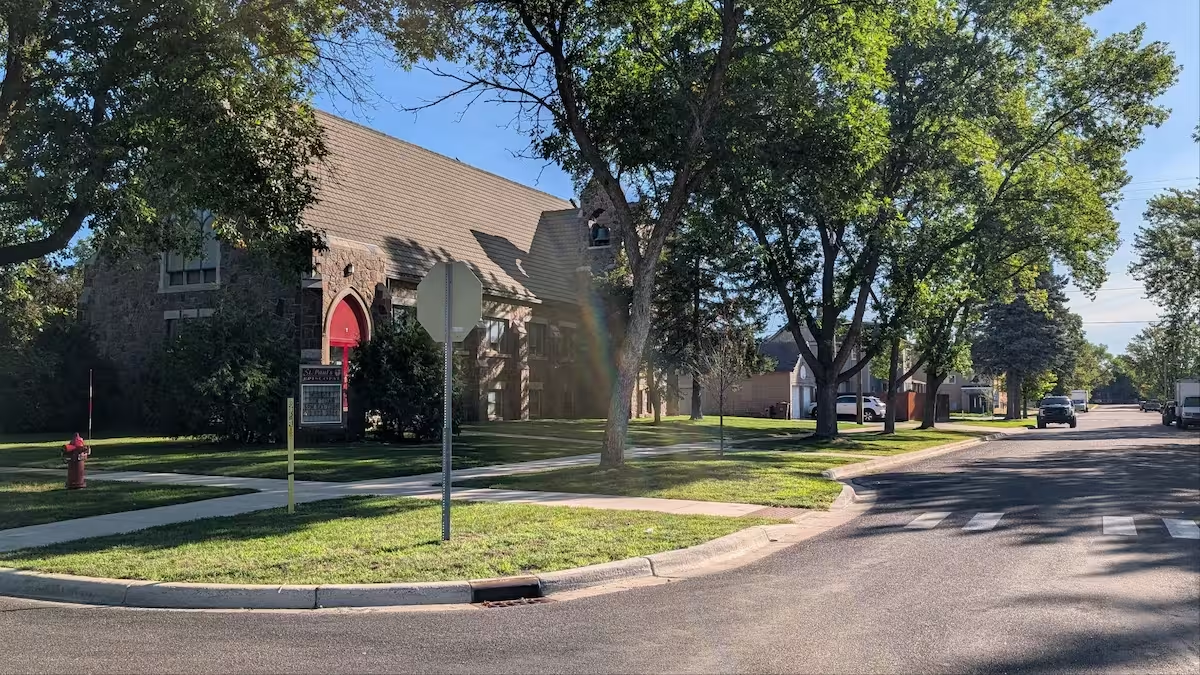
Now, to be fair, some things have slipped in over time that undermine St. Paul’s presence. The shrubs around the entrance have been allowed to grow a bit wild and now are starting to overwhelm the entrance, instead of accentuating it. The pine next to the bell tower is also unfortunate — it’s competing with the grandeur of the building. It should have been planted (or allowed to grow) in a different location, but today they could trim the bottom branches, open up the site, and give that architectural highlight less competition. Even so, these are largely maintenance issues. Nobody is trying to cover anything up here. And they shouldn’t be. This is one of the neighborhood’s great buildings.
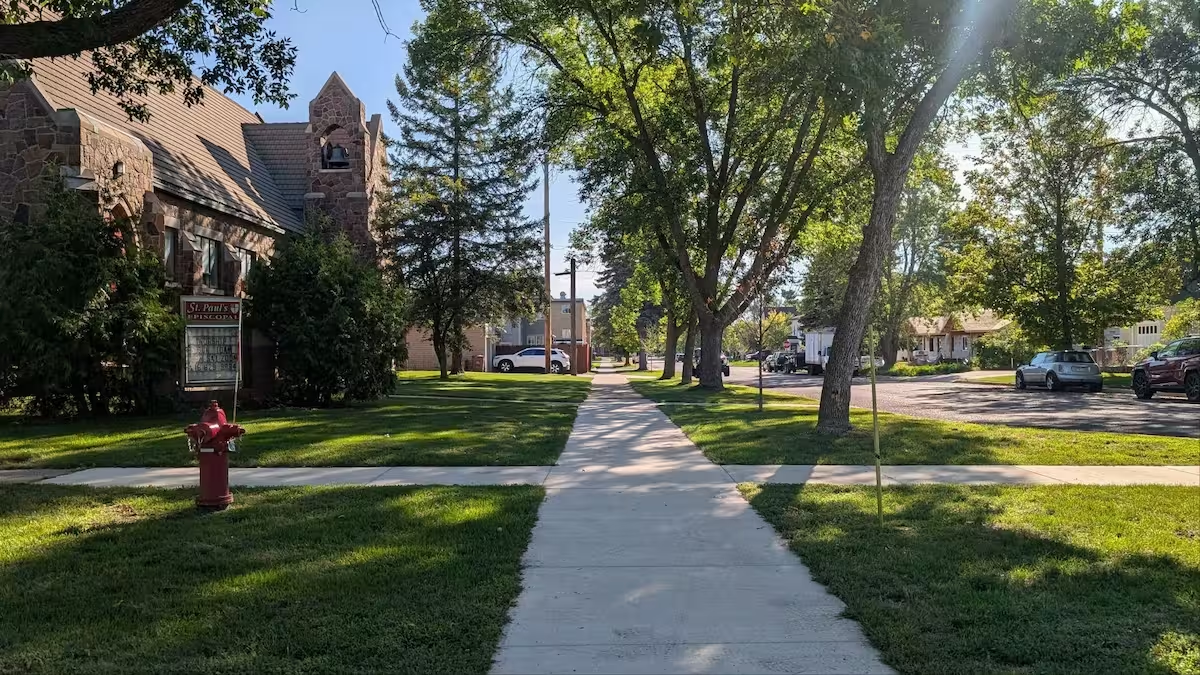
This sidewalk is part of my commute, and it’s also part of our evening dog walking route. After walking past this church, we get to mine — St. Francis — and this is where my wife has started to note, and gently push back on, my crankiness. She’s not wrong. Let me explain.
Here’s a row of trees that was generously donated to the parish. I was told that whoever planted them consulted the city and was given the guidance that the trees shouldn’t be placed between the sidewalk and the street (framing) but instead between the sidewalk and the building (screening). Today they are young plantings. If they had been placed 20 feet to the west, in the boulevard, they would tie this stretch of street together, accentuate the building, and provide very comforting space to anyone walking down this street. Instead, they will grow to hide the school and add to the raceway feel that is North Eighth Street.
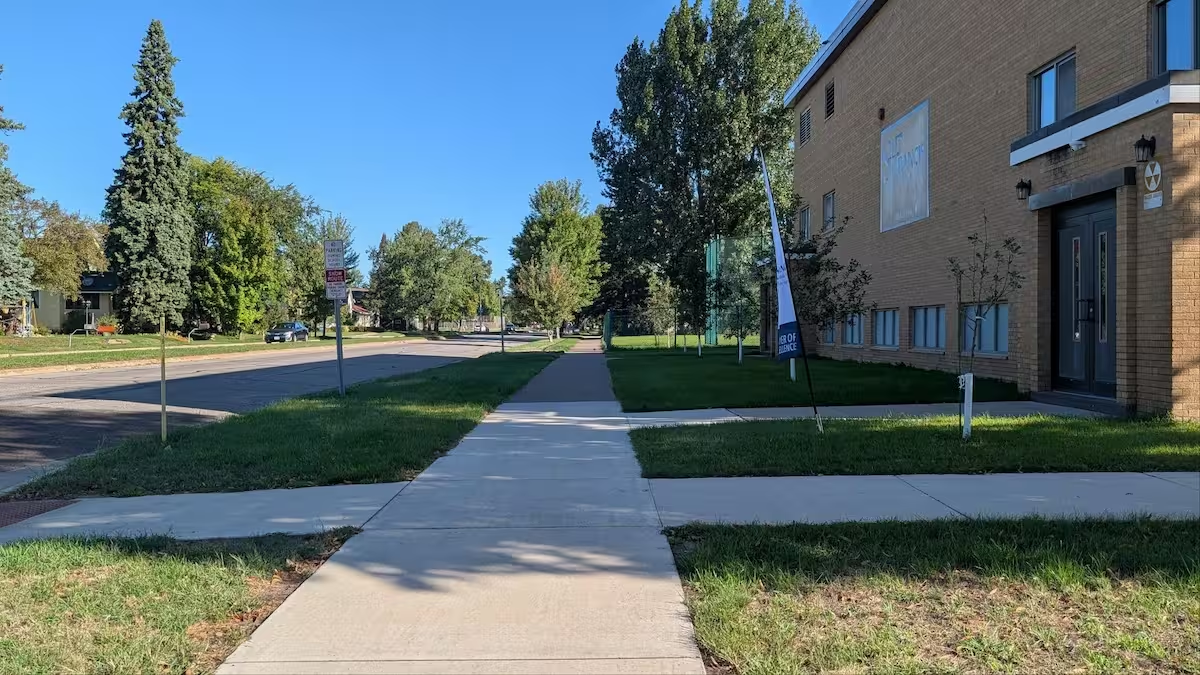
Most of my fellow parishioners look at this and see “wow, pretty tree” because most of our parishioners live in environments where this kind of nature band-aid is a welcome reprieve from the vast empty and undefined space they regularly navigate through. I’m not one of those parishioners. I live near the church, in what used to be an urban neighborhood, one that is slowly losing its form and suburbanizing.
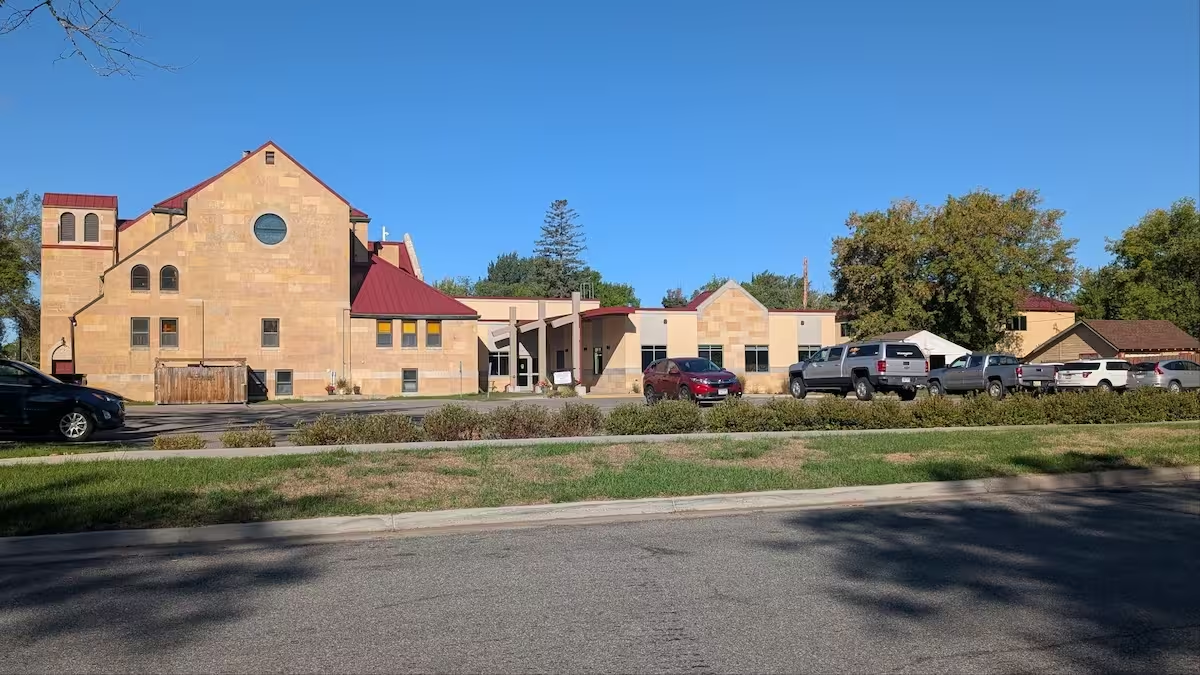
That pattern is even more pronounced around the church itself. Our “campus” planning incorporates the suburban design ethic, so we start with buildings and traffic management, including parking. We are, in the strictest sense, denuding the neighborhood and creating our own empty and undefined space. Note the nature band-aid.
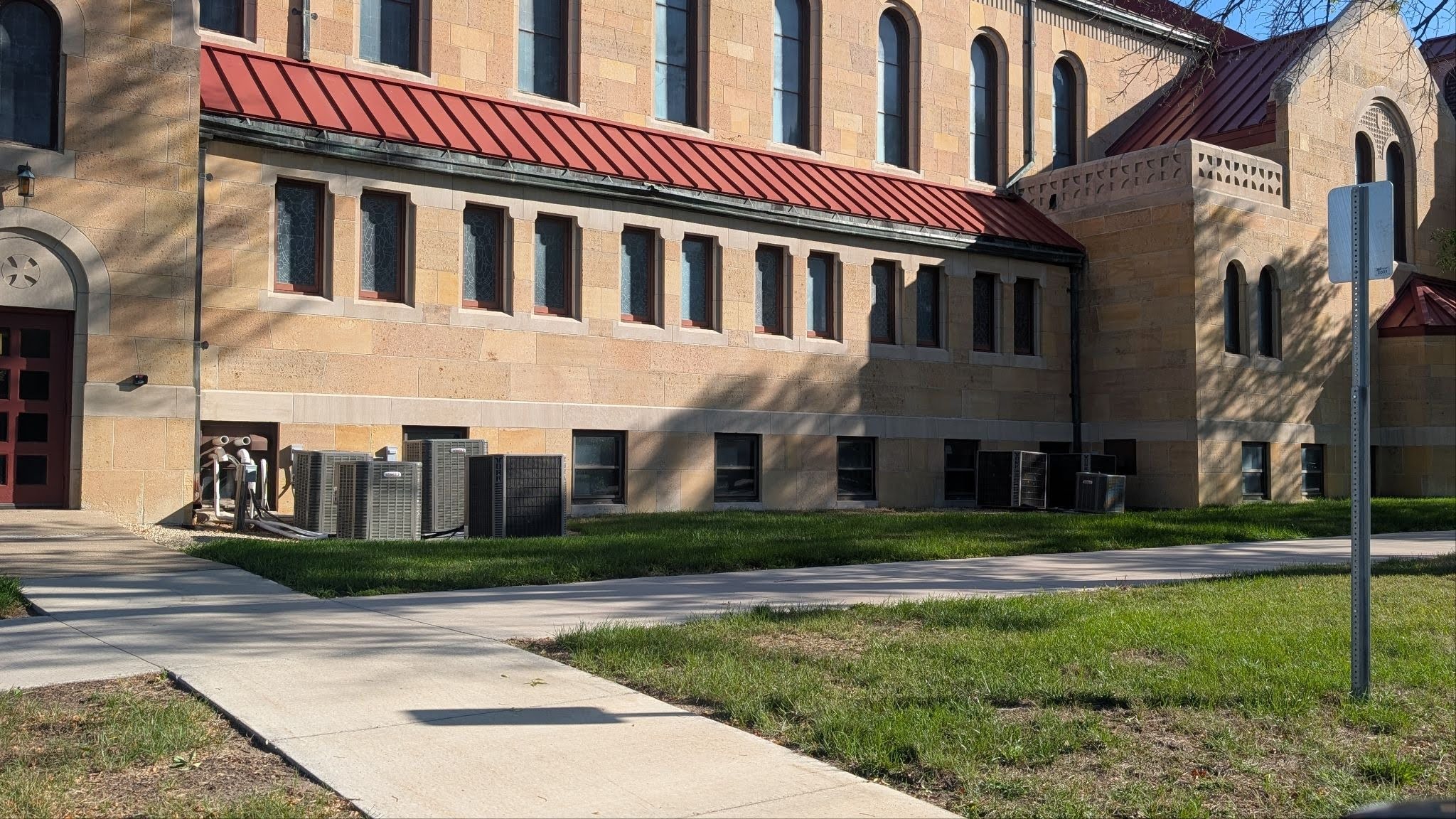
And these small insults — like air conditioning units strewn about without any sense of the space — demonstrate the apathy. People walk past this, but nobody sees it. Like the space between our parked car and the Costco entrance, it’s an environment we’ve grown numb to.
So, are the flowers at the base of the new sign pleasant? Yes, which was the point my wife was making. I should have acknowledged it and agreed with her. They add a bit of a nature band-aid. At least someone cares enough to do that.
The thing I am frustrated about, the thing that prevented me from being generous with my wife, is that I don’t think we should be covering up anything. We are applying a band-aid to self-inflicted wounds. We were bequeathed the most beautiful church building in the entire area. We should be accentuating it. Celebrating it.
Ignore for a moment the addition we did to the left side of the building and the snarl of railings we felt compelled to build there. Just focus on the main entrance. This is a work of art, especially for a small town in the north woods of Minnesota.
There is a cross at the top, silhouetting the sky. Underneath that is a statue of St. Francis recessed into the building. Below that is a recessed area surrounding a gorgeous stained glass window. And below that is a scene sculpted into the little space above the door. All of it provides symmetrical, powerful lines pointing the way to where we gather. Now, that’s an entrance!
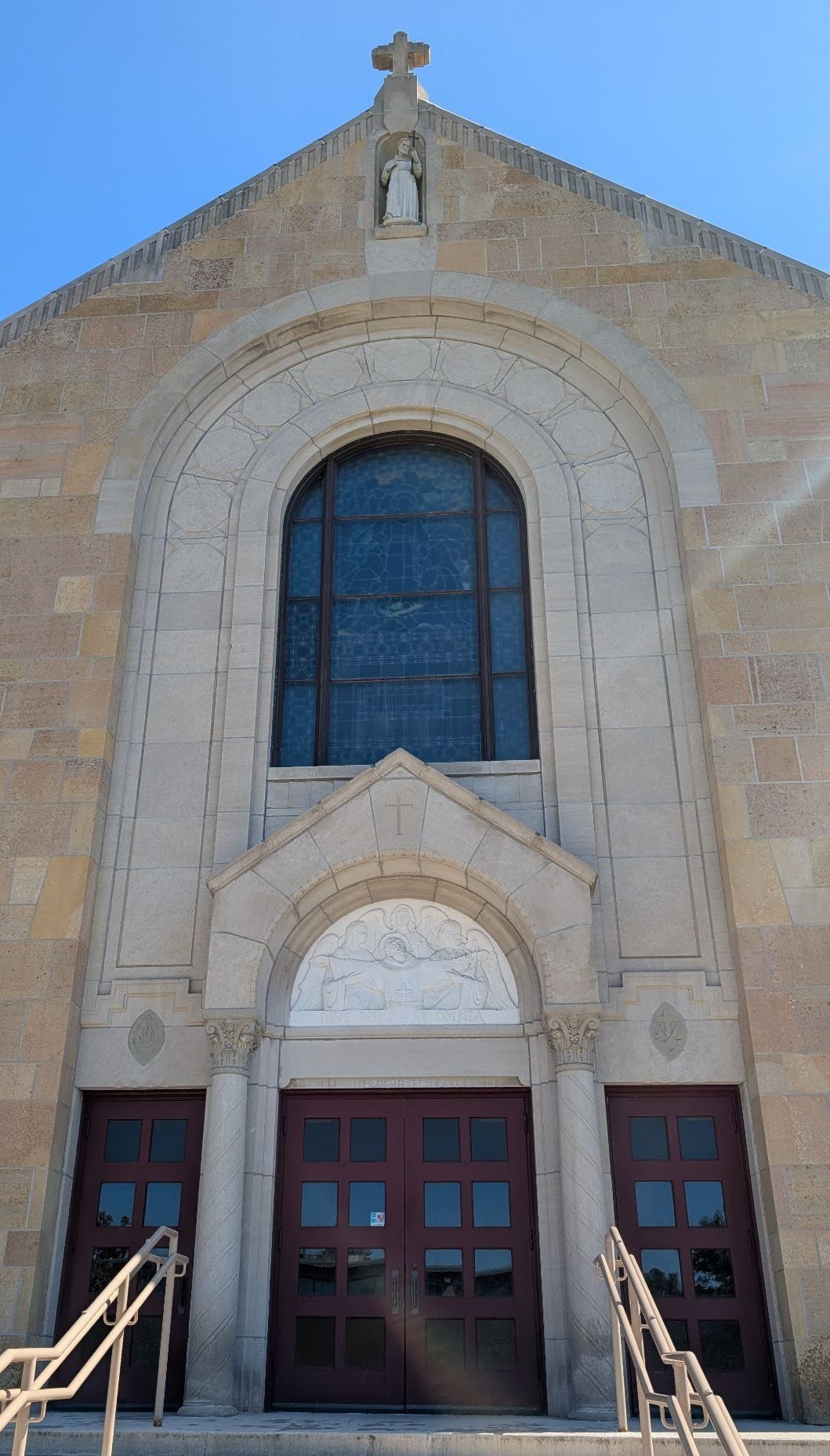
Nothing about this entrance needs to be screened or softened. It doesn't need a nature band-aid. Everything about it is trying to draw your attention toward it. If I were going to accentuate something — if I were going to literally shine a light on something to tell the world what we are about — I would shine it on that entrance. That’s what my ancestors who built this church did, but they lived in the neighborhood and were culturally sensitive to good urban form (because they lived in it). Instead, we are accentuating the new sign, another suburban artifact imported into our new campus, but now with a nature band-aid.
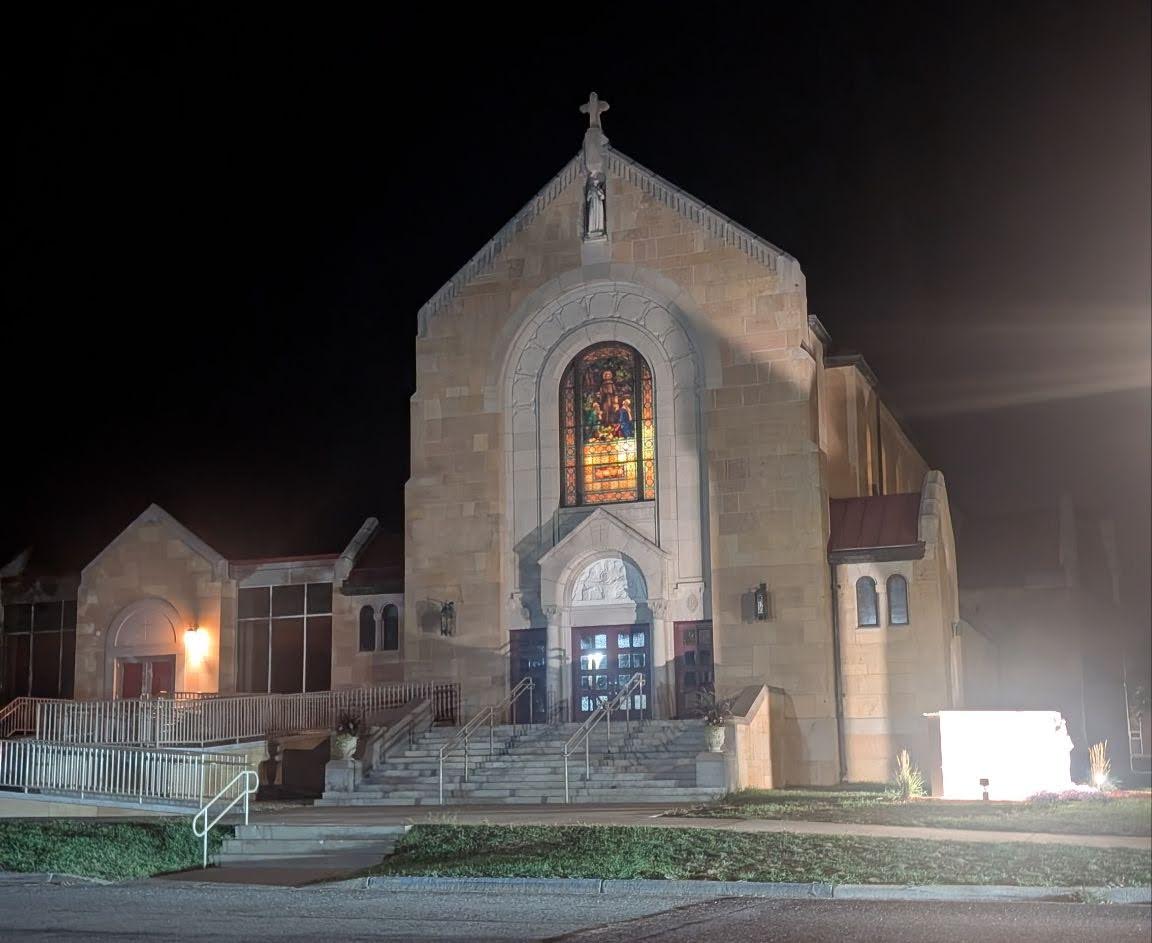
I took this photo on a recent night when I was out for a walk. Someone had forgotten to shut off the light inside, so Gryffindor and I were treated to a rare view of the stained glass lit up. I was listening to a podcast where a Minnesotan I know was interviewing my friend, Sam Quinones. It was a nice interview, so I stopped here, took the photo, and sent it to Sam along with my congratulations.
There are days when I walk through my neighborhood and feel like I’m watching a language slowly disappear. There are still people who speak it, and there are beautiful examples of it all around me. But fewer and fewer of the things we build seem to be written in that language.
It’s a language that says this building matters. This street matters. The experience of people walking here matters. It uses buildings and trees and sidewalks and gardens to create places that feel soothing, comfortable and dignified — in a word: human — not to cover up the places where we failed to do so.
It doesn’t take much to speak this language. A row of trees planted in the right place can define a street. A building can frame a sidewalk. A light left on inside a church can illuminate a stained-glass window and completely change the experience of walking past it. These are simple things, but together they can make our world profoundly more beautiful.
I want us to remember how to speak that language, especially in places where our hearts and souls need to be open to experiences beyond our own routines. Not every place needs to inspire us, but surely the design of a church site should aspire to something more than the design of a Costco.
And when my wife points out some nice flowers, I want to be generous enough to acknowledge that they are nice. She was right. I just don’t want the flowers to be the extent of what we know how to say.
Charles Marohn (known as “Chuck” to friends and colleagues) is the founder and president of Strong Towns and the bestselling author of “Escaping the Housing Trap: The Strong Towns Response to the Housing Crisis.” With decades of experience as a land use planner and civil engineer, Marohn is on a mission to help cities and towns become stronger and more prosperous. He spreads the Strong Towns message through in-person presentations, the Strong Towns Podcast, and his books and articles. In recognition of his efforts and impact, Planetizen named him one of the 15 Most Influential Urbanists of all time in 2017 and 2023.
%20(1).avif)
.avif)
%20(1).avif)