Everything Is a Safety Improvement

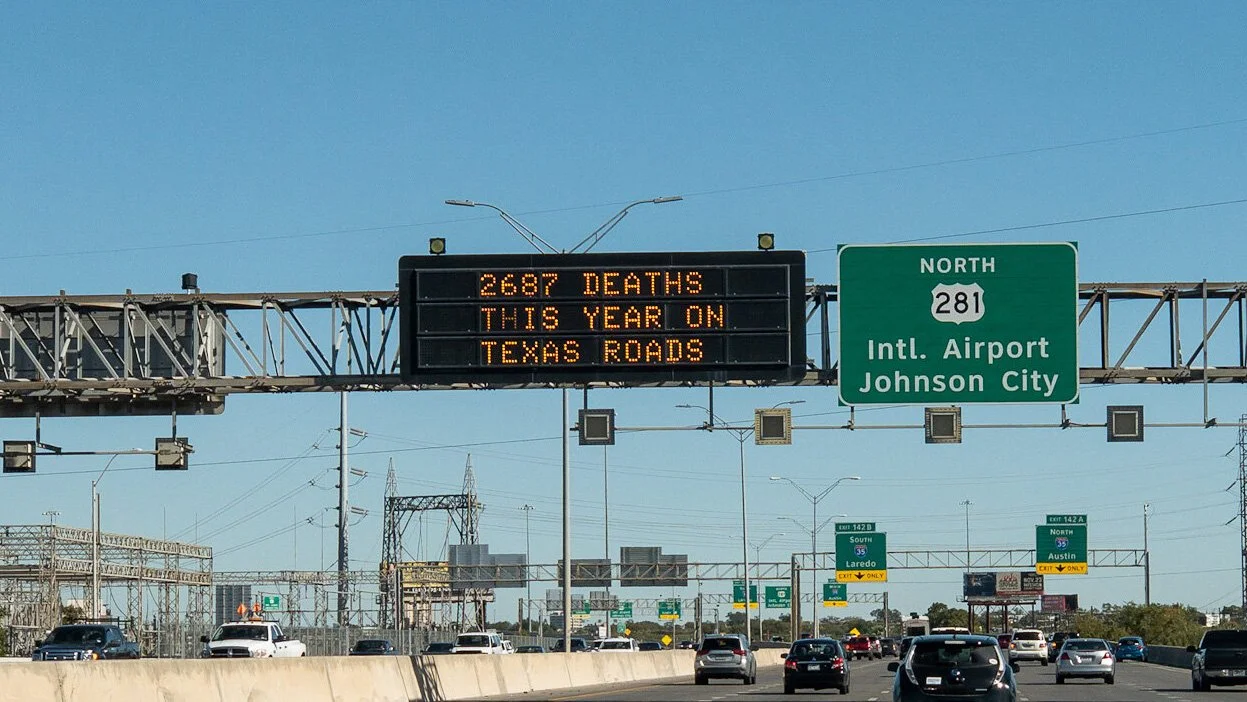
%20(1).avif)
%20(1).avif)
%20(1).avif)
%20(1).avif)
In the opening chapter of Confessions of a Recovering Engineer, Chuck Marohn illustrates a painfully circular conversation between his younger self and a resident impacted by the infrastructure project he’s advancing. Of the many insights that can be gleaned from that chapter is the apparent dissonance between how “safety” is defined by transportation professionals and the general public. For the former, safety standards may look like wide roads complete with shoulders, clear zones, and other features that serve to forgive driver error, even when traveling at high speed. For the latter, these features spell out a space for cars and not for people walking, riding bikes, or giggling in a stroller. Those standards may in some instances create a marginally safer environment for drivers, but introduce a whole new set of lethal hazards for pedestrians, cyclists, and other road users.
When it comes to infrastructure projects, our discourse around safety is generally dominated by the definitions of transportation professionals. Recently, Kevin DeGood noticed how the Minnesota Department of Transportation (MnDOT) appropriated the language of safety to advance the priorities of speed and capacity on a planned expansion of US-14 and bypass of the town of Courtland.
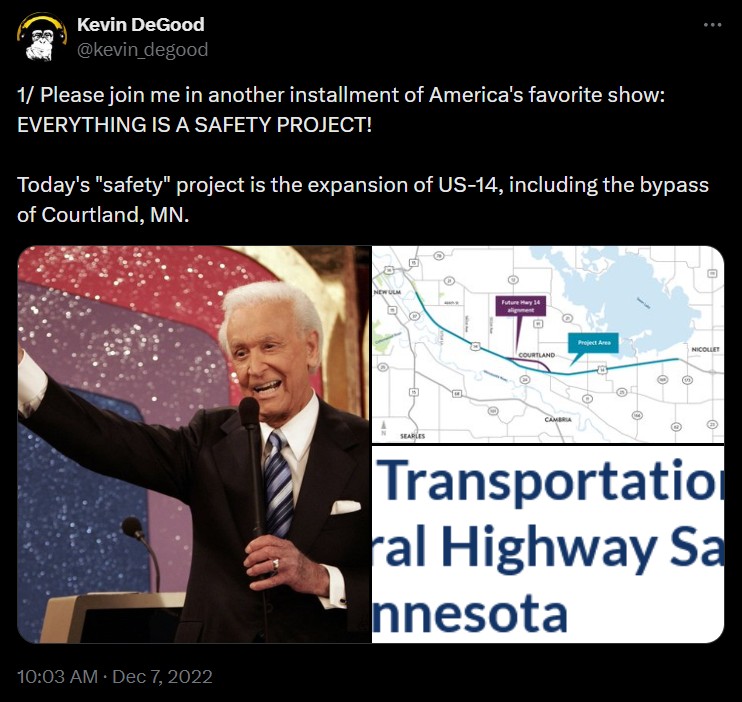
In the Environmental Impact Statement (EIS)—a mandatory assessment that outlines the impact of a proposed project on its surrounding environment—the word “safety” was used 121 times.
In light of such an explicit commitment to safety, DeGood points out the irony of US-14 accommodating a design speed of 70 mph. Higher speeds increase not only the potential for collision, but also the severity of any resulting injuries.
At the same time, MnDOT explicitly identifies a speed limit of 35 mph on a residential stretch of US-14 as a key reason the corridor operates below the agency’s “average speed performance target.”
As DeGood observes, the agency’s priorities appear to be synonymizing safety with speed. He suggests, “if safety were the central concern, you could add traffic calming and complete streets features in Courtland for a *fraction* of this price.”
When DeGood says, “Everything is a safety project!” at the outset of this thread, it’s reminiscent of how frequently engineers use the word “improvement” in infrastructure projects. Similar words, including “enhancement,” “upgrade,” “sustainability,” and “safety” can obfuscate the less exciting and more disruptive reality that these projects entail. For example, “enhancement of the clear zone” doesn’t communicate that dozens of trees will be removed to further forgive driver speeds. These descriptors also artificially assign a positive value, rather than a neutral one, to these projects. Who’s opposed to “improvement”?
At best, this decorative language fails to be informative and at worst, it’s dishonest. A more accurate, honest, and neutral presentation of a proposed project will allow the communities impacted to judge for themselves whether it is an improvement.
Asia (pronounced “ah-sha”) Mieleszko’s career defies easy categorization—from researching Ukrainian folk traditions to covering infrastructure policy, from performing on the world’s biggest stages to the most cramped basements. At heart, she’s a storyteller, driven by curiosity about how people and places become what they are.
While at Strong Towns, Asia paired analytical rigor with empathy to examine the forces shaping our built environment. As host of Stacked Against Us, she guided listeners through the labyrinth of housing, finance, and local governance, revealing both the systems constraining communities and the openings for meaningful action.
Off the clock, Asia can be found behind a camera, playing the accordion, or riding the rails across the country, always curious about the places and people along the way.