Large Redevelopment Projects Aren't The Answer
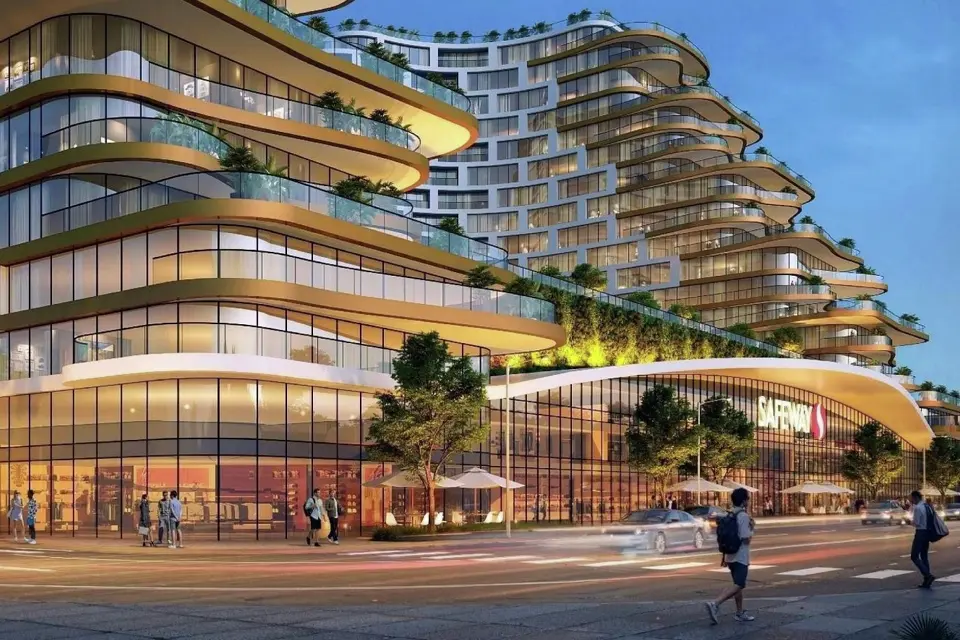
San Francisco's Marina District is contested ground for a large-scale redevelopment project that is slated to provide hundreds of housing units and a supermarket. (Image credit: Arquitectonica.)
I’ve recently seen a lot of chatter about a proposed Safeway redevelopment in the Marina district of San Francisco, including Dave Deek’s December article summarizing the messy (and perhaps hypocritical) politics involved: San Francisco's Marina Could Get 790 Homes. Mayor Daniel Lurie Says No. YIMBYs Say Yes.
I don’t live in San Francisco anymore, and I’m not writing to opine on the particular project. Rather, I want to share a few thoughts on this kind of project. Specifically, I think that large projects with shiny renderings tend to draw a disproportionate amount of pro-housing advocates attention. While projects like this will be part of the housing solution, I don’t think they’re the answer to our housing problems, and I don’t think we should overly focus on them.
Why do I say that?
First, large redevelopment projects will always be relatively few in number.
- These projects require enormous skill and capital to execute. There aren’t that many developers with the access to capital or the skill to deploy many projects like this. I’m skeptical that there are even 100 development companies that could execute this kind of project.
- Even if I’m wrong about how many developers are capable of delivering projects on this scale, there’s a finite number of sites that are viable for this kind of project. The Safeway in the Marina is uniquely under-developed relative to its location near the heart of America’s second most important city center, already surrounded by dense, mixed-use development. There’s no shortage of under-developed land, but most of it could not redevelop anywhere at anywhere near the level of the Marina site.
- Opportunity sites tend to be clustered, and, ironically, when one site experiences a massive leap in development intensity it can stall the local market, and make the nearby opportunity sites harder to redevelop rather than easier.
Second, large redevelopment projects like this are uniquely political.
- Because they are large, they’re extremely visible, and because they will always be relatively few in number, it’s easy for opponents to organize against them.
- It’s also much easier to make people upset about something concrete — “this tower will block your view of the bay!” — than it is to rally against something abstract like single-stair reform.
Third, I’m skeptical that large projects like this could actually scale to meet the housing need in supply-constrained cities, even if they were politically easy to get approved and built.
- No single project (of any scale) provides enough units to matter. Let’s assume, optimistically, the Marina project will make it through from concept to completion in 5 years. That means its delivering 158 units per year, which is great! But it’s nowhere near enough to meet San Francisco’s housing needs on its own.
- As mentioned previously, there are a limited number of redevelopment sites that can even support large-scale projects like this.
- Even we assume there were 100 capable firms executing these projects in parallel, and that they’d never run out of viable sites, that would net 15,800 units per year. That would be great! But, for context, it’s still less than the 20k + ADUs California has been adding annually.
Now, I’m not trying to argue that projects like this are good or bad, or that we should or should not do them. In the context of San Francisco, the Marina project makes sense to me, I think it should go forward. But I often run into pro-housing advocates who, I think, are overly focused on bulldozing the political obstacles in front of large-scale projects because they think that large-scale projects are the answer, singular. And I think that misunderstands the reality on the ground.
As a case in point, I’ve heard housing advocates characterize California’s ADU program as a modest “take what you can get” reform, even though ADUs are probably already adding more units per year than we could achieve via large-scale apartment projects. That’s an error in thinking.
Housing markets are not made of a few local projects, they’re made of regional aggregates. Even in smaller cities there are tens of thousands of lots, the biggest cities contain millions of parcels. Reforms that apply to millions of parcels are going to unlock more housing than reforms that only apply to hundreds of parcels.
Consider this napkin sketch to illustrate the point:
If we take the zip code 94116 as representative of the Outer Sunset, it contains 16,139 housing units in 2.53 square miles, or 6,379 units per square mile. The Outer Sunset is often criticized as an area that has resisted new housing units and needs to develop further—I agree with that. But there are several hundred zip codes in the Bay Area, and very few of them are near this level of development.
To take one example, let’s look at 94061, in Redwood City. The zip code is currently 54% as dense as the Outer Sunset; 14,006 housing units over 3.86 square miles, or 3,628 units per square mile. The area has some sites that could redevelop into apartment buildings, but the majority of lots are single family homes. The biggest opportunity is to open up new housing options for all those existing homeowners. That means allowing a family to build a backyard cottage for their aging parents to move into, a retiree to convert their basement into an accessory apartment for some extra cash flow, or a local builder to convert a run down house into a duplex or triplex.
If those options were allowed by right, this part of Redwood City could mature to the level of the Outer Sunset; still predominately single family residential, but up from 14,006 homes to 24,623, an increase of 10,617 homes.
There are 323 zip codes in the broader Bay Area, although some of these are quite far from the city, and some contain mostly mountainous terrain. If we passed reform that that permitted ten thousand new homes in half of these, it would unlock 1.6 million new homes.
This is why the Strong Towns Housing Ready Toolkit focuses on reform that can unlock incremental infill and evolution across entire regions, not just ideally located grocery stores.
I think my thoughtful YIMBY friends already know this—they’re pragmatic folks. But I don’t know if the median YIMBY is as excited about the power of incrementalism as they should be. Incremental housing is no half-loaf; the most scalable reforms are the ones that open up responsive housing supply within the neighborhoods that constitute the vast majority of our developed land today.
[[divider]]
This article was originally published, in slightly different form, on Andrew Burleson's Free Range City. It is shared here with permission.
Andrew Burleson has served as Chairman of the Board for Strong Towns since 2014. Andrew’s professional work has spanned several fields, from newspaper publishing and urban planning to real estate and financial technology. Before Strong Towns, Andrew founded the Houston chapter of the Congress for the New Urbanism in 2009, and he met Chuck Marohn through CNU. Andrew has been a key advocate for Strong Towns’ evolution from an engineering-centric blog to a broader, movement-building organization. Andrew lives in Denver, Colorado, with his wife and four children.
%20(1).avif)
%20(1).avif)
%20(1).avif)
%20(1).avif)