
Hello,
It's Member Week at Strong Towns and we're asking you to help support this movement. We'll be direct: Strong Towns is a nonprofit organization that depends on donations from generous readers like you in order to continue the work we're doing. That includes bringing you articles like the one you're about to read! We're a small team, and we're only able to do what we do with your help. Please consider donating whatever amount is meaningful for you. Thank you so much, and keep doing what you can to build a Strong Town.

A Pro-City Agenda for State Government

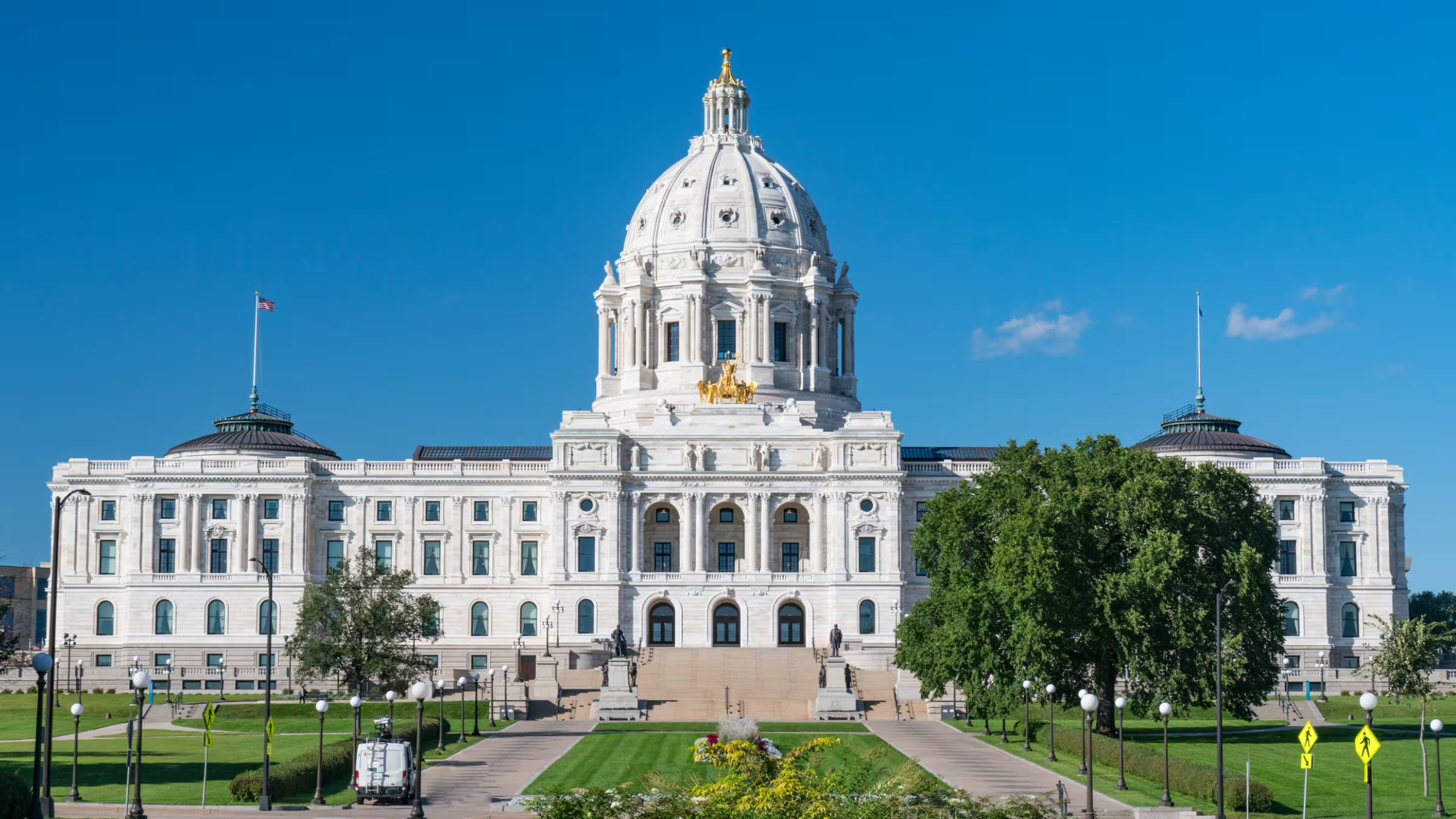
The Minnesota State Capitol. (Source: Paul Brady)
Last week, I had the opportunity to spend a couple of hours with some of my state’s legislators and legislative staff, along with people most of us would identify as lobbyists (although, in fairness, most of them were advocating for causes rather than advancing a client’s direct financial interest). It was a good reminder of what it’s like to be at a state capitol trying to make decisions that improve people’s lives within a system that has priorities of its own.
I don’t spend much of my time working at the state level (or even thinking about it) beyond wishing states would stop making the job of transforming our cities into Strong Towns so much harder. Much of what needs to happen to make our cities financially strong and resilient, and to improve the lives and prosperity of Americans, requires action at the block level. This is work that state and federal governments are not set up to do well.
Paint a crosswalk. Repair a broken sidewalk. Plant some trees. Slow traffic on a neighborhood street. Tighten up an intersection. Let someone open a corner store. Put a small home on a vacant lot. Allow backyard cottages and duplex conversions by right. Bring an empty storefront back into use. Maintain your existing infrastructure before you expand it.
When state and federal governments try to help with these things, they often make them worse. Walking and biking investments are appended to highway projects that do more damage than those investments can repair. Economic development money gets funneled through programs like Corridors of Commerce that do more to subsidize corporations than to help local businesses. State housing legislation preempts local agency, providing more directives than support, often in ways that make outward expansion easier than maturing existing neighborhoods. All of this comes on top of myriad programs and subsidies that support the outward expansion of cities and metropolitan areas in nearly every form.
Building a financially strong and resilient city is hard. It becomes especially difficult when your partners share in the immediate gain but not in the long-term pain. State and federal governments can provide money or impose a mandate, but the city and the people who live there must manage the consequences. It is easy to align around the next budget cycle. Balancing the long-term tradeoffs is far more difficult.
One legislator asked what is probably the question I am asked most often: What city is doing this right? In other words, whose program can we copy, paste, and replicate at scale? I understand the instinct — if you’re a legislator, you need to legislate — so I tried not to sound bored by the question, even though I am. I’ve been getting some version of it for two decades, and my answer has not changed:
Minnesota is a large and varied state. Tell me what a small town on the Iron Range has in common with Minneapolis, what a farm town on the western prairie has in common with Duluth, and what a tourist area like Brainerd has in common with a medical hub like Rochester, and then I can tell you which city’s program everyone else should copy. We can learn from what others are doing — we need to learn from what others are doing — but each city is complex and unique. We can’t simply copy a program from one to another. In fact, that standardization instinct is what got us into trouble, in the first place.
But legislators need to legislate. So what does a pro-city agenda look like at the state capitol? I’m going to offer four things that are front of mind after those conversations.
First, Do No Harm
The first thing state government can do is stop making the work of local government harder. Before creating another program, issuing another mandate, or appropriating another dollar, legislators should ask a simple question: Will this make it easier or harder for a city to become financially strong and resilient?
For example, I have been writing for more than a year about the proposed Buttonhook interchange in Baxter. Through its Corridors of Commerce program, Minnesota has committed $58 million to build an interchange serving 86 acres of low-productivity gas stations, strip malls, and big-box stores with a combined property value of just $40.8 million. In contrast, the neighboring Washington Street corridor in Brainerd has been undermined by decades of state transportation policy (which is ongoing with a project to remove parking and restrict turning movements in progress), yet it remains nearly twice as productive on a per-acre basis.
The state calls the Buttonhook economic development. It is difficult to see it as anything other than a subsidy for a fragile development pattern, one that creates long-term maintenance obligations for local taxpayers while shifting commerce away from places capable of supporting themselves. As I wrote at the time, “The buttonhook is not an accident. It’s the predictable outcome of a funding system that rewards the wrong things.” The Corridors of Commerce program should go away before it does more harm.
There are less dramatic versions of this throughout Minnesota. I’ve written about how my own street, 4th Street North in Brainerd, carries roughly 455 vehicles per day, yet is part of Minnesota’s state-aid system. That means, in exchange for receiving ongoing state support, the otherwise quiet, residential street is forced to be over-engineered like a highway. This benefits nobody, least of all the residents on this street, yet giving up the money would require the city to assume the entire cost of maintaining the street, something they are understandably reluctant to do.
Do no harm does not mean the state never acts. It means the state stops paying cities to weaken themselves. It stops attaching harmful requirements to funding. It stops treating highway expansion as economic development, and it stops pushing local governments to take on liabilities they will struggle to maintain.
Expand the Toolbox
There is a lot of discussion about reducing mandates on cities. I understand that instinct, but reducing mandates is not the same thing as expanding local agency. Cities need room to experiment, along with the legal and financial tools to respond to what they learn.
One example is a land value tax. Minnesota legislation introduced in 2025 would have allowed cities to voluntarily create land-value taxation districts. It would not have required any city to do this, nor would it have created another state program with applications, eligibility requirements, and appropriations. It would simply have given cities another option.
A conventional property tax applies to both land and the buildings on it. Improve a building and the tax bill generally goes up. Leave a valuable piece of land vacant or underused and the tax bill can remain comparatively low. This rewards speculation while taxing productive investment.
A land value tax shifts more of the tax burden onto the underlying land and less onto the building. A city could use that tool to encourage investment in existing neighborhoods, reduce the penalty for improving a building, and make it more expensive to leave valuable land idle. Whether that is the correct approach for Minneapolis, Brainerd, or any other city is a decision each place can make for itself. The state’s role is merely to make the option legal.
There are other tools like this. Minnesota already allows cities to use special assessments and municipal borrowing for certain public improvements and some improvements to private property. The state could extend that authority to incremental housing. A homeowner who wants to build a backyard cottage or convert part of a house into another unit could voluntarily finance the project through the city, with the assessment repaid over time through the property.
The city would not be subsidizing the project. The property owner would repay the entire cost. The city would merely use its ability to borrow for longer periods and at lower rates to make an otherwise viable project possible. Again, the state would not run the program or require cities to participate. It would authorize the tool and allow local governments to determine whether and how to use it.
That is the kind of state action cities need: fewer programs directing them toward a predetermined outcome and more tools that allow them to observe, experiment, and adapt.
Reform First, Money Second
This was the most tense part of the conversation. A lot of people in the room had come with some version of a funding request. We need more money for transportation. More money for transit. More money for sidewalks. More money for water infrastructure. These are all real needs, and I understand why advocates focus on them.
But if we pour more money into the current system, we are going to get more of what the current system produces.
Our work on "Mission Accomplished" examines this problem in federal transportation policy. Congress has responded to growing maintenance needs by repeatedly adding money while leaving the underlying incentives intact. As the report puts it, “Nothing about the structure that produced the fiscal shortfalls was reformed; it was merely funded at a larger scale.”
Minnesota has the same basic problem. Our systems were designed during the postwar expansion era. They were built to extend highways, water systems, sewer systems, and development outward. The professional standards, funding formulas, project-selection criteria, and institutional habits all reflect that mission.
A system designed for expansion does not become a maintenance system because the Legislature appropriates more money and adds maintenance to the list of eligible uses. Maintenance remains one priority among many, while the institutional machinery continues to reward large projects, new construction, and money moved out the door.
Reform means starting over with maintenance as the primary objective. First, take care of what already exists. Then make the high-return investments that improve the productivity and resilience of existing neighborhoods. Expansion (even expansion hidden within maintenance and safety projects) could still happen, but it should carry a much greater burden of proof. The long-term revenue must justify the long-term liability.
Reform first, money second is not an argument for austerity, nor is it a demand that cities comply with a state agenda before receiving funding. The state needs to reform its own systems — the formulas, standards, incentives, and programs — before putting more money through them. Otherwise, more funding will merely accelerate the outcomes we already say we want to change.
Score Stock, Not Flow
In my forthcoming book, "Grow Strong," I describe how the postwar economy came to measure growth:
Gross Domestic Product counts transactions. It counts spending. It counts production. It does not distinguish between wealth that endures and wealth that is replaced.
That is the distinction between flow and stock.
State and federal governments tend to focus on flow. How much money was appropriated? How many projects were completed? How many housing units were permitted? How many jobs were announced? How many vehicles or tons of freight moved through a corridor?
Local government must live with the stock. The streets, pipes, buildings, businesses, neighborhoods, tax base, and accumulated maintenance obligations all remain after the transactions are complete. Those things either become more valuable and adaptable over time, or they decline.
The Buttonhook looks successful when we score flow. It moves traffic. It generates construction spending. It serves busy stores. It produces transactions. When we score stock, the picture changes. The state is spending $58 million to support access to $40.8 million of property while, in the neighboring city, undermining a neighboring corridor that produces nearly twice as much value per acre.
When state funding programs choose among competing projects, they use scoring systems. Too often, those systems reward flow: vehicles moved, freight throughput, jobs announced, housing units produced, dollars leveraged, and construction spending. These are all measures of activity. A stock-based scoring system would ask what the community will have when that activity is over. Will existing infrastructure be in better condition? Will long-term liabilities decline or grow? Will the project increase the value and productivity of the tax base? Will it strengthen local businesses and the community’s capacity to make the next investment? Most importantly, can the city maintain what is being built?
A project that generates a burst of activity but leaves the community with more liabilities and less wealth should not score well, no matter how impressive the flow metrics look.
That brings me back to the question at the capitol: What does a pro-city state agenda look like? It does not identify a model city and then build a statewide program around copying it. It creates the conditions in which cities can respond to what they see. That means ending subsidies for fragile development, expanding the legal and financial tools available to local governments, reforming existing systems before putting more money through them, and scoring investments based on the wealth and capacity they leave behind.
That will not give legislators a program they can copy, paste, and replicate at scale. It will leave Minnesota with cities better able to observe, adapt, and make the next decision for themselves. The work of building a strong city will still happen block by block. A pro-city state agenda should make that work easier.
Charles Marohn (known as “Chuck” to friends and colleagues) is the founder and president of Strong Towns and the bestselling author of “Escaping the Housing Trap: The Strong Towns Response to the Housing Crisis.” With decades of experience as a land use planner and civil engineer, Marohn is on a mission to help cities and towns become stronger and more prosperous. He spreads the Strong Towns message through in-person presentations, the Strong Towns Podcast, and his books and articles. In recognition of his efforts and impact, Planetizen named him one of the 15 Most Influential Urbanists of all time in 2017 and 2023.