Trump’s Housing Order Isn’t a Crackdown on Institutional Investors. It’s an Exit Strategy.

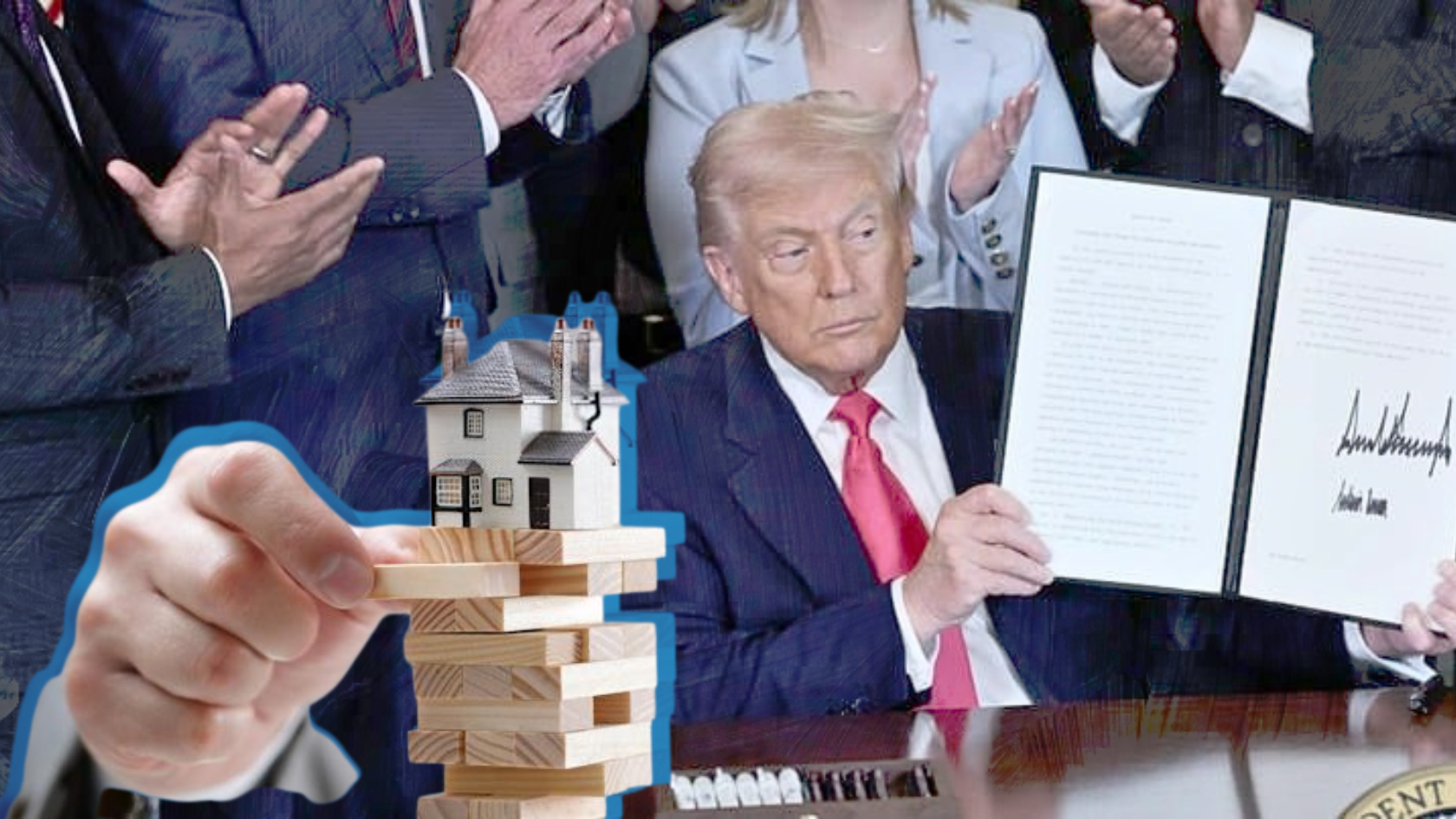
On January 20, 2026 President Trump signed an executive order that many headlines described as a "barring institutional investors from buying single-family homes."
For the first time in a long while, the federal government has said something out loud that has been quietly true for years: Wall Street buying single-family homes is a problem.
Last week, the White House issued an executive order declaring that large institutional investors should not be competing with families for starter homes. The language is moral, even blunt. People live in homes, not corporations. Families can’t compete with vast pools of cheap capital. Neighborhoods should not be swapped on a trading floor.
At a rhetorical level, this feels like a breakthrough. For years, anyone pointing out that housing had become a financial asset first and shelter second was told this wasn’t happening. Or that it was simply how markets work. Now Washington is signaling that who owns housing matters, and that federal policy helped tip the scales.
But, when you look closely at what this order actually does, and then read a related White House fact sheet, a different picture emerges. Not one of reform, but of transition. Not a crackdown on Wall Street, but a carefully managed exit.
This isn’t a solution to the housing crisis. It’s not even a path to a solution. It’s a performance designed to avoid confronting the one thing policymakers still refuse to accept: housing prices have to fall.
What the Order Does and Doesn’t Do
Despite the sweeping language, the executive order is remarkably narrow. It does not ban institutional investors from buying single-family homes. It does not regulate private real-estate transactions. And crucially, it does not touch the private capital markets that large institutional investors rely on almost exclusively.
Instead, the order operates entirely at the margins of federal involvement. It instructs agencies like HUD, the VA, USDA, and the Federal Housing Finance Agency to stop insuring, guaranteeing, or securitizing purchases of single-family homes by large institutional investors, where allowed by law.
It promotes “first-look” policies on federally owned properties, giving individuals and other non-institutional investors the opportunity to buy foreclosed properties before investors do. It increases disclosure requirements. It signals heightened antitrust scrutiny.
For institutional players in the single-family rental market—who typically use cash, private equity, portfolio lending, and private securitization—these measures do nothing to constrain behavior. As we explored in our podcast series Stacked Against Us, they are still free to operate almost entirely outside the federally backed housing finance system, deploying capital at a scale that overwhelms local markets—capital made artificially cheap through monetary policy and financial structures unavailable to households or small local buyers.
That makes this executive order seem largely expressive. On its own, it might be dismissed as political theater, calling out Wall Street while leaving the system intact. But the White House fact sheet makes clear that this order is operating within a much larger and very familiar framework.
In it, the President directs Fannie Mae and Freddie Mac to purchase $200 billion in mortgage-backed securities, part of an ongoing effort to expand credit, lower borrowing costs, and push more households into homeownership through increasingly financialized mechanisms. In other words, a new iteration of the same basic financial strategy that defined the early-2000s housing boom, and much of U.S. housing policy in the postwar era.
Wall Street Didn’t Invade Housing. It Was Invited.
To understand what’s happening now, we need to remember how we got here.
After the Great Financial Crisis, housing prices were falling sharply. More importantly, the value of mortgage-backed securities was collapsing. Policymakers panicked. Housing was no longer just shelter; it had become the primary store of household wealth, the foundation of bank balance sheets, and a cornerstone of the broader financial system. A prolonged price correction was politically and economically unacceptable.
So, Wall Street was invited in.
After the Great Financial Crisis, institutional investors were offered cheap money and access to distressed housing inventory. They were encouraged to buy foreclosed homes at scale and convert them into rental portfolios. This was not an accident. It was a deliberate strategy to stabilize prices and prevent further decline.
As I wrote in Escaping the Housing Trap, the recovery bubble needed a new marginal buyer. With subprime borrowing curtailed, Federal Reserve Chairman Ben Bernanke offered a path forward. In a 2012 speech to the National Association of Home Builders, he suggested that “with home prices falling and rents rising, it could make sense in some markets to turn some of the foreclosed homes into rental properties.” Wall Street investors were already busy doing exactly that.
The results were predictable. Cheap capital flowed into local housing markets at a scale no household could match. Foreclosed homes were consolidated into large rental portfolios. Prices stopped falling, then began rising again.
It worked. Too well.
That is the context missing from most debates today. Wall Street did not corrupt an otherwise healthy housing market; it was deployed to defend one that had already become financially and politically incapable of absorbing a price correction. Housing had long since been transformed from shelter into a financial instrument. Institutional investors were not an invasion force. They were a policy tool used to enforce a no-price-decline rule that had been decades in the making.
This Order Isn’t a Crackdown. It’s an Off-Ramp.
Read together—and with a clear understanding of housing’s role in today’s economy—the executive order and the fact sheet tell a coherent story, one that is legible to financial markets even as it is packaged in populist language for the broader public.
First, the administration signals that institutional investors should stop buying. Federal programs will no longer facilitate new acquisitions. Regulatory and reputational risk is raised. The political message is clear: the gold rush in housing, kicked off in the wake of the Great Financial Crisis, is officially over.
Second—and far more importantly—the administration moves to support housing prices and liquidity through massive purchases of mortgage-backed securities. Borrowing costs are pushed down. Asset values are protected. Stability is provided. This is not how you correct a distortion. It is how you manage an exit.
Large institutional investors are being told, quietly but clearly: don’t add more exposure here, but don’t worry, we’ll help you leave without triggering losses.
That is what an orderly bailout looks like. Not a panicked check written in public, but balance-sheet support that socializes risk and preserves asset values.
The Question We Still Won’t Answer
If institutional investors are stepping back, and housing prices are still being propped up, then one question hangs in the air: Who, exactly, is allowed to lose?
If prices don’t fall, affordability doesn’t improve. If prices do fall, someone bears that cost. For decades, federal policy has been designed to ensure that cost is never borne by the financial system, even if it means locking an entire generation out of homeownership.
Until we are willing to confront that tradeoff honestly—and accept that housing cannot be both an endlessly appreciating asset and an affordable place to live—every “families first” housing policy will remain what this one is.
A carefully staged performance, designed to ensure the system never has to tell the truth about itself.
Charles Marohn (known as “Chuck” to friends and colleagues) is the founder and president of Strong Towns and the bestselling author of “Escaping the Housing Trap: The Strong Towns Response to the Housing Crisis.” With decades of experience as a land use planner and civil engineer, Marohn is on a mission to help cities and towns become stronger and more prosperous. He spreads the Strong Towns message through in-person presentations, the Strong Towns Podcast, and his books and articles. In recognition of his efforts and impact, Planetizen named him one of the 15 Most Influential Urbanists of all time in 2017 and 2023.
%20(1).avif)
%20(1).avif)
%20(1).avif)
%20(1).avif)