The Missing Defendant in Crash Cases

I am a personal injury attorney, and my caseload tells a story that Strong Towns readers know well: American streets are designed to kill.
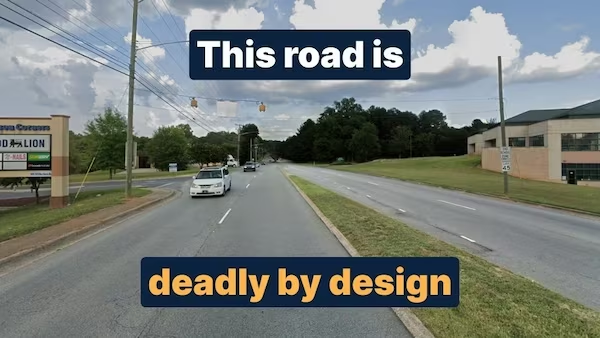
Not intentionally, of course. But predictably. The same road designs that traffic engineers have deployed for decades—wide lanes, long blocks, signal timing that prioritizes throughput over safety—keep producing the same outcomes. Pedestrians are struck crossing arterials. Cyclists are killed by right-turning vehicles. Families are destroyed at intersections that everyone knew were dangerous.
What brings me to write for Strong Towns is the disconnect I see between what happens on the street and what happens in the courtroom. The infrastructure advocacy community has done extraordinary work documenting how road design contributes to these outcomes. But the legal system hasn’t caught up. When I represent a person who was struck while crossing a stroad, the legal framework still defaults to analyzing individual behavior first.
The Cases That Haunt Me
Let me describe a case without identifying details. A man walks to his bus stop every morning at 5:30 AM, before dawn. The stop is across a five-lane arterial from his apartment complex. There is no crosswalk. The nearest signal is a quarter mile away. The speed limit is 45 mph.
One morning, he’s struck and killed.
In the legal analysis, the focus immediately turns to his behavior. Did he look both ways? Was he wearing reflective clothing? Did he cross at the safest point?
But consider the design. This man had to cross that road every day. The transit agency put the stop there. The apartment complex was approved knowing residents would need to cross to access the bus. Every decision along the way created the conditions for this death—yet, in the courtroom, they’re largely invisible.

Why the Legal System Fails
Most states have some form of governmental immunity that shields municipalities from liability for design decisions. Once a road is built to approved standards, the government is often protected—even if those standards are decades out of date, even if the design has proven deadly.
The legal system tends to treat design as settled, and individual behavior as variable.
Private defendants—drivers—become the sole focus of liability. And while individual drivers do bear responsibility, focusing exclusively on driver behavior ignores the systemic failures that made the crash likely.
What Strong Towns Principles Mean for Law
Strong Towns advocates for incremental, human-scaled development. For streets designed for people, not just vehicle throughput. For honest accounting of the costs and consequences of infrastructure decisions.
If we applied those principles to legal frameworks, several questions emerge:
Is design truly neutral?
When safer alternatives exist—when traffic engineers know that narrower lanes reduce speeds, that refuge islands shorten crossings, that adequate lighting improves visibility and therefore, can save lives—choosing the more dangerous option is not a neutral act. It is a decision that should carry responsibility.
How should immunity interact with evidence?
When crash data shows that an intersection or corridor consistently produces severe injuries or fatalities, hasn’t the design empirically proven itself dangerous? Is ongoing maintenance of that design simply passive continuation, or does it become an active choice?
Who is part of the system?
When a person is killed crossing a stroad to reach a bus stop, the driver is the final actor. But the built environment reflects layered decisions: the transit agency that located the stop, the developer that built housing nearby, the municipality that approved the road design. Shouldn't our legal framework at least allow inquiry into how those layers interact?
The Path Forward
I don’t expect legal reform to happen quickly. Governmental immunity doctrines, for example, are deeply entrenched. But I do believe that the conversation Strong Towns has started about street design needs to extend to the legal system.
Every time I take a case involving a pedestrian struck on a dangerous road, I’m working within a framework that assumes the road was fine and the person on it made a mistake. That framework is wrong. The infrastructure advocacy community knows it’s wrong. And eventually, the law will catch up.
Until then, people will keep dying on streets designed to kill them. The legal system will keep blaming the victims. And families will keep paying the price for infrastructure decisions made in conference rooms by people who never walk those streets.