Looking Beyond the Crash
.avif)
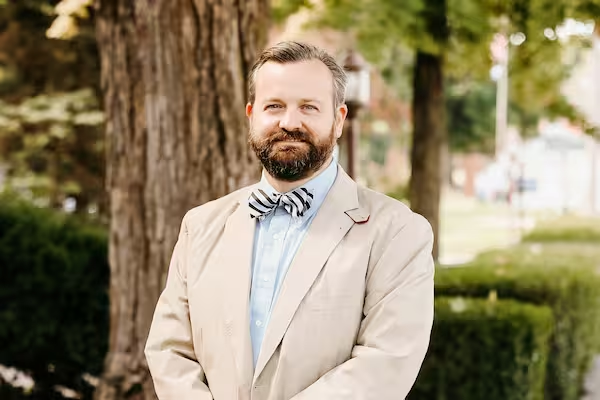
Malisa McCreedy, Transportation Manager for the City of Ann Arbor, MI, and Strong Towns member. (Source: City of Ann Arbor)
.avif)
%20(1).avif)
%20(1).avif)
When most people hear about a traffic crash, they immediately look for a cause: a distracted driver, a pedestrian who wasn't paying attention, or someone who made a mistake.
But for Malisa McCreedy, Transportation Manager for the City of Ann Arbor, Michigan, the most important question is often much bigger than that.
As Ann Arbor implemented the goals of its Moving Together Toward Vision Zero Comprehensive Transportation Plan, city leaders recognized that crashes are rarely isolated events. Crashes are the product of a system: street design, speed, visibility, land use, lighting, enforcement, expectations, and countless other factors that shape how people move through a place every day.
That realization led the city to create a multidisciplinary Crash Response team that meets monthly to review serious crashes that occur in the city. Representatives from the police department sit alongside city staff responsible for every aspect of the public right-of-way, from day-to-day operations to long-range planning. This team examines what happened, but more importantly, they ask why the system produced that outcome.
The Work Wasn't Always Easy
As the Crash Response team dug deeper into crash analysis, they discovered that understanding the crash and explaining the contributing factors were often two different challenges. Ann Arbor Staff could identify multiple contributing factors, but communicating those findings to the public proved difficult. Community advocates wanted answers. Residents wanted accountability. Yet reducing a crash to a single cause often obscured what the city was learning.
Malisa in her role as Transportation Manager introduced the Strong Towns' Crash Analysis Studio to her team to tackle this struggle. The Crash Response Team strengthened both their review process and their ability to communicate what they were finding. The Studio helped shift conversations away from blame and towards understanding. Instead of asking who was at fault, the Crash Response Team became better equipped to ask what conditions contributed to the crash and what changes could make future crashes less likely.
Just as importantly, Malisa discovered that Ann Arbor was not alone in this work. Through Strong Towns, city staff were connected to a broader community of practitioners, local leaders, and transportation professionals grappling with many of the same questions. How do you talk about crashes without reducing them to a single cause? How do you help residents understand the role that street design plays in safety outcomes? How do you create space for learning while still responding to community concerns? The value wasn't simply a new process. It was the confidence that comes from learning alongside others who are committed to making their communities safer.
That shift has had real results. Ann Arbor has seen a reduction in overall crashes and is now able to focus more attention on the most serious crashes as it continues pursuing its Vision Zero Comprehensive Transportation Plan objectives.
What makes this story compelling is not that Ann Arbor found a simple answer. It's that city staff embraced the complexity of the challenge.
Strong Towns often talks about the danger of false confidence. Cities are complex systems, and meaningful change rarely comes from a single solution. It comes from observation, learning, collaboration, and the willingness to ask better questions.
Malisa's work demonstrates what that looks like in practice.
As a Strong Towns member, Malisa is helping bring these ideas into the daily work of local government. She is showing that safer streets are built not through certainty, but through curiosity, humility, and a commitment to learning from every experience.
Strong Towns members make this work possible. Their support helps communities access programs like Crash Analysis Studio, connect with peers facing similar challenges, and build the capacity to learn from experience. Members are not simply supporting an organization. They are helping create a movement where local leaders can find the tools, encouragement, and relationships needed to take the next prudent step toward safer and stronger places.
That work doesn't happen all at once. It happens one conversation, one crash review, and one lesson at a time.
Edward Erfurt is the Chief Technical Advisor at Strong Towns. He is a trained architect and passionate urban designer with over 20 years of public- and private-sector experience focused on the management, design, and successful implementation of development and placemaking projects that enrich the tapestry of place. He believes in community-focused processes that are founded on diverse viewpoints, a concern for equity, and guided through time-tested, traditional town-planning principles and development patterns that result in sustainable growth with the community character embraced by the communities which he serves.