The Reflector That Started a Conversation

%20(1).avif)
%20(1).avif)
%20(1).avif)
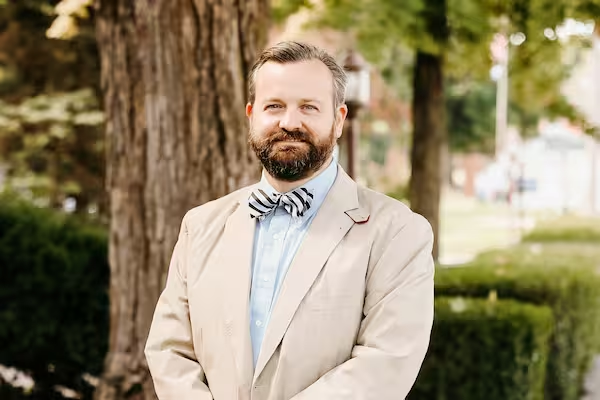
When Andy Posterick first began paying closer attention to the streets of Fort Smith, Arkansas, he saw something many miss: the people who weren’t in cars.
He saw pedestrians crossing wide streets. People walking at night. Cyclists navigating roads designed primarily for vehicle movement. He also saw a troubling reality: Fort Smith had experienced pedestrian fatalities, and while city leaders were working toward safety improvements, meaningful street redesigns would take years and significant resources to accomplish.
Like many people who care deeply about their communities, Andy found himself asking a difficult question: What can one person do?
As a Strong Towns member and participant in the Confessions of a Recovering Engineer Accelerator Program, Andy was introduced to a different way of thinking about change. The Strong Towns approach helped him understand that cities are complex systems and that lasting improvements often begin with small, focused actions rather than grand solutions.
Andy realized he couldn’t reconstruct a dangerous road himself.
But he could start a conversation.
That insight led to a simple idea: a small reflector that could be handed to pedestrians and cyclists throughout the community. The reflector features a uniquely Fort Smith logo: a footprint shaped from the letters “FS,” making it both a practical safety tool and a symbol of local pride.
What happened next surprised him.
Every time he handed someone a reflector, a conversation followed.
People talked about walking. They talked about safety. They talked about where they crossed the street, how they got around town, and what it felt like to navigate the city outside a vehicle. The reflector did more than catch the light from approaching headlights. It helped people notice something often overlooked: every trip begins and ends as a pedestrian.
The idea spread. Andy distributed hundreds of reflectors, including 275 during Halloween alone. The Fort Smith Police Department now carries them in patrol vehicles and hands them out to vulnerable road users at night. What started as one citizen looking for a way to help has become a growing community effort to raise awareness from the bottom up.
The story is a reminder that nobody changes a place alone.
Large infrastructure projects matter. Street redesigns matter. Policy changes matter. But before communities make better decisions, people often need to see their community differently. They need opportunities to recognize who is using their streets and whose needs may have been overlooked.
Strong Towns members help make that work possible. Through programs like the Accelerator, members gain practical tools, encouragement, and support that help turn concern into action. Just as importantly, they become part of a movement of people discovering that meaningful change often starts with a conversation, a relationship, or a small next step.
Andy didn’t solve pedestrian safety in Fort Smith; he started helping his neighbors see pedestrians. And sometimes that’s exactly where change begins.
Edward Erfurt is the Chief Technical Advisor at Strong Towns. He is a trained architect and passionate urban designer with over 20 years of public- and private-sector experience focused on the management, design, and successful implementation of development and placemaking projects that enrich the tapestry of place. He believes in community-focused processes that are founded on diverse viewpoints, a concern for equity, and guided through time-tested, traditional town-planning principles and development patterns that result in sustainable growth with the community character embraced by the communities which he serves.