Don't Punish the People Trying to Fix Your Town
.avif)
This week, I had the opportunity to spend time with the Strong Towns Local Conversation in Steubenville, Ohio. Like many conversations I've had with local advocates over the years, the discussion didn't center on abstract planning theory. It centered on a very real local struggle.
And I suspect it won't be unique to Steubenville.
The city has a new city manager who is making property maintenance a priority. After years of inconsistent enforcement, the city has adopted the International Property Maintenance Code and begun issuing notices of violation to property owners across town.
From the city's perspective, this makes perfect sense. Steubenville, like many Rust Belt communities, has endured decades of economic decline. Buildings have deteriorated. Paint has peeled. Brick has gone unpainted. Windows have broken. Confidence has slowly disappeared. If the city wants to reverse that trajectory, allowing visible neglect to continue doesn't seem like an option.
But there is another side to this story.
Over the last several years, a new generation of people have begun buying these long-neglected buildings. They aren't national developers arriving with millions of dollars in financing. They're entrepreneurs, local business owners, and incremental developers who have invested what savings they have simply to acquire a property. Now they're trying to figure out what comes next.
Many fully intend to repair the broken windows. They plan to repoint the brick. They want to restore the storefronts and eventually open businesses that bring life back downtown. Their challenge isn't willingness. It's time.
When a building has accumulated decades of deferred maintenance, it is almost impossible for a new owner to address every deficiency within a 60- or 90-day compliance window. The purchase itself often consumed most of the available capital. The business they hope to open hasn't begun generating revenue. Financing is difficult. Contractors are expensive.
Instead of feeling welcomed as someone trying to improve the community, many are experiencing their first interaction with City Hall as a notice of violation.
The city is trying to restore confidence. The investors are trying to build confidence. Neither side is wrong. They're simply operating on different timelines.
That tension points toward a question worth sitting with: what would it look like if the city approached these property owners not as gatekeepers, but as guides?
A Bank Run on Confidence
Steubenville's situation reminded me of a story Strong Towns has shared for years from Oswego, New York.
Like Steubenville, Oswego had experienced years of disinvestment. The city's leaders eventually realized they weren't simply dealing with deteriorating buildings. They were experiencing what they called a bank run on confidence. Residents weren't avoiding improvements because they didn't care. Many were waiting to see whether anyone else believed the neighborhood had a future.
Why paint your house if your neighbors aren't going to paint theirs?
The city's response wasn't a massive redevelopment initiative. Instead, they created a matching microgrant program of up to $1,000 for visible exterior improvements for painting, landscaping, porch repairs, lighting, windows, roofs. Small projects people could actually accomplish.
But the most important part wasn't the money. Seven out of every 10 property owners on a block had to participate. Suddenly neighbors were knocking on one another's doors. People who hadn't spoken in years were coordinating projects. Residents who couldn't physically or financially participate found neighbors willing to help paint a front door or clean up a yard.
The grants didn't transform neighborhoods because they were large. They transformed neighborhoods because they rebuilt confidence together. Sometimes the most valuable investment isn't the dollars. It's giving people confidence that they won't be investing alone.
That's the guide mindset at the neighborhood scale.
What If Enforcement Came With a Path Forward?
Code enforcement doesn't have to arrive as a dead end.
When I was working at the Community Redevelopment Agency (CRA) in Martin County, Florida, many neighborhoods had significant code enforcement issues. For years, the county hesitated to enforce violations because many residents simply lacked the resources to make repairs. But ignoring the problems wasn't helping anyone either.
So before code enforcement entered a neighborhood, the CRA assembled partners. The housing authority identified rehabilitation programs and grants. Habitat for Humanity's Brush With Kindness program became a resource for modest repairs. Community organizations like Habitat Angles came forward as volunteers to lend a helping hand. All of these programs were coordinated alongside enforcement efforts.
When an inspector identified a problem, they weren't limited to handing someone a violation. They could also connect that person to the CRA who coordinated people prepared to help. The notice remained and accountability remained. This difference was that hope was also introduced.
Communities often have more resources than they realize. The challenge is that those resources frequently operate independently of one another. Sometimes the most valuable role local leaders can play is simply helping people find each other.
The question isn't simply: how do we get this building fixed? It's also: how do we help this building become productive again?
Becoming Guides
The clearest example I've seen of what this looks like in practice comes from Broad Avenue in Memphis, Tennessee.
Most people know the Better Block story because of the temporary street improvements where residents painted bike lanes, constructed parklets, added planters, and a right-sized street. These temporary measures eventually became permanent and this process was repeated along the street. But another transformation which is less reported was also happening inside the buildings.
Vacant storefronts became temporary pop-up businesses alongside the street improvements. The first of these pop-ups simply involved opening a door and setting up a temporary shopfront. This proof of concept demonstrated interest in permanent shops that would require appropriate permitting.
Instead of requiring every building to undergo a complete renovation before opening, city officials worked with business owners to identify what was necessary to make spaces safe. The inspectors focused on the bare minimum: clear exits, emergency lighting, installing fire extinguishers. Rather than demanding every future improvement upfront, officials established a path for incremental compliance as businesses grew. Some communities have even experimented with temporary certificates of occupancy that document what activities are allowed today while establishing what improvements will be required as the business expands.
The role of the building official changed. They weren't lowering standards. They were helping people understand how to reach them.
The city shifted from being gatekeepers to guides.
The Role of a Strong Towns Local Conversation
This is where I think Strong Towns Local Conversations have an opportunity to do something uniquely valuable.
Not by choosing sides. Not by telling the city it's wrong. Not by telling property owners they're right. But by helping everyone understand one another's struggle.
A local conversation can introduce examples from places like Oswego, Martin County, and Memphis. It can convene property owners, city staff, building officials, lenders, nonprofits, and neighborhood organizations around the same table. It can ask questions instead of assigning blame.
What barriers are owners experiencing? What responsibilities does the city have? Where are the opportunities for partnership? How can we encourage visible progress while recognizing that revitalization happens incrementally?
Those aren't questions with one correct answer. They're questions communities have to work through together.
Every Strong Town starts with people willing to help their neighbors see a path forward. Sometimes the most important thing a local conversation can do isn't advocate for a particular policy. It helps restore confidence that progress is possible.
I'd love to hear from others: join us in the Commons to continue this conversation with me and other Strong Towns members. Has your community struggled with balancing code enforcement and incremental investment? What responses have you seen help both cities and property owners move forward together?
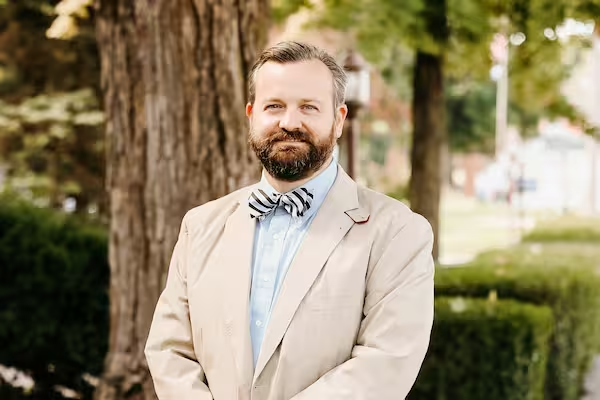
Edward Erfurt is the Chief Technical Advisor at Strong Towns. He is a trained architect and passionate urban designer with over 20 years of public- and private-sector experience focused on the management, design, and successful implementation of development and placemaking projects that enrich the tapestry of place. He believes in community-focused processes that are founded on diverse viewpoints, a concern for equity, and guided through time-tested, traditional town-planning principles and development patterns that result in sustainable growth with the community character embraced by the communities which he serves.
%20(1).avif)
.avif)
%20(1).avif)
%20(1).avif)