The Housing Debate's Canonical Chart

.avif)
(Source: @billybinion/Threads and Wikimedia Commons)
I've spent enough time around financial markets to have developed a particular reflex. Whenever someone shows me a chart with a compelling trend line, the first question I ask is not whether the data is accurate. The first question is: why did you choose that starting point?
You'll hear investment managers do this constantly. "Since 2009, the stock market has delivered exceptional returns." True, but 2009 also happened to be the bottom of the Great Financial Crisis. "Since 2001, housing prices have consistently risen." Why 2001? "Since 1990, Japanese stocks have underperformed." Why not 1989? The starting point is rarely arbitrary. It often contains the entire argument.
I experienced that same reflex when I read the recent report from The Pew Charitable Trusts on Austin, Texas.
The report presents Austin as a housing success story. The argument is that Austin reformed its zoning and permitting processes, encouraged more housing construction, added roughly 120,000 homes between 2015 and 2024, and then saw rents decline. The lesson, according to Pew, is that building more housing works.
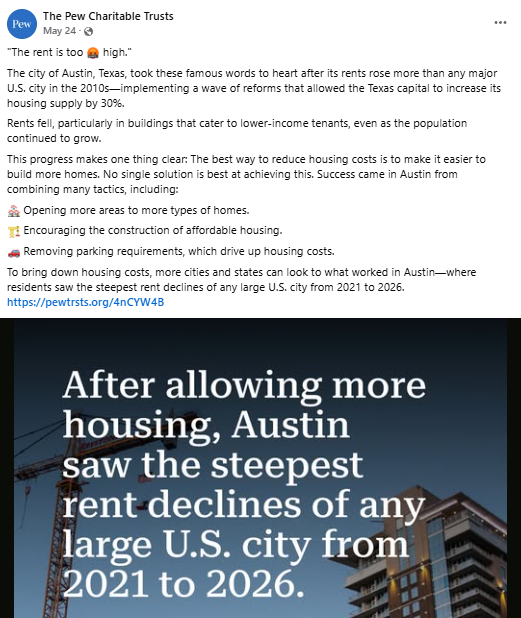
Derek Thompson, co-author of "Abundance" and a guest on Ezra Klein's podcast, made the same case in almost identical terms. "What we've seen essentially is that Austin built an enormous number of homes in the 2010s and early 2020s, and average rents have gone down down down over the last eighteen to twenty four months," Thompson said. "Austin is like a canonical story, here…"
The word "canonical" is worth sitting with. A canonical story is one that has stopped being examined and started being cited. It is the kind of story you reach for when you want to end a conversation, not continue one.
There is certainly truth in that story. Austin did build a lot of housing. Rents did decline. What struck me was not what the report said. It was what the report didn't seem interested in asking.
Because the Austin story is strange, especially if you back up far enough to see all of it.
Between 2020 and 2022, Austin experienced one of the most dramatic rent increases in modern American history. Rents then declined. During the same period, the city saw massive in-migration, the rise of remote work, historically low interest rates followed by rapidly rising rates, substantial investor activity, and a construction boom that was itself extraordinary by any normal measure.
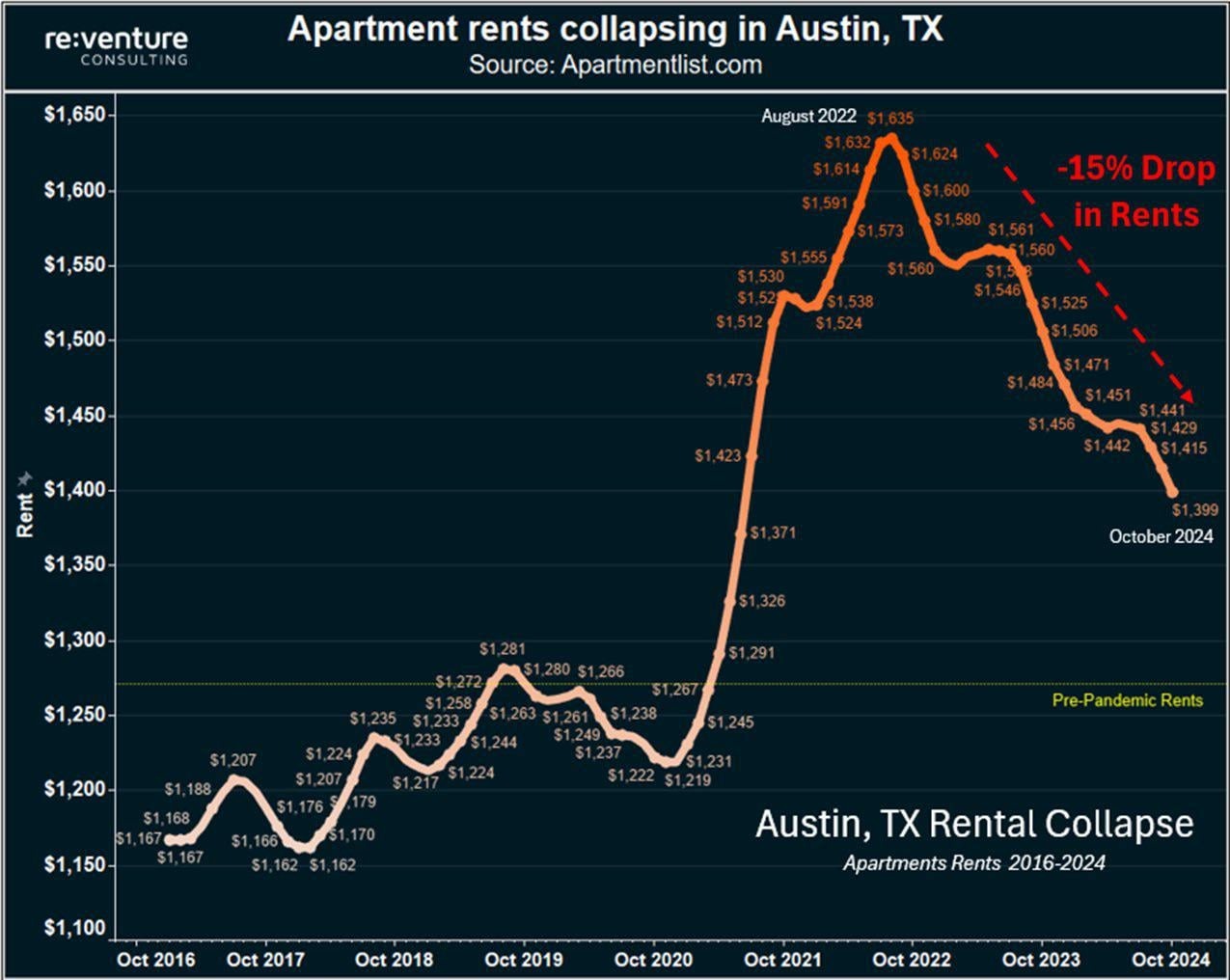
Each of those forces was significant on its own. Together, they produced a housing market that behaved unlike almost any other city in the country, swinging violently in both directions over just a few years. That should make anyone curious. Instead, it seems to have made a lot of people, especially those involved in housing policy, way more certain.
If I begin the Austin story in late 2021, I can tell a story about rents falling. If I begin in 2015, I can tell a story about rents rising dramatically before they fell, despite the construction of an “enormous number of homes.” If I zoom out further, I can tell a story about a broader housing market experiencing a kind of financial volatility. All of these stories are supported by the data. The question that interests me is not which one is true. The question is why we keep choosing one over the others.
After all, that act of choosing one explanatory myth over another is how a story becomes canonical. It doesn't happen because someone decided to deceive. It happens because the story is useful, and useful stories attract repetition, and repetition eventually substitutes for examination. At some point, Austin stops being a complex city with a complex housing market and becomes a proof. You cite it. You don't study it.
What gets lost in that process is the kind of curiosity that might actually teach us something. How much of the rent decline was driven by new construction, and how much by interest rates that priced buyers out of purchasing and left them renting longer? What role did investor pullback play as capital retreated from speculative markets? Why did Austin swing so much harder than comparable cities? These are not rhetorical questions. They are the questions a canonical story makes it easy to stop asking.
I've watched this happen on both sides of the housing debate. Some people look at Austin's falling rents and conclude that supply is everything, that anyone who raises complications is simply obstructing the obvious. Others look at the same chart and insist that construction had nothing to do with the decline, that it was all interest rates, or migration reversals, or investor retreat. None of these simplified stories is especially interesting to me. What I keep noticing, instead, is how quickly the curiosity disappears on both sides, and how quickly it gets replaced by the comfort of a story that already confirms what someone believed.
At Strong Towns, we've spent years trying to be students of cities. Some of the most important things I've learned about housing, transportation, and local finance came from moments when the evidence didn't cooperate, when a city I expected to be a cautionary tale turned out to be more complicated, or when a success story started asking harder questions the further I looked into it. The moment you become more committed to defending a narrative than understanding what's actually happening, the canonical story has done its work on you.
Housing is not simple, yet a canonical story requires it to be. It is shelter, and it is also a financial asset, a retirement strategy, a tax base, and a source of local wealth, all shaped by regulations and finance systems and migration patterns and interest rates and demographics in ways that interact and resist clean summary. A story that reduces all of that complexity to a single chart, and then treats the chart as settled, is not a story that will teach you very much about the next city.
This matters because the canonical story doesn't just end the conversation, it determines which solutions are even allowed into the room. If the housing problem is fundamentally a simple supply story, one in which only large developers with access to institutional capital can move the needle by merely building more units, then a whole range of other approaches disappears.
Serving the entire entry-level market is one of them. The idea that communities could build modest, affordable homes using local contractors, local financing, and local knowledge — housing scaled to what people in that place actually earn — gets crowded out before it's even seriously considered. It's not that anyone decides to exclude it. It's that the canonical story makes it irrelevant.
The case for building more housing is already strong. Austin may well strengthen it further. But a canonical story and a true story are not the same thing. When we treat them as identical we don't just stop learning; we start making the kind of confident mistakes that set good ideas back. The people who will pay for that are not the ones having the debate.
[[divider]]
Strong Towns members helped shape this article by contributing to a discussion on an early version of it. If you want to join in the conversation, head over to the Strong Towns Commons.
Charles Marohn (known as “Chuck” to friends and colleagues) is the founder and president of Strong Towns and the bestselling author of “Escaping the Housing Trap: The Strong Towns Response to the Housing Crisis.” With decades of experience as a land use planner and civil engineer, Marohn is on a mission to help cities and towns become stronger and more prosperous. He spreads the Strong Towns message through in-person presentations, the Strong Towns Podcast, and his books and articles. In recognition of his efforts and impact, Planetizen named him one of the 15 Most Influential Urbanists of all time in 2017 and 2023.
%20(1).avif)
%20(1).avif)
%20(1).avif)
%20(1).avif)
