Before You Issue the Violation Notice
.avif)
(Source: Daniel X. O'Neil/Flickr)
I had the opportunity to spend time with the Strong Towns Local Conversation in Steubenville, Ohio. Like many conversations I’ve had with local advocates over the years, the discussion didn’t center on abstract planning theory. It centered on a very real local struggle.
The city has a new city manager who is making property maintenance a priority. After years of inconsistent enforcement, Steubenville has adopted the International Property Maintenance Code and begun issuing notices of violation to property owners across town.
From the city’s perspective, this makes perfect sense. Like many legacy cities, Steubenville has endured decades of economic decline. Buildings have deteriorated, paint is peeling, brick has gone unpointed, and windows are broken. If the city wants to reverse that trajectory, allowing visible neglect to continue isn’t an option.
But there is another side to this story.
Over the last several years, a new generation of people have begun buying these long-neglected buildings. They aren’t national developers arriving with millions of dollars in financing. They’re entrepreneurs, local business owners, and incremental developers who have invested what savings they have simply to acquire a property. Now they’re trying to figure out what comes next.
Investment is not easy in a rust-belt community like Steubenville. Decades of disinvestment compound over time. Visually this is obvious with peeling paint and broken windows, but what is less obvious is the lack of available capital. Nobody wants to be the first investor, so traditional lending tools are not available and developers need to find creative ways to cash-flow these projects.
The entrepreneurs that take on these types of investments, fully intend to repair the broken windows because they want to see their investment grow. They plan to repoint the brick and they want to restore the storefronts and eventually open businesses that bring life back downtown. Their challenge isn’t willingness. It’s time.
When a building has accumulated decades of deferred maintenance, it is almost impossible for a new owner to address every deficiency within the orderly 60- or 90-day compliance window. Purchasing the building often consumed most of their available capital. The business they hope to open hasn’t begun generating revenue. So these investments require calculated phasing within the cash-flow of the development.
This type of development requires a lot of patience.
There is generally a lot of excitement when that tired building on main street switches owners and when the promise of new businesses are proposed. The city finally has someone believing in their community who they can share their concerns of the property with. The problem is that instead of feeling welcomed as someone trying to improve the community, many experience their first interaction with City Hall as a notice of violation.
There is this fragile balance where the city is trying to restore confidence and where the investors are trying to build confidence. Neither side is wrong. They’re simply operating on different timelines.
That conversation reminded me of Paul Stewart and how he inspired his neighbors to revitalize their declining neighborhoods in Oswego, New York. The Oswego Renaissance Association (ORA) helped the community understand they weren’t simply dealing with deteriorating buildings. They were experiencing what he called a “bank run on confidence.” People weren’t avoiding investment because they didn’t care. They were waiting to see whether anyone else believed the neighborhood had a future.
Confidence works the same way in cities as it does in financial markets. Once people believe decline is inevitable, they stop risking their time and money. But once they begin to see credible signs of progress, confidence can spread just as quickly.
That’s why the first people willing to invest matter so much.
When someone restores a vacant storefront, opens a neighborhood bookstore or coffee shop, renovates apartments above a downtown business, or brings an abandoned building back into productive use, they’re doing more than improving a single property. They’re providing visible proof that investment is possible. They create comparable projects that make future lending easier. They give other entrepreneurs confidence to take the next step. They help neighbors imagine a different future for their downtown.
If those first investors succeed, they rarely remain the only investors.
None of this means cities should abandon code enforcement, because life-safety and basic standards matter. Property maintenance protects public health, preserves neighborhood confidence, and communicates that decline is not acceptable. But enforcement is only one tool available to local governments.
When someone has demonstrated a genuine commitment to restoring a neglected building, the city’s role can become something more than issuing citations. Cities can become guides with helping them succeed. That might mean working with owners to establish realistic timelines, connecting them with available resources, or simply recognizing the difference between an absentee owner allowing a property to decay and someone making steady progress with limited means.
The goal remains the same: healthier buildings, stronger neighborhoods, and a more prosperous downtown. The question is how local governments help achieve that goal.
Communities don’t recover because buildings receive violation notices. They recover because people regain confidence that investing in their place is worthwhile.
Code enforcement has an important role to play in that process. But if we’re serious about rebuilding places that have experienced decades of decline, we should ask whether enforcement alone is enough or whether we can accomplish far more by pairing accountability with guidance and helping the first people willing to invest succeed.
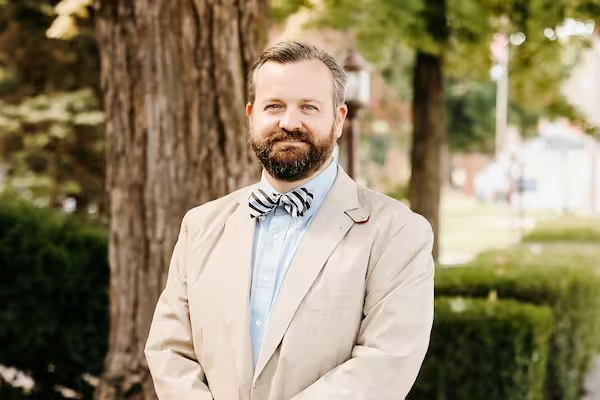
Edward Erfurt is the Chief Technical Advisor at Strong Towns. He is a trained architect and passionate urban designer with over 20 years of public- and private-sector experience focused on the management, design, and successful implementation of development and placemaking projects that enrich the tapestry of place. He believes in community-focused processes that are founded on diverse viewpoints, a concern for equity, and guided through time-tested, traditional town-planning principles and development patterns that result in sustainable growth with the community character embraced by the communities which he serves.
%20(1).avif)
%20(1).avif)
%20(1).avif)
%20(1).avif)