Are We Growing Numb to Record-High Pedestrian Deaths?
%20(1).avif)
.avif)
Last year was the year that, a decade prior, Los Angeles declared it hoped to achieve Vision Zero.
Instead, in 2025, 290 people were killed in the city, 150 of them pedestrians. Traffic deaths in LA were roughly 20 percent higher than they were when the city made its pledge to eliminate traffic deaths a decade ago. More people were killed on city streets last year than there were homicides.
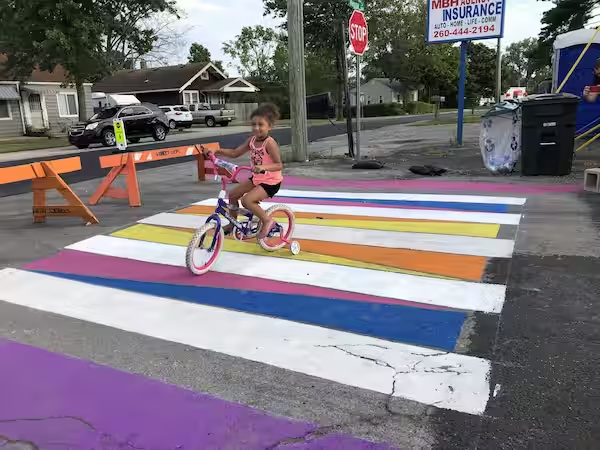
Jonathan Hale, an LA resident and third-year law student, and some of his friends were having a hard time stomaching the constant drumbeat of deaths combined with lack of action from the city. They wanted to make a point. Last summer, he and a group calling themselves “The People’s Vision Zero” went out to the intersection where 9-year-old Nadir Gavarrete was hit and killed in West LA. They painted a high-visibility code-complaint crosswalk on every leg of the intersection.
“They were up for two months,” Hale said. “People were using them.”
Then city crews got word of the demonstration, came out and ground them off the street. Backlash from neighborhood residents was swift.
“It drew even more attention to their failure to provide safe infrastructure,” Hale said.
The same kind of pattern being experienced in Los Angeles — rising deaths and official indifference and inaction — is a widespread pattern, according to a new report from Smart Growth America.
According to the group’s bi-annual "Dangerous by Design" report, which was released last month, pedestrian deaths have reached extreme levels in cities around the U.S. Despite a 6 percent decline in the total number killed, in the most recent year for which data is available, the number of people killed on the roadways remains near 40-year historic highs.
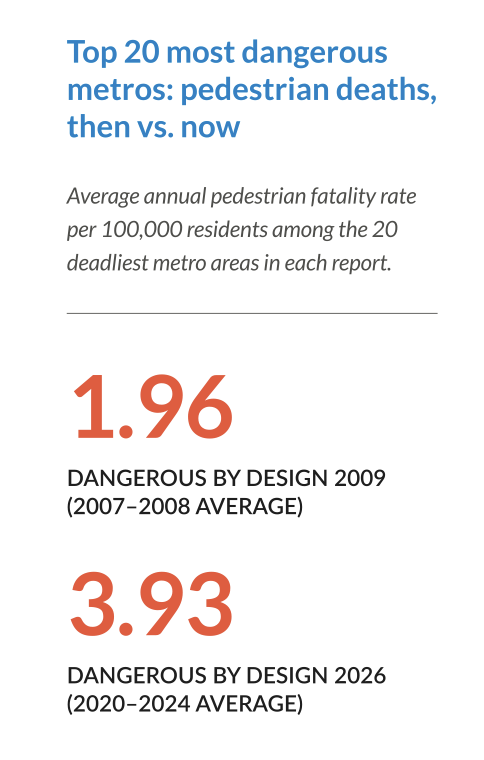
In fact, since Smart Growth America began releasing this report in 2009, the number of pedestrians being killed every year has roughly doubled in the 20 most dangerous metro areas. Across the U.S., pedestrian deaths are 72 percent higher than they were that year (2009).
The kind of frustration Hale described in LA is echoed in the overall language of the report.
“Though the federal government and transportation agencies at every level claim safety is their top priority, this hasn’t produced sufficient change in how roads are designed, how transportation dollars are spent, and how success is measured,” the authors write.
Smart Growth America’s Beth Osborne stated on the Strong Towns Podcast that she was furious about how many safety agencies had framed the slight reduction in pedestrian deaths that occurred between 2023 and 2024.
“It gives leaders an excuse to say things are getting better,” she said. “We are still above 2019 levels and we are insanely above 2009 levels.”
At the rate the U.S. is improving on this problem, it would take until 2042 to reach the same fatality rate the U.S. had in 2009.
“In that time, 100,000 people would have to die,” she said. “My staffer crunched these numbers. I almost couldn’t believe it.”
Osborn blamed the rise of mega-large SUVs and pickups for part of the change. According to a New York Times investigation, that factor accounts for 10 percent of the increase. But dangerous road design is also a major factor.
In peer nations, where there has been bolder action to redesign streets and rein in dangerous driving, the pattern has been just the opposite of the U.S. Over the same period Smart Growth America examined, Japan, Germany and the U.K. reduced pedestrian fatalities by 30, 20 and 10 percent, respectively.
Sun Belt areas, once again, absolutely dominated as the most dangerous states in "Dangerous by Design."
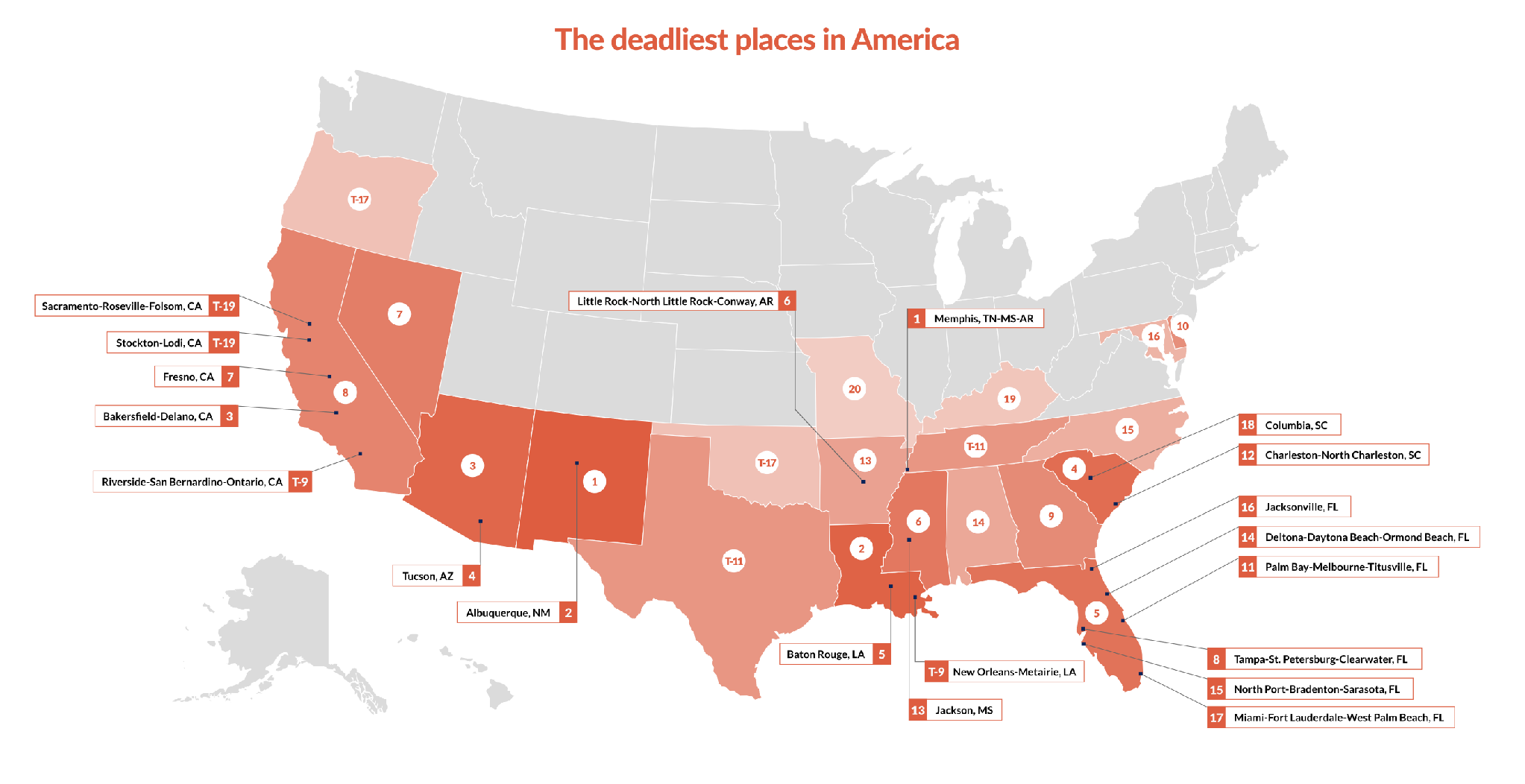
The most dangerous state is New Mexico, which topped the list in the 2024 report, as well. The pedestrian fatality rate in New Mexico is a staggering 4.42 deaths per 100,000 residents. Between 2020 and 2024, 469 pedestrians were killed in the state, representing an 89 percent increase over the previous four-year period.
Ana Mihaela Lucaci, the founder of the nonprofit group Made2Walk, and a PhD researcher in civil engineering based in Albuquerque, said she was surprised by New Mexico’s continued outlier status. In Albuquerque, there has been some controversy and negotiation over the safety budget, but a number of infrastructure improvements are planned, including new bike lanes. The scale, however, may be insufficient.
“The needle is moving down if we look granularly, but it’s not fast enough and needs a lot of funding,” Lucaci said.
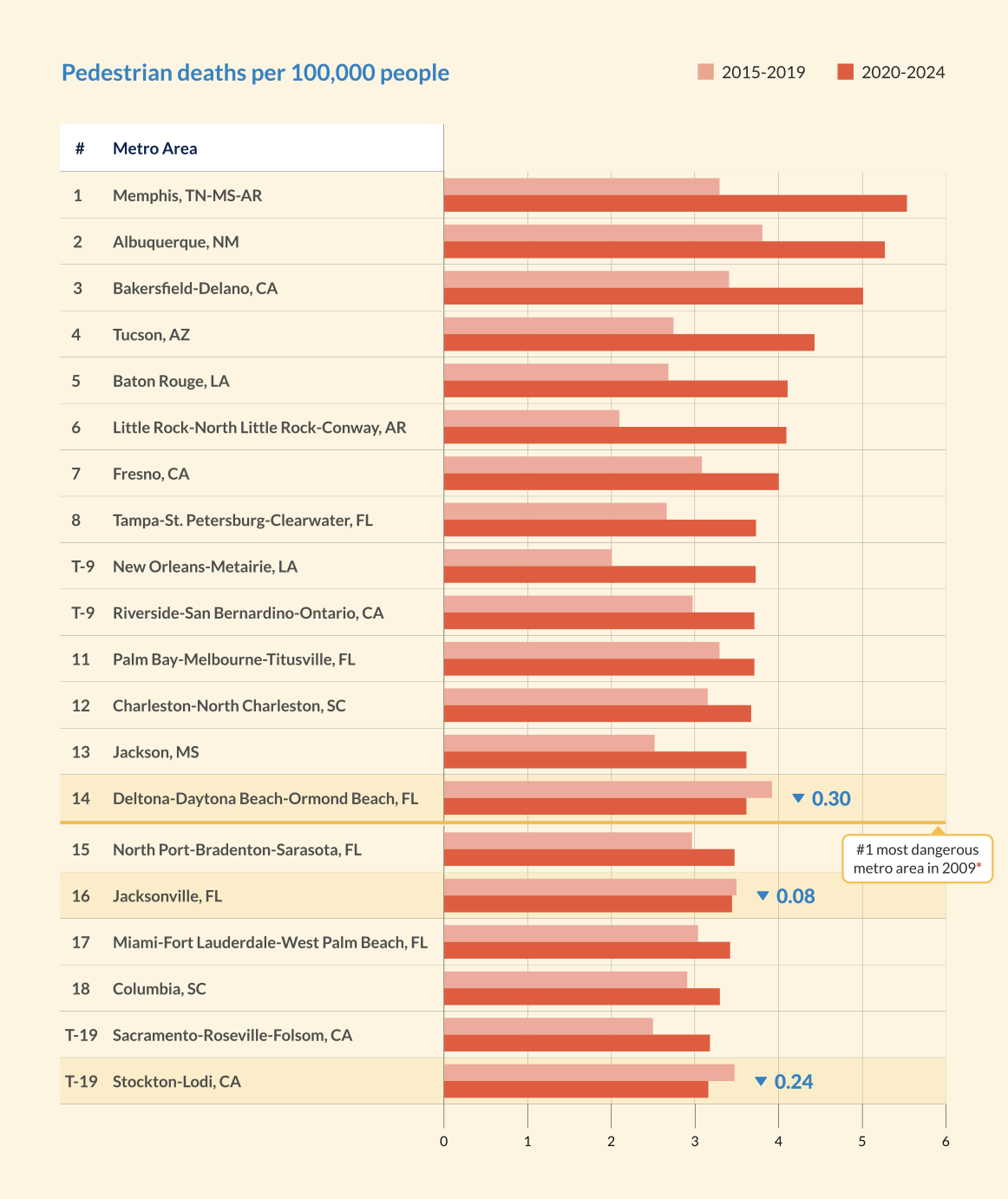
At the metro level, Memphis (again) topped the list of most dangerous metro areas. The region has seen a more than doubling of the number of people killed on the roads over the last four years to about 74 pedestrian deaths a year.
Those killed while walking in Memphis and nationally, the report points out, are more likely to be older adults and people of color. Native Americans and Black people are respectively nearly eight and four times as likely to be killed. This disparity results not only from inequality in car access, but also reflects disparities in which neighborhoods are prioritized by government agencies for safety improvements, and which are neglected.
Joe Martinez lost his only child, 21-year-old Paul, in Fresno in 2013.
He wrote in the Fresno Bee that he “left the hospital with my son’s blood on my face and clothes” and “spent months grieving.”
The Fresno region remains deadly, ranking 7th nationally in this year’s report. Martinez has been a leading voice for safety improvements in the region. He is currently campaigning for changes in state law that would target recidivist speeders and allow red light cameras.
Bold action to protect local residents like what Hale and Martinez are demanding, however, has been too little and too far between, according to Smart Growth America. Of the 100 metro areas ranked by the report, only 21 showed improvements in the number of people killed.
Still, there were a few tiny bright spots, demonstrating that government action to save lives works, given the proper commitment. For example, Florida, which for many years was the most dangerous state in this ranking, has seen a notable decline in fatalities. Its major metro areas were well represented on the list of the few places that had notched improvements. Orlando was a standout as one of the most improved metro areas.
Billy Hattaway, a civil engineer who helped lead safety efforts for Florida DOT in the previous decade, said Orlando’s Vision Zero director, plus the work of Bike-Walk Central Florida and FDOT District 5 seems to be making a difference. He’s also hopeful that federal Safe Streets and Roads for All grants, which have been awarded to Florida municipalities, could make a big difference.
Smart Growth America also singled out El Paso, Texas, for managing to produce a sustained decline in the death rate, even against strong cultural headwinds, like the rise of supersized trucks and fallout from the Covid-19 pandemic. The city has been doing the hard, boring work to keep people safe. Since it was singled out for being dangerous two years ago, the city has implemented a strong, comprehensive Complete Streets policy, Smart Growth America said. Three major safety projects are underway on important and dangerous corridors, as well.
In fact, in this year’s “Dangerous by Design,” Los Angeles is ranked 30th most dangerous, behind places like Dallas and El Paso. According to Hale, the city knows what it would have to do to bring deaths back under control.
“It’s pretty clear that the city just does not care about this,” he said. “We value driver convenience more than human life.”
Since he began working with “The People’s Vision Zero,” Hale’s been involved with the painting of 14 crosswalks, all in places where people have been injured or killed. In January, Hale was arrested for one of his crosswalk projects, though the city dropped the charges.
His group says they will stop their work if the city gets serious about safety, or if they establish a program that would allow volunteers to participate in street safety projects.
“We’re asking people to recommit to Vision Zero,” he said. “We want the city to address the number-one cause of death for kids in Los Angeles.”
Strong Towns columnist Angie Schmitt is a Cleveland-based author and urban planner. Her book Right of Way: Race, Class and the Silent Epidemic of Pedestrian Deaths in America was published in 2020 by Island Press. A mom of two, she is working on a second book (North Point Press, 2028) about how to make cities and neighborhoods more kid friendly.
%20(1).avif)
.avif)
%20(1).avif)