Your Transportation Plan Won't Save Anyone. Not Today.
.avif)
.avif)
%20(1).avif)
%20(1).avif)
You've sat through the meetings, and you supported the plan, but nothing is actually safer.
You are the local champion for the latest updates to your city’s transportation plan. You encouraged your neighbors to show up to the meetings and complete the surveys. You helped build the consensus with the consultants. Maybe you even served on the committee. Year after year you put your heart into this effort because you believed that if your community could just get the right plan in place, things would change.
Then a serious crash happened on a street you know well. You asked what could be done, and you are told you one of two things:
"That location is already identified in our transportation plan," or, "That location isn't currently scheduled for improvements."
Both answers may be technically accurate, but neither helps the family that just lost someone. And if you've heard them more than once, you've probably started to wonder whether the plan is actually working or whether it has quietly become the reason nothing can happen yet.
That frustration points to something real, and it deserves an honest answer.
An Orderly Process
Transportation planning is designed as a linear process. Communities observe existing conditions through studies or walking audits. This information is then used to develop a plan illustrating what is possible, sometimes with several alternatives. The community is then asked to prioritize all of the recommended projects and the projects are ranked on a list. The plan is then submitted to secure funding for the final design and then the construction. Then, several years later, almost like clockwork, we begin the process all over again. The assumption built into that process is that implementation is what happens between plans.
Crashes that occur in the meantime get absorbed into the system. Staff reference them, residents ask about them, and officials express concern. Eventually someone notes that the location was already identified, or that it isn't yet scheduled, and the conversation moves on. The crash becomes another isolated event and a date point rather than new information about how the transportation system is actually performing.
When the assumption is that implementation is what happens between plans, we miss the opportunity to learn.
This would be considered a serious gap in almost any other field. Hospitals conduct regular reviews of unexpected patient deaths, not to assign blame, but to understand what happened and prevent the next one. Airlines study incidents to improve procedures. Manufacturers investigate defects to improve production. None of these organizations wait five years for the next strategic plan before learning from failure. They build learning into normal operations.
Transportation planning rarely does. There's no equivalent process or structured moment where a community stops after a serious crash and asks: What is this telling us?
That missing step has consequences. Transportation committees lose momentum after a plan is adopted. Their role shifts from shaping the future to waiting for projects that may take years to reach design, let alone construction. Meanwhile, crashes continue. Residents keep raising the same concerns. And elected officials keep being told to reference the plan as if the plan were a response rather than a starting point.
You Do Not Have to Wait
Here is what most transportation officials are never told: you don't have to wait.
There is something your community can do right now, without a new plan, without a new funding cycle, and without waiting for projects to clear design review. It's called the Crash Analysis Studio, and it exists to fill exactly the gap described above.
A crash analysis studio is a structured process for learning from serious crashes. When a fatal or life-altering crash occurs, a small response team gathers information about the location, the road design, the operating conditions, and the history of the site. Then a group of participants reviews that information together: elected officials, technical staff, community members with direct knowledge of the place. They work through a single question: What can we learn from this?
The purpose is not to assign blame. It's not a legal proceeding. It doesn't replace a police investigation or override the capital improvement process. It is, simply, the structured review that transportation has always needed and rarely had the same kind of learning process that hospitals and airlines have long considered essential to getting better over time.
Most communities already have what they need to begin a crash analysis studio because learning does not require a new city department, an external consultant, or additional budget line items. The people, the information, and the institutional capacity are already there. What's been missing to tackle our dangerous streets is a structured process for putting those pieces together after every serious crash and not just at the start of every planning cycle.
Cities Can Commit to Learning
The plan you worked so hard to support matters, because it identifies the big projects that are worth building. But a plan is a statement of intent, not a mechanism for learning. And the gap between a plan and safer streets is filled by something plans alone cannot provide.
Communities don't become safer because they adopted the right policy or an award winning plan. They become safer because they are committed to learning. They keep that commitment after every serious crash, not just once every five years when the planning cycle begins again.
That commitment is actually an easier lift than any plan because it starts with a single studio.
To learn more and find free resources for establishing the Crash Analysis Studio process in your community, visit strongtowns.org/crashstudio.
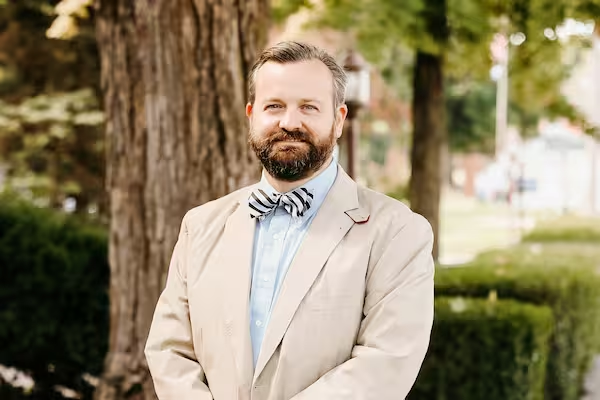
Edward Erfurt is the Chief Technical Advisor at Strong Towns. He is a trained architect and passionate urban designer with over 20 years of public- and private-sector experience focused on the management, design, and successful implementation of development and placemaking projects that enrich the tapestry of place. He believes in community-focused processes that are founded on diverse viewpoints, a concern for equity, and guided through time-tested, traditional town-planning principles and development patterns that result in sustainable growth with the community character embraced by the communities which he serves.