America’s Most Overlooked Developer: Local Churches
%20(1).avif)
.avif)
As communities seek solutions to the housing crisis, many are overlooking a group of landowners positioned to create housing through local stewardship and incremental development. These property owners are some of the oldest community anchors, long-standing gathering spaces, and large sources of organized power and funding. They are faith institutions: the churches, synagogues, mosques, temples, and land they own. In neighborhoods across America, faith institutions are deeply rooted in their communities and located in areas with existing infrastructure, nearby schools and transit, where housing is needed the most. Those qualities make them uniquely suited to create small-scale housing that fits within existing neighborhoods and make a difference toward more housing opportunities.
Religious buildings have long served as gathering spaces where communities organized in support of independence, democracy, and civil rights. From the colonial era when religious freedom in the U.S. colonies took root in St. Mary’s, Maryland, to the self-determination of African-American communities after the Civil War, religious facilities have been literal and figurative safe havens. Still today, these properties serve as far more than a place for worship. They host essential services like childcare and food pantries, learning opportunities, and celebrations. Most congregations have a mission to serve others, and research shows in some faiths nearly 90% of households who benefit from congregational support services are non-members. Faith institutions already own land and want to help address community needs — can this include housing?
According to the Lincoln Institute for Land Policy, some 2.6 million acres of land are owned by religious institutions nationwide. Faith-owned land and buildings could support many forms of housing, from a parking lots turned into homes, extra land built out as small apartments, an empty sanctuary adapted to housing, and even fellowship and classroom spaces transformed into condos while preserving historic character.
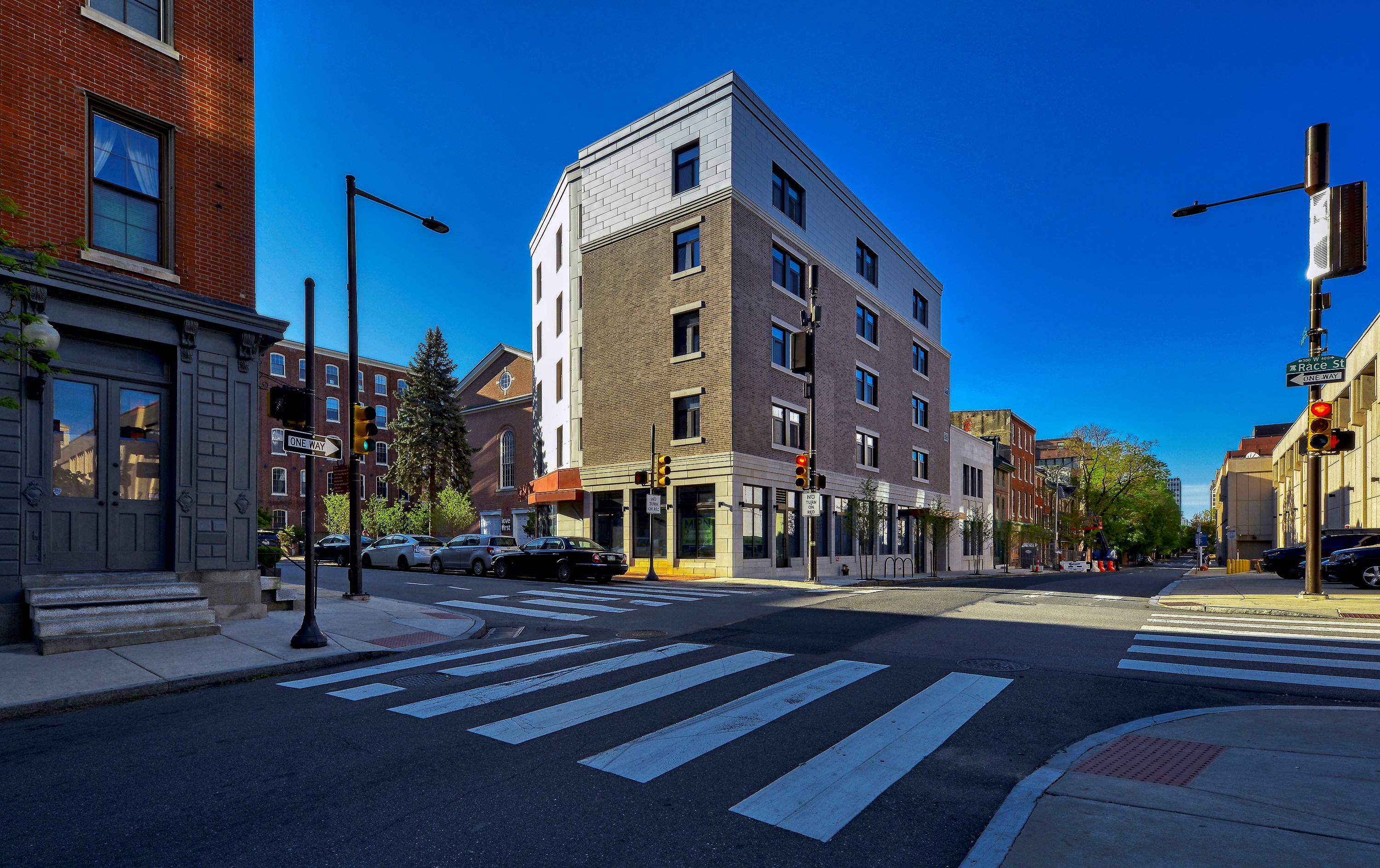
While some faith communities have pursued large-scale projects, the greatest untapped opportunity are small-scale, incremental projects that are compatible with existing neighborhood development patterns. A great example is the Collister United Methodist Church in Boise, Idaho, which developed two rental homes at the back of their property in 2022, now rented at 50% below market rate. In 2023, a historic church in Highlandtown in Baltimore was converted into 10 live/work units. In Philadelphia, the Old First Reformed United Church of Christ transformed a small church-owned parking lot and adjacent lot into 34 units of supportive housing for people previously experiencing homelessness. Old First even moved a historic house to a different spot on their property to make the development work.
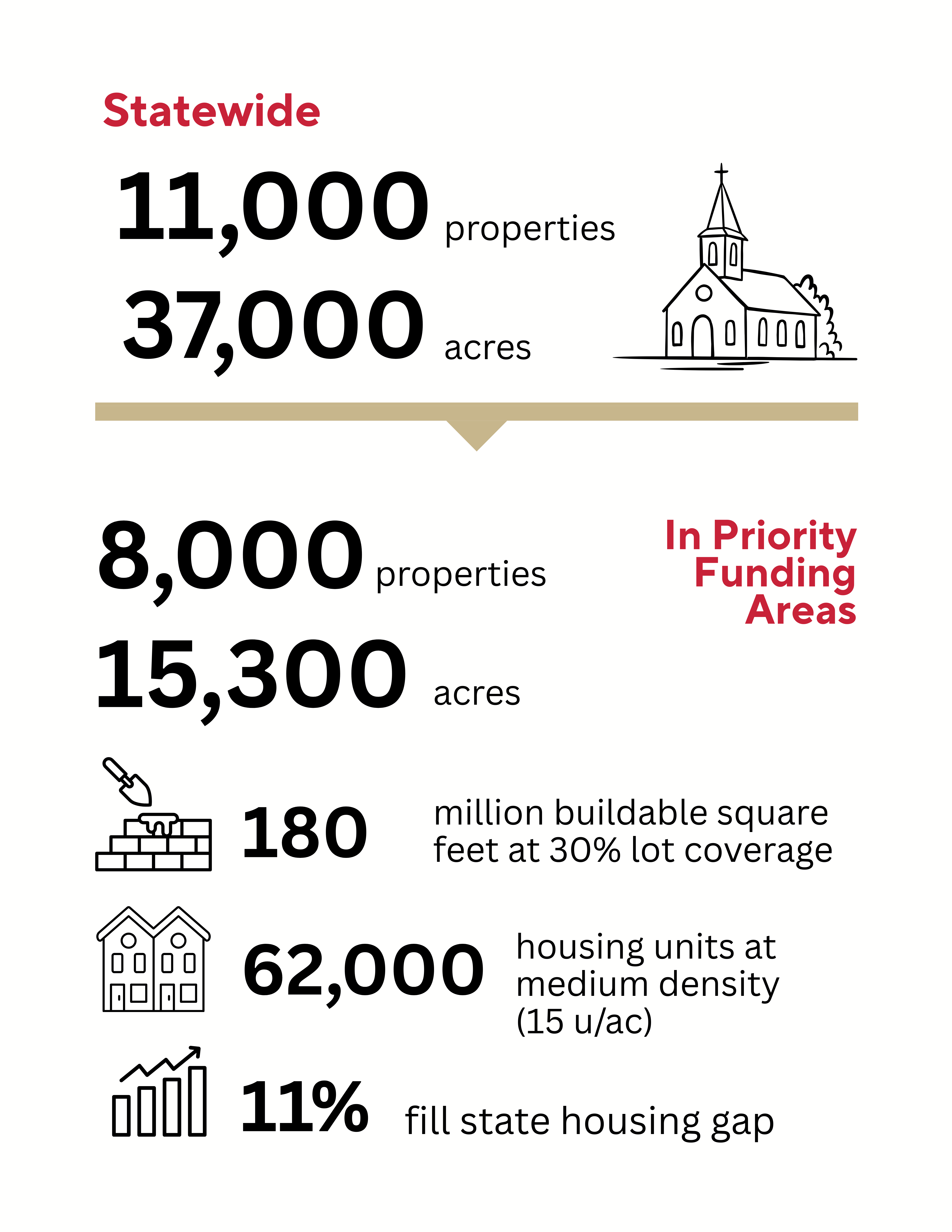
To better understand the role religious properties could play in addressing housing needs, Smart Growth Maryland conducted some original research. Thanks to a statewide parcel dataset, we mapped and analyzed faith-owned properties across Maryland in places (Priority Funding Areas) already served by infrastructure or slated to receive growth. We identified over 8,000 parcels. If some of this was built out as small-scale, missing-middle housing (single-family, duplex, triplex, quad, etc.: a housing density of approximately 15 units per acre), this could fill 11% of Maryland’s housing gap. While not a huge number, it is not a potential for housing development that Maryland, as the ninth-smallest state and gateway to the Chesapeake Bay, can afford to ignore. Similar analyses in other states (Colorado, Virginia, Massachusetts) reveal equally significant potential for religious-owned property to contribute to housing opportunities.
Faith institutions occupy a unique place in the housing conversation because of their time horizon. A typical developer may own a property for a few years. Congregations often steward property for generations. Religious owners are not looking for the highest immediate return; they are looking for ways to sustain their mission and strengthen their community. This long-term community steward as a developer could mean housing that is smaller in scale, more context-sensitive, and more likely to reflect local priorities. Most housing today is delivered through one of two models: large suburban subdivisions or large multifamily developments by large corporate developers. Both play important roles, but they leave little room for locally driven, small-scale housing creation. Faith institutions could fill this void. With deep ties in the community, they can pursue projects that are too small to attract major developers but large enough to create meaningful housing opportunities and generate income to support their congregation.
You might be asking: why aren’t all religious institutions jumping up to build housing? For starters, nationally, an estimated 100,000 churches may close in the coming decades due to declining membership, particularly among small congregations. A 2023 Faith Communities Today national survey showed the median church size is only 60 regular worship participants. Congregations that are struggling to maintain their existing operation have tough choices to make regarding their properties. On one hand, building housing or other uses could add new income streams to assist the financial viability of the congregation. When a church is forced to close, the property could be adaptively reused. In 2025, the Archdiocese of Baltimore announced closure of nearly half its city parishes, leaving many concerned about what would become of the properties.
Whether the property remains owned by the faith institution or changes hands, turning religious land into housing is often far more complicated than one would expect. Through our work, we consistently see three major barriers: zoning, technical capacity, and financing.
Zoning is often the first and most uncertain obstacle. Many faith institutions sit on land designated for “institutional” or “residential” uses where housing is either heavily restricted or prohibited outright. This year marks the 100th anniversary of the Supreme Court case Village of Euclid v. Ambler Realty, which cemented modern zoning practices in the United States. The amount of land zoned “single-family residential only” in American is profound. Seattle 81%, Los Angeles 75%, Charlotte 84% as visualized by the New York Times in 2019.
Basically, American zoning laws put the single-family house with a yard on a pedestal as “the best” type of land use. Over time, changes to this status quo are met with fear. The term "density" has become conflated with building height or skyscrapers. Many traditional forms of dense housing — duplexes, courtyard apartments, and mixed-use buildings — that once fit naturally into American neighborhoods are illegal to build today. In some communities, even modest apartments, duplexes, or cottages require lengthy rezoning processes, public hearings, or variances.
Beyond zoning, many congregations do not have the technical and financial expertise needed to navigate development. Real estate projects require financial analysis, attorneys, architects, loans and fundraising, permitting, and long-term property management plans. Financing remains a challenge for these types of real estate projects due to nonprofit status, denomination finance rules, and scale. Most congregations assume housing development is financially out of reach for them. Yet this technical capacity can be outsourced, the financing leveraged, and with a clear vision and consistency, the project can happen. Rather than selling land outright, a congregation can retain ownership through a long-term ground lease, ensuring that future development remains aligned with community values while generating a stable revenue stream.
Across the country, legislation is attempting to remove zoning barriers that prevent congregations from building housing on their own property. In places like Virginia, Colorado, Connecticut, and New York, policymakers have proposed or adopted reforms that allow qualifying faith institutions to develop housing by-right or through streamlined approval processes. Montgomery County, Maryland, recently passed legislation that permits housing on certain religious properties while with substantial affordability commitments. At the same time, technical assistance models are emerging to help congregations navigate the development process. In Charlotte, North Carolina, the Faith in Housing initiative provides workshops, planning support, and $30,000 grants to help congregations assess whether their property could support housing or community-serving uses. These efforts signal that the biggest challenge for congregations, in reality, is the gap between vision and implementation. Many congregations already want to serve their communities in this way; they simply need regulatory pathways and trusted partners to make projects feasible.
So what makes a religious property a good candidate for housing? For one, sites already connected to existing infrastructure: properties in towns, neighborhoods, or commercial corridors with access to water, sewer, transit, schools, and services. Not every congregation has “extra” land suited for development, but many have underutilized parking lots, vacant classrooms, or aging ancillary buildings that could support small-scale housing. There are clear opportunities for small-scale infill housing or adaptive reuse without displacing residents or demolishing historic structures.
Successful projects also depend on partnerships. Few congregations can or should take on development alone. Instead, projects succeed through collaborations between faith leaders, local developers, architects, preservationists, attorneys, housing nonprofits, and property managers. Some congregations establish internal task forces to guide decision-making and ensure projects align with their mission and long-term goals. Local governments also play a critical role. Municipalities can reduce barriers by updating zoning codes, reducing parking minimums, streamlining approvals for faith-based housing projects, and allowing incremental housing types in more neighborhoods.
The greatest opportunity for housing may not be found in massive redevelopment projects, but in thousands of small decisions made by local institutions that already know and care about their communities. In many cases, the most financially sustainable and neighborhood-compatible projects may be the smallest ones: a few cottages, several apartments in an underutilized fellowship hall, or a handful of homes added to a large parking lot. These may not be headline grabbing projects but repeated across thousands of properties, it could create meaningful housing opportunities across the country while allowing congregations to continue their tradition of being a community anchor.
Briana Paxton is a historic preservation professional, housing advocate, and small-scale developer based in Savannah, Georgia. For her day job, she works remotely as a policy analyst for Preservation Maryland where she actively researches, develops, and advocates for policy innovations and regulatory systems that promote equitable and sustainable development. She previously worked in the private sector as a consultant with Ethos Preservation and PlaceEconomics focusing on preservation and economic development.
She volunteers locally with the Historic Waters Community Association and Historic Savannah Foundation. On the national scale, she brings the preservation voice to Congress as Chairwoman of Preservation Action and previously served on the board of the National Alliance of Preservation Commissions. She holds a Master’s in Historic Preservation from the University of Pennsylvania and a Bachelor’s from the College of William and Mary.
%20(1).avif)
%20(1).avif)
%20(1).avif)
%20(1).avif)