Filtering Is Not a Housing Affordability Strategy

.avif)
I am a skeptic of filtering, the academic concept that (perhaps unfairly) often translates into: build a luxury condo unit here and, as a result, a poor person somewhere else gets a place to live.
I remember sitting through a lecture in graduate school, circa 2001, hearing this theory for the first time and thinking, "This is total B.S." In fact, it discredited the professor and the entire course for me — that is how absurd I found it.
Yet, there is an entire set of people — advocates, academics, and policymakers — that believe deeply in this concept. There are studies that document its effects. I think the people making this case are generally thoughtful, earnest, and intelligent. It would be intellectually reckless of me to casually dismiss them out of hand. There is something there and it deserves to be wrestled with.
So, today I’m going to do my best to explain the concept of filtering, why I find it incomplete, and how I approach it in "Escaping the Housing Trap" and in our work here at Strong Towns. I’m doing this in the spirit of exploration so please consider this a special invitation to point out shortcomings in my thinking.
The Case for Filtering
YIMBY Action offers a simple and straightforward explanation of filtering that starts with an obvious objection: The new apartments are too expensive. How does building them create housing affordability?
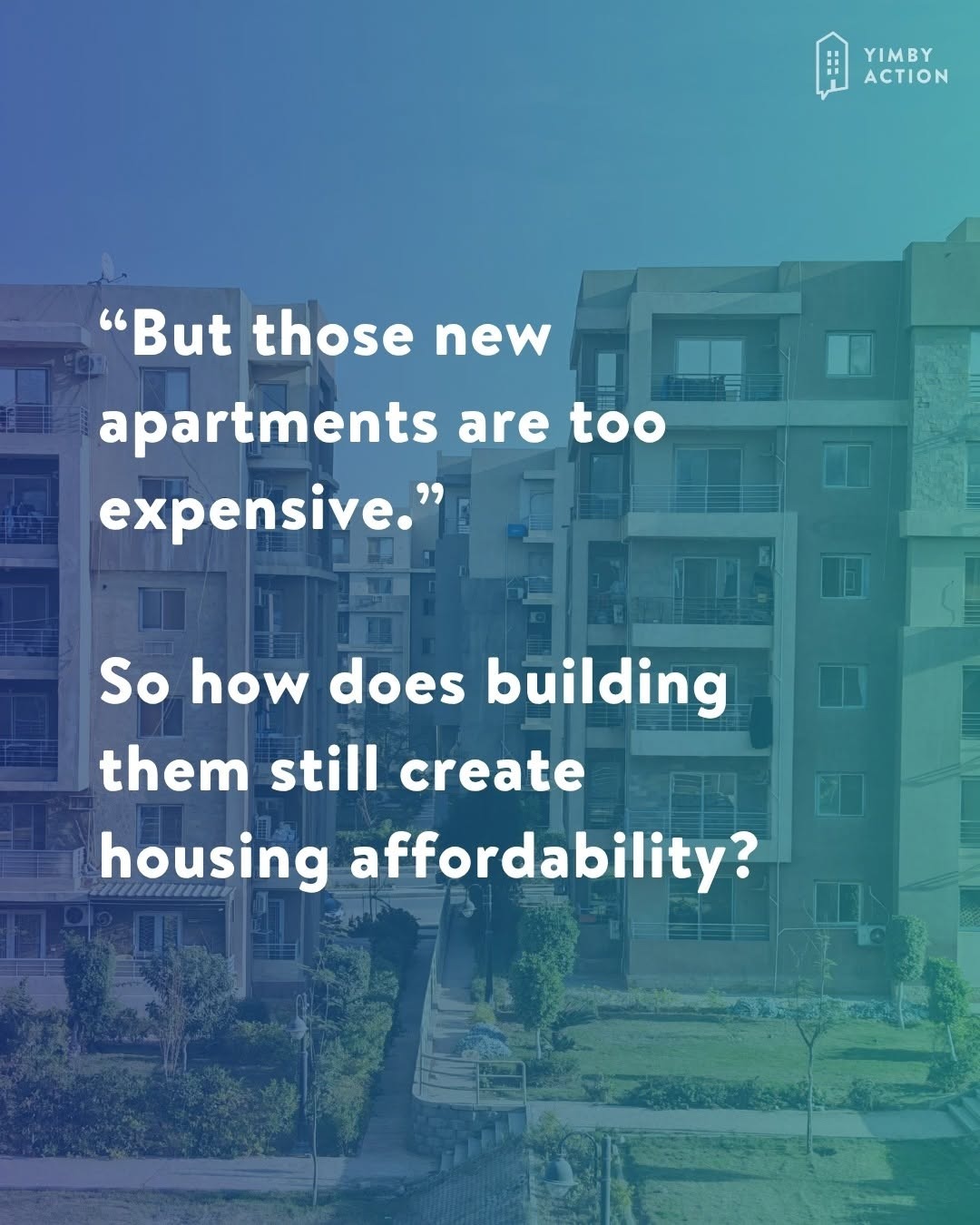
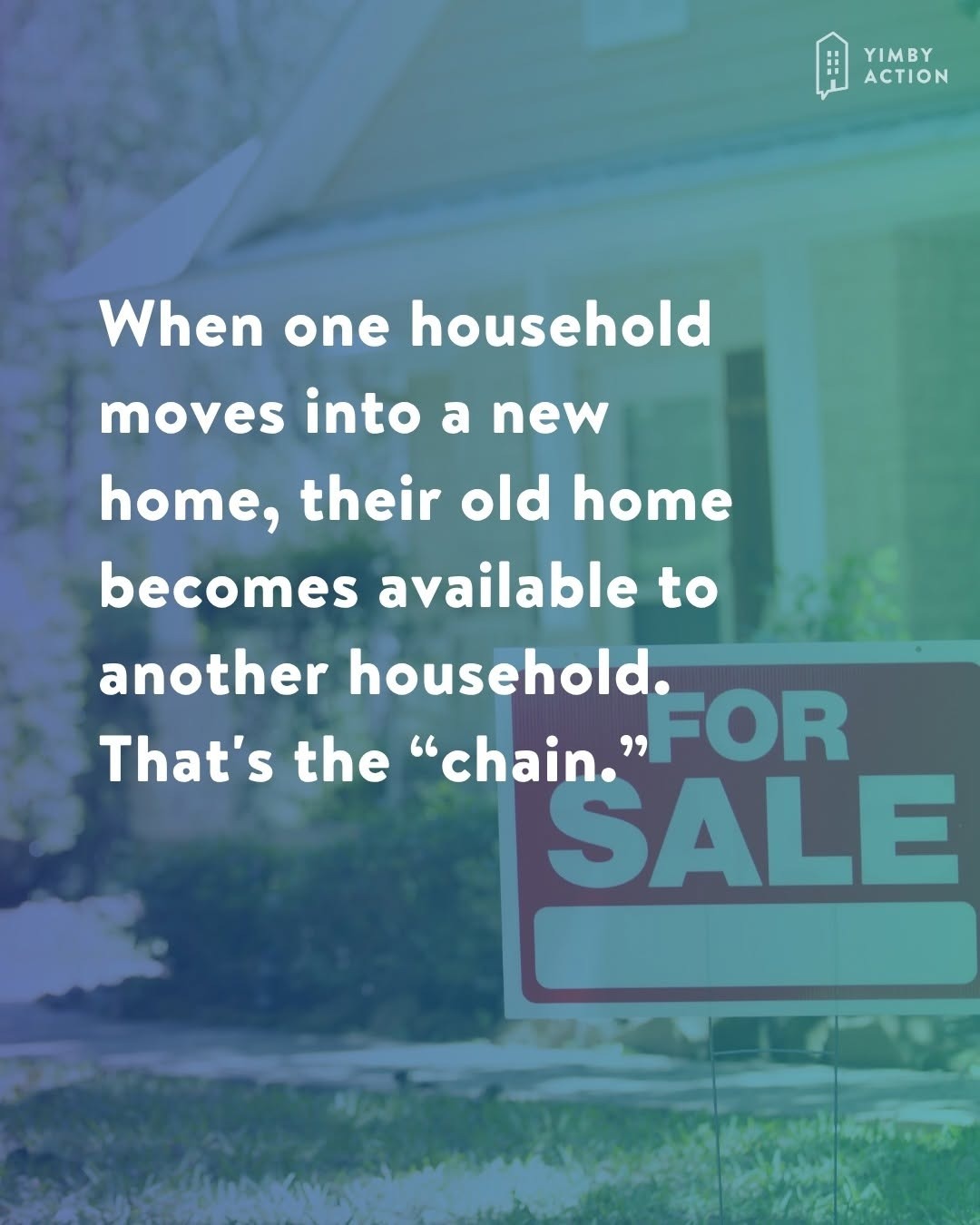
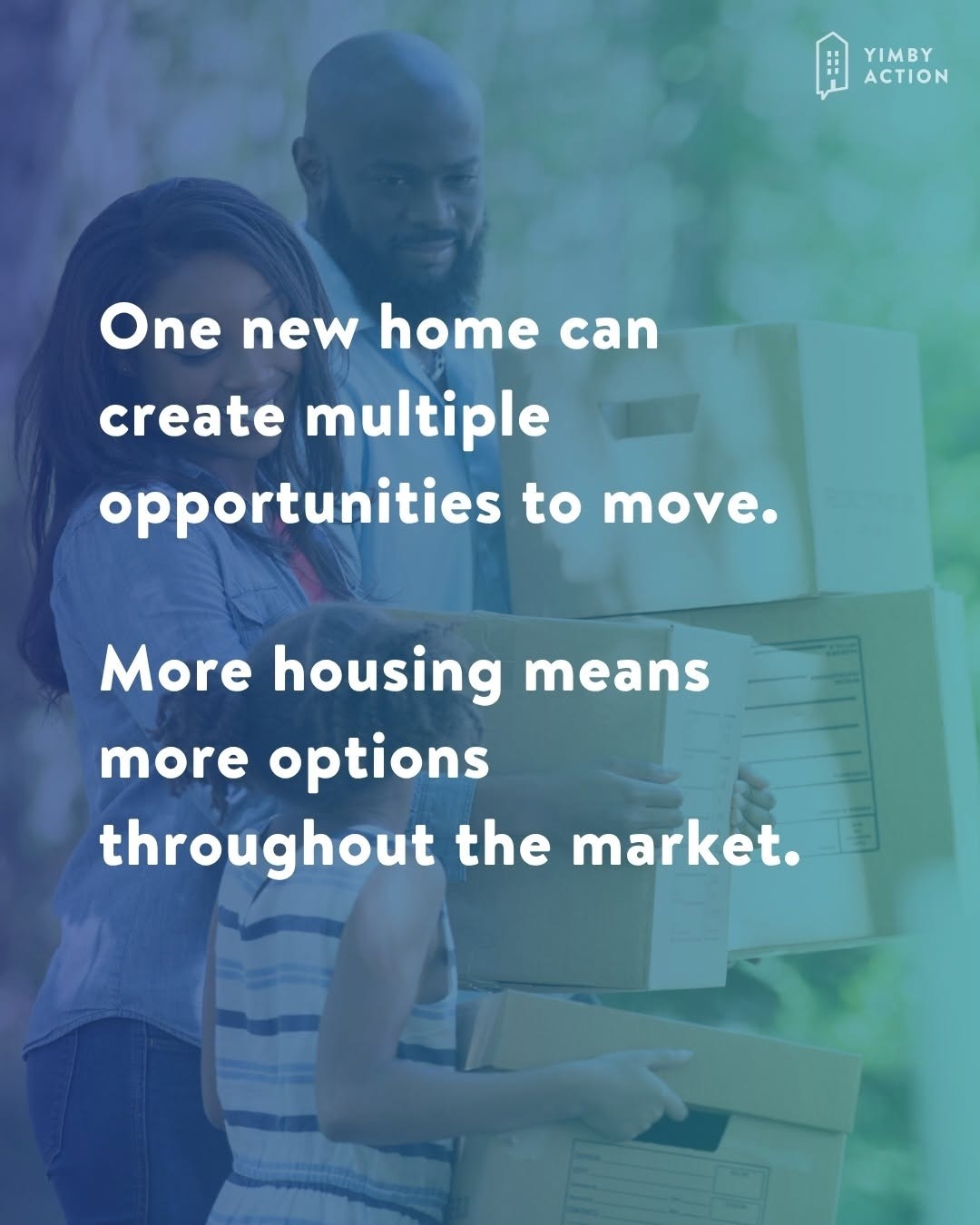
When a new home is built, that is an opportunity for someone to move into that new home. That means the home where they previously lived becomes available to someone else. When that second household moves, another home becomes available. This is the way that one new home can create multiple opportunities to move, spreading the benefit of that new construction to households that will never live in it.
Consider a household with enough income to rent a new luxury apartment. If the apartment is built, they move into it and vacate their existing home. If the luxury unit is not built, that wealthy family does not disappear. They instead compete for one of the homes that already exists, and they do so with more money than most other competitors.
The household they outbid must then look for another home, putting them in competition with households that have less money still. Preventing the luxury apartment from being built does not reserve existing housing for people with lower incomes. It forces them to compete for that housing with people who have more resources.
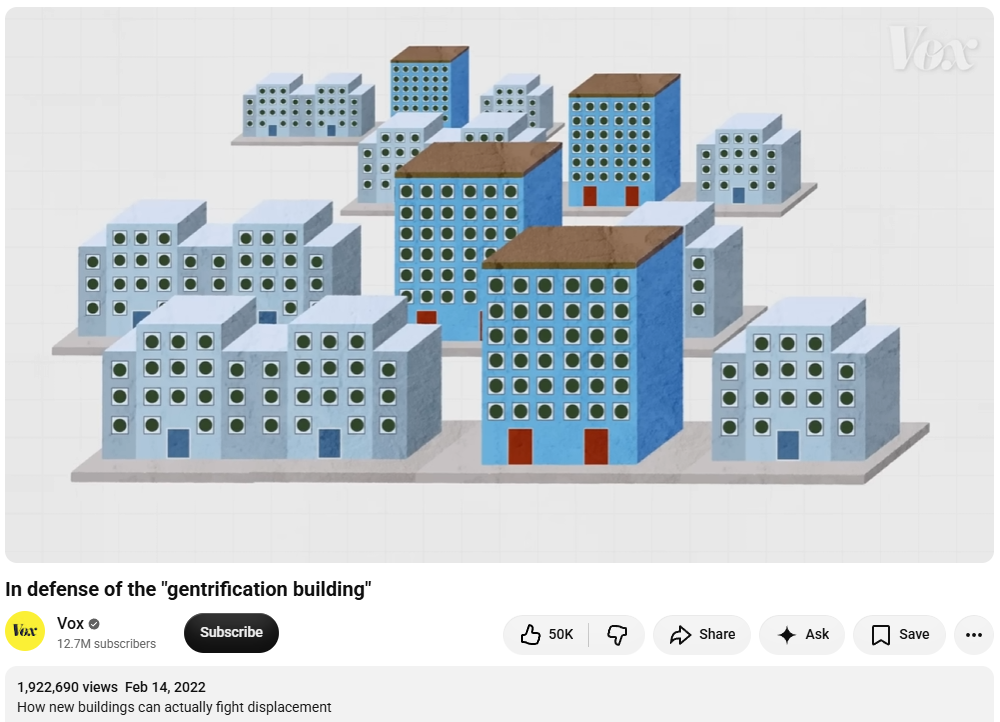
A widely shared video from Vox featuring Jerusalem Demsas explains that researchers have tried to measure two competing outcomes from new housing construction. The first is the demand effect. A new building can make a neighborhood more attractive, bringing in new residents, new businesses, and more investment. This added demand can increase prices and contribute to displacement.
The second is the supply effect. A new building gives people who want to live in the neighborhood somewhere to go without bidding for an existing home. When those people move out of their prior homes, they create vacancies elsewhere.
If a neighborhood is desirable and no new homes are built, the people who want to move there must compete for the homes that already exist. Those with more money are likely to win that competition, increasing the chance that current residents will be displaced.
Building more homes gives newcomers somewhere else to go. The neighborhood may still become wealthier over time, but fewer current residents need to be pushed out to make room for them. That is the distinction Demsas makes between gentrification, which changes a place, and displacement, which forces people from their homes.
Filtering also happens over longer periods of time. Buildings age. Their fixtures become dated. New homes offer features and amenities they lack. Unless they are substantially renovated or located where land values are increasing rapidly, homes that were once at the top of the market become ordinary housing.
None of this guarantees that a low-income household will be able to afford a home in a particular neighborhood. The Vox argument does not make that claim, and I think the most honest arguments for filtering don’t either. New market-rate housing can reduce scarcity and displacement, while subsidies preserve opportunities for people whose incomes will not allow them to compete in the market.
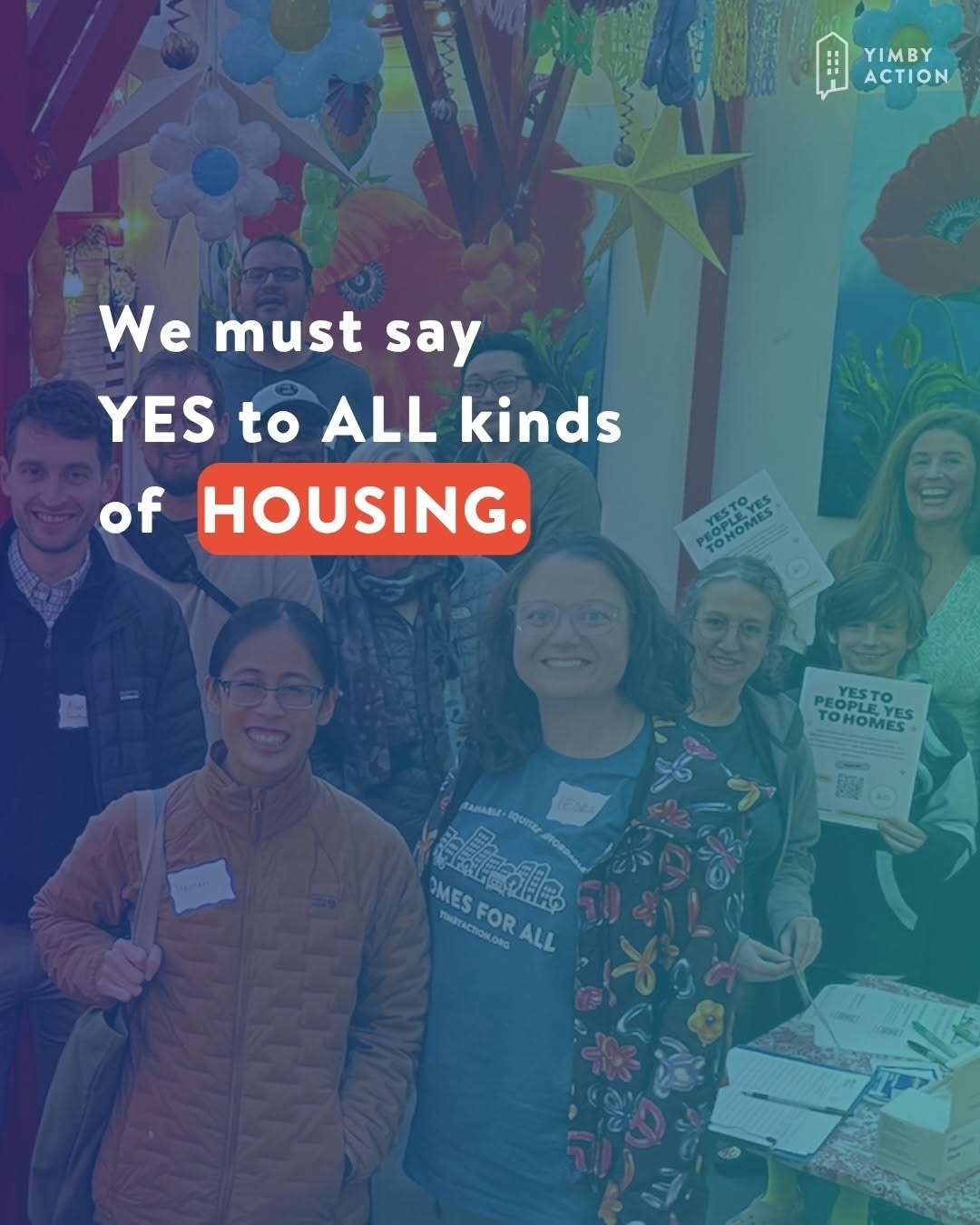
The conclusion YIMBY Action draws is straightforward: We must say yes to all kinds of housing.
This is the strongest case for filtering as I understand it. Expensive housing does not need to become inexpensive before it provides a benefit. By absorbing households with greater purchasing power, it reduces the number of people competing for the homes that already exist. Each move creates the possibility of another move, providing more options throughout the market.
What Filtering Gets Right
I’ve tended to dismiss filtering wholesale, mostly because I measure it against an objective of broad housing affordability. To be fair, many housing advocates stop short of presenting filtering as a comprehensive approach to affordability. Demsas suggests that subsidies are needed to make housing affordable to people with low incomes. YIMBY Action makes a similar concession, acknowledging that even if market-rate housing becomes less expensive, there will likely always be people who cannot afford it. They advocate increased funding for subsidized housing and rental assistance to meet that need.
In that sense, affordability becomes some combination of filtering plus subsidies, which makes it kind of like the American approach to healthcare: accept an expensive system, tinker at the margins to control costs a bit, and then subsidize access for (a portion of) those who cannot afford it.
That’s not my version of a good system — in fact, I think it’s a really bad system — but that also doesn’t mean we should throw everything out with the filtering bathwater. I think we can all agree that there are some things in the filtering story that are obviously true:
- New construction gives some households somewhere to go without competing for existing homes.
- Vacancy chains are real, although they do not necessarily move housing down the income ladder.
- New supply can reduce rents and displacement relative to what might otherwise have occurred, although housing demand is constantly changing in response to jobs, prices, migration, and the availability of attractive alternatives.
- Blocking expensive housing does not reserve existing housing for poorer households.
If we can agree on these things, then perhaps we can also identify the obvious shortcomings of any housing affordability strategy that relies primarily on filtering.
Where Filtering Is Insufficient
About a decade ago, I was in Portland getting a tour from city officials who were touting a major development around one of their transit stops. It ostensibly had everything: a farmer’s market, a hub for local restaurants, lots of housing and plenty of affordable housing, all within walking distance of a major transit stop.
A delegation from the neighborhood joined me on the tour. Most of them were Black and significantly older than myself or the eager professionals giving us the tour. I sensed the skepticism and, in a moment of transition, I turned to one of them and discretely said, “This is all bullshit, isn’t it?”
“Pretty much,” he shrugged back. The vision being presented was compelling for young professionals moving to Portland and seeking housing, but not so much for him and his neighbors.
The foundational analysis of most modern housing advocacy is that there is an insufficient number of homes. There is a housing shortage. It is this shortage that is causing x number of people to bid on y number of homes, where x is much greater than y, driving up prices as people scramble to find a place.
If there are 10 households competing for eight homes, two households are going to lose. Build a ninth home and the situation improves, but one household still loses. A vacancy chain can change who lives in which home, and it can reduce the amount of competition throughout the market, but it does not change the underlying math until enough homes are added to close the gap.
The filtering narrative generally follows the chain from the top. A wealthy household moves into a new home. The home they leave becomes available to someone with less money, who then leaves another home for someone with less money still. I don’t think it is incidental that the filtering argument is most often made by professionals looking down the housing chain. From that vantage point, the chain is a series of opportunities opening up.
Now consider the same chain from the bottom, a position of less comfort. People with low incomes do not stop needing housing because there are too few inexpensive homes. They spend more of their income on rent. They accept worse conditions. They double up with family or roommates. They move farther from their jobs and the people they depend on. Before doing any of those things, they bid as much as they can for the limited housing available.
The Portland development may have reduced aggregate rents relative to some alternative where it was never built. It may have given young professionals somewhere to live without competing for existing homes. It may even have reduced the number of longtime residents who were displaced. None of that necessarily kept the people standing next to me in their homes nor made their new housing alternatives affordable or attractive to them.
If you are at the end of the filtering process, what is left for you? Either nothing makes it through, or the only housing that does is so deteriorated that everyone with more resources has already rejected it. How is that a positive vision for housing affordability?
The Housing Trap Arrests the Filtering Process
The common response to this objection is to keep building. If 10 households are competing for eight homes, build a ninth, then a 10th, and then an 11th. Continue until there are enough homes that people no longer need to bid against each other for whatever becomes available. Eventually, landlords must compete for tenants, sellers must compete for buyers, and prices should fall.
That explanation assumes that falling housing prices are an acceptable economic outcome, that the system won’t push back on it. It will. Falling prices are not acceptable for banks, holders of mortgage-backed securities like insurance companies and pension funds, existing home owners, voters, politicians, municipalities with a property tax, builders, developers, land speculators, and essentially everyone except renters and the poor.
There is a libertarian-esque belief that, if we just liberalize regulations enough, the market will provide enough capital to reduce the price of building homes the same way it has reduced the price of computers and flat-screen televisions. People who believe this — and those who believe in filtering — tend to overlook the centralized way in which housing is financed.
Computers and televisions are consumer products. When technological improvements make them cheaper to produce, the lower price does not undermine trillions of dollars of existing debt, wipe out household wealth, reduce municipal tax revenues or threaten the solvency of financial institutions. Nobody takes out a 30-year loan to purchase a television with the expectation that it will appreciate in value.
Housing is different. Over the past century, we have centralized the financing of housing while consolidating the range of things that finance is capable of producing. The system is essentially optimized for two products: the single-family home purchased with a conventional mortgage and the large apartment complex financed by institutional capital.
These products receive capital because they can be standardized. A conforming residential mortgage can be sold into a secondary market, bundled with thousands of similar mortgages and turned into a security. A large apartment complex can be underwritten according to its rental income, packaged with other loans and sold to investors through the bond market. The federal government supports this system directly through programs like FHA and Ginnie Mae and indirectly through Fannie Mae, Freddie Mac and the broader financial markets built around them.
This system can provide enormous amounts of capital when prices are rising. It can build millions of expensive homes. What it cannot do — it literally won’t do — is continue providing capital until its own collateral becomes broadly affordable.
As prices soften, comparable sales decline. Appraisals come in lower. Expected rents fall. Projects stop penciling. Lenders pull back. If the decline becomes severe enough to threaten banks, homeowners or the broader economy, policymakers intervene to stabilize the market. That is not a malfunction within the system. That is the system functioning as designed.
This does not mean that new housing accomplishes nothing. It can absorb some demand, open up some existing homes and reduce the pressure on rents. It can make housing less expensive than it otherwise would have been.
“Make housing slightly less expensive than it otherwise would have been” is not exactly a great bumper sticker. Nor, by itself, is it an adequate housing policy, especially for people at the end of the chain.
Filtering begins by producing housing for people with money and asks everyone else to wait. Households near the top receive an actual new home. Households at the bottom receive a statistical assurance that their limited options are not quite as bad as they might otherwise have been.
Again, it is not incidental that filtering is most enthusiastically defended by professionals who are far more likely to benefit near the beginning of the chain than to be left waiting at the end of it.
Moving the Goalposts
This brings us to two claims that are often treated as if they are interchangeable:
- New housing can make rents lower than they otherwise would have been.
- Housing can become broadly affordable.
Those are not the same outcome.
Most of the evidence offered in support of filtering addresses the first claim. It compares what happened after housing was built with an estimate of what would have happened without it. Rents may still increase, but not as quickly. People may still be displaced, but perhaps fewer of them. Housing may remain unaffordable, but less unaffordable than under the alternative scenario.
That can be a meaningful improvement. A household paying $1,800 per month is better off than one paying $2,000. But if that household can reasonably afford only $1,000, neither outcome represents housing affordability.
The goalposts move when evidence supporting the first claim is presented as proof of the second. A policy can reduce upward pressure on rents without ever producing homes that people with even modest incomes can afford. It can make a dysfunctional system somewhat less punishing without changing the basic structure that makes housing so expensive.
This distinction matters because the housing trap allows us to pursue the first outcome while preventing us from reaching the second. Our system will finance enough housing to capture rising prices and rents. It will not continue financing housing until those prices and rents fall to broadly affordable levels.
This is why the lengths that academics, advocates and policymakers go to in presenting Austin as some kind of breakthrough housing success are so frustrating. Austin offers strong evidence for the first claim. It does not come close to demonstrating the second.
This does not make Austin a failure, but it does make it an excellent demonstration of the housing trap.
Attainable From the Start
An institutional belief in filtering, even when accompanied by a commitment to subsidized housing, creates its own kind of trap. The market produces expensive housing for people who can afford it. Subsidies provide housing for a limited number of people who cannot. Everyone else is told to wait for something to filter down.
And what, exactly, are they waiting for?
If they wait long enough, perhaps a poor person gets a crappy house. If that home deteriorates far enough to become genuinely inexpensive, authorities will condemn it for being substandard, require improvements that make it more expensive, or demolish it altogether. Where we allow it to remain, we make it vulnerable to extractive owners willing to profit while doing as little maintenance as possible. The SFR3 homes documented in the "Stacked Against Us" podcast are an example of where that process frequently ends.
The reason I reject filtering as an affordability strategy is that it does not intentionally produce an entry-level housing product. It produces an expensive product and waits for time, deterioration and changing preferences to make it less expensive. I described this in "Escaping the Housing Trap" as an approach that produces Gucci sandals and Air Jordans in the hopes that, as they become worn out, they are eventually priced as penny loafers.
Let’s stop pretending to be so clever and just make penny loafers.
The household purchasing a luxury condominium was never going to occupy a 500-square-foot starter home. Building that starter home does not require waiting for anything to filter down. It creates the missing product directly.
At Strong Towns, we have organized that practical response into three parts.
1. Make it legal. Every neighborhood should be able to take the next incremental step. A homeowner should be able to add an accessory apartment or backyard cottage. A single-family home should be able to become a duplex. A vacant lot should be able to accommodate a modest starter home or small apartment building. No neighborhood should experience radical change, but no neighborhood can be exempt from change.
2. Make it possible. Legalizing incremental housing does little when nobody has the capacity to build it. Communities need local builders, tradespeople, property owners and small developers who can complete these projects repeatedly. They need people who can observe what is missing in a neighborhood, take a modest risk and respond. A healthy housing ecosystem depends on many people making many small investments, not merely a handful of large developers assembling enough capital to undertake large projects.
3. Make it financeable. Small projects need financing suited to small projects. Our centralized system can move enormous amounts of capital into conventional mortgages and large apartment complexes, but it routinely struggles with a starter home, backyard cottage, duplex conversion or a four-unit building. Communities need local banks, public institutions, philanthropic partners and other sources of patient capital willing to close these gaps without forcing cities to assume substantial risks or absorb losses.
These are three interdependent parts of a single housing strategy. Making incremental housing legal accomplishes little if nobody can build it. Developing local builders accomplishes little if they cannot obtain financing. Financing accomplishes little if the housing remains prohibited. A community needs all three working together.
We do not have to wait for today’s luxury housing to become someone else’s affordable housing decades from now. We can start producing homes that are attainable from the beginning.
[[divider]]
In the coming weeks, we will release a free implementation guide for "Escaping the Housing Trap." It will combine revised versions of our first two housing toolkits with a new third toolkit focused on expanding local housing finance. Sign up for our email newsletter to be notified when it is available.
If this is the kind of work you want Strong Towns to continue — and a movement you want to be part of — then become a member.
Charles Marohn (known as “Chuck” to friends and colleagues) is the founder and president of Strong Towns and the bestselling author of “Escaping the Housing Trap: The Strong Towns Response to the Housing Crisis.” With decades of experience as a land use planner and civil engineer, Marohn is on a mission to help cities and towns become stronger and more prosperous. He spreads the Strong Towns message through in-person presentations, the Strong Towns Podcast, and his books and articles. In recognition of his efforts and impact, Planetizen named him one of the 15 Most Influential Urbanists of all time in 2017 and 2023.
%20(1).avif)
%20(1).avif)
%20(1).avif)
%20(1).avif)