Warning Signs of a Fragile Town
.avif)
.avif)
One of the core messages from Strong Towns is that the standard North American style of development creates fragile places. That’s bad, right? We don’t want fragility. We want durability and strength. What does fragility actually mean, though? What does it look like for a town to be fragile? I wanted to cover this idea and help you spot fragility in your own town when you see it.
What Fragility Means
Cities and towns are municipal corporations. To avoid getting into the legal weeds, I want to be direct in how this applies to our topic: this corporation is publicly owned and forms the governance of the land area that makes up a city or town or what we can refer to as a municipality. It is the custodian of the city, handles its operations, policy adoption, and all of the little things that we expect our local governments to do. For a municipality, fragility typically looks like a reduction in options and ability that can affect its fulfillment of obligations. In practice, fragility looks like having to raise taxes, triaging which infrastructure gets repaired and which doesn’t, lowering the quality of services or neglecting them, and also having poor leverage in negotiating deals. In short, it looks like a corporation that struggles fulfill its basic operations.
Municipalities Must Match Long-term Spending to Long-term Revenue
This framing points out that we need think about the municipality in a fiscally responsible way, or else it could fail. This failure manifests in different ways, bankruptcy is rare, and typically the failure is more subtle. It usually plays out with the municipality becoming a less and less pleasant place to live and the local government increasingly hamstrung to do anything about that. While the main goal of a municipality is not profit, it does need to make one in order to sustain itself into the future. If a city continuously operates at a financial loss, it will find itself in an increasingly fragile state where the promises of the past are coming due, but there is no budget to meet them. To avoid this, the decisions that municipalities make using the public wallet should ultimately create a return on public investment. It should create wealth, over time, for the municipality and its residents.
We need to ask these questions when we are thinking about publicly investing into new developments. Does this public investment motivate private investment that will translate into additional taxable value that offsets the cost? This is why Strong Towns cares about land productivity, because it is a signal for what is earning money and what is costing money. When you look at a value-per-acre map of Dover (or any city in the Seacoast, New Hampshire, where I live) you can distinctly see where the downtowns are located because of their high value-per-acre. Whereas the further you get from the city’s core, the lower the values are.
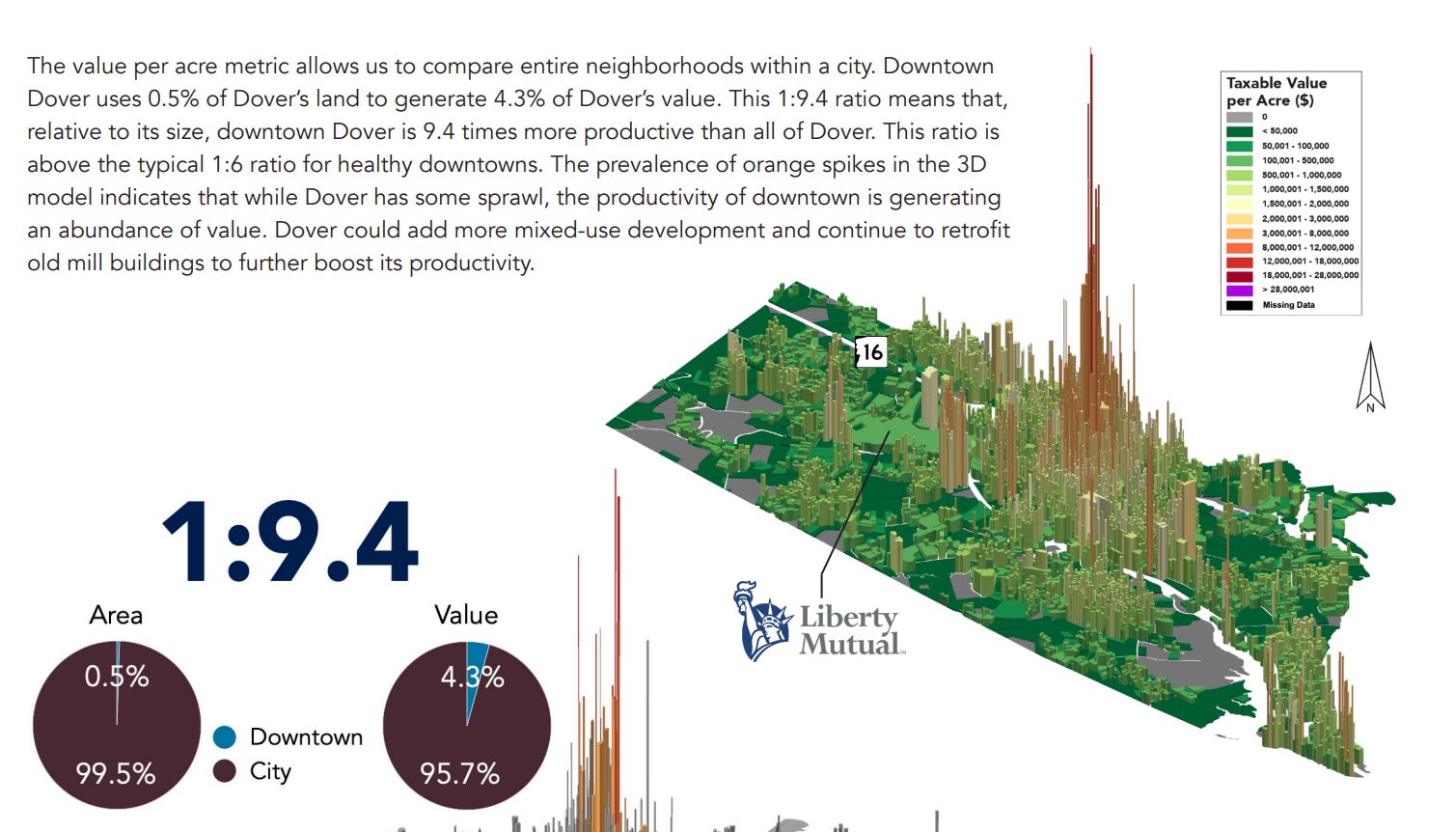
Consider that for a moment. That means that our centuries-old downtown development pattern along with all of the historic buildings surrounding it are outperforming newly built developments on value per acre. This matters because public obligations increase with the amount of infrastructure that must be maintained, whereas taxable value increases based on the amount of private investment present. This outperformance is evidence of how well the development pattern is working. When you consider the additional amount of infrastructure that surrounds new developments (traffic lights, parking lots, turning lanes, etc.) you can see that the number of obligations is increased relative to the more distributed private investments that are present. This increases fragility and municipalities should be pursuing development patterns that create strength over time.
The Signs of Fragility
You can start to see the signs of this manifest with the decisions that your municipality makes, the conditions of its built environment, and its socioeconomics. The obvious signs look like unmaintained infrastructure or a decline in service quality. However, there are less visible signs that can be more difficult to diagnose without looking into the financials of your municipality’s operations.
Surviving on Grant Money
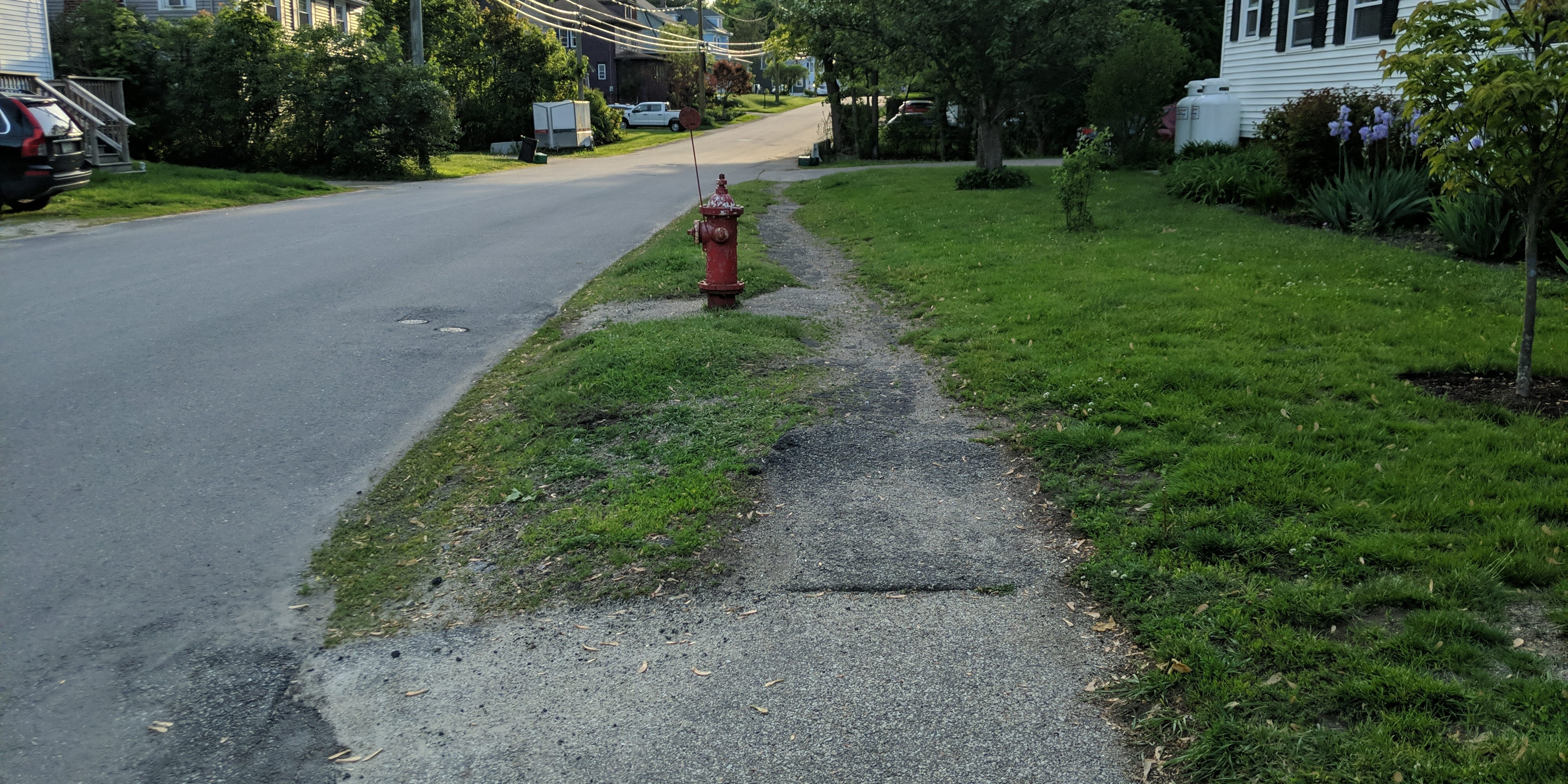
We are all familiar with the pothole that hasn’t been fixed in years or the sidewalk that is crumbling apart. Municipalities often rely on securing state or federal grants before they will plan a street reconstruction and this can leave some streets in dire conditions. I had a discussion with Dover’s city engineers, who revealed to me that the city has a $30+ million backlog on just sidewalks alone, not to mention the rest of their infrastructure. This means that they have to triage where to fix things, and where to let things continue to decay. It also means that grant money is hugely helpful in relieving this stress.
However, grants typically come with strings attached and this means that a municipality must conform its projects to the grant instead of to the community. Decisions change, plans change, morals change, all to satisfy the grant. The direction that your city wants to move in, that residents want to pursue, is only permissible to the degree grants will allow. Your town’s identity is up for sale.
This is not a unique issue to Dover and lots of municipalities operate like this. Though, let’s ask the question: If a municipality’s infrastructure requires grant money to successfully maintain it, what happens if no grants can be secured? Can a municipality support its own weight if the crutches of external financing were taken away? The reason to build infrastructure, the reason to spend public money on this public good, is to grow the wealth of the public. If the infrastructure we are building is going unmaintained due to financial stress, then it is failing that job.
If you survive on grant money, you starve when it isn’t available. A poster child for this is the COAST bus service. Around 80% of their funding comes from federal grants, with only 6% coming from ridership. This service could likely be eliminated with the stroke of a pen from the federal government. That’s a possible reality that is currently looming over our primary transit service. Without strong, financially independent legs to stand on, these projects and services are in a fragile state and our municipalities will struggle to save them if the need arises.
Necessary and Painful Growth
The housing crisis has gotten a little crazy over the last few years and municipalities everywhere (except for perhaps Newington) are examining ways to help alleviate it. Despite this obvious necessity for an increased housing supply, abutters and residents still regularly show up to push back on new developments. However, before we call them cold-hearted NIMBYs, let’s try to understand the several valid issues that they are bringing forward. “Character of the neighborhood” arguments aside, many opposing residents will cite traffic and parking concerns, water, sewage, drainage, snow removal, and a host of other genuine problems that an increased housing supply could bring. At our most recent Exeter meeting, a member mentioned that our region is currently in a water ban and asked why towns should want new developments if we don’t even have enough water for our current ones.
These are important concerns to alleviate if a municipality wants to make cultural and political headway against opposition to housing and development. They need to be addressed in order to bring community support to resolving these issues. Adding more people, more housing, and more traffic to an area that isn’t set up for it is painful. Current residents expect to feel that pain and remember that most of our municipalities can’t even maintain their infrastructure without grants, much less expand capacity.
The municipality is between a rock and a hard place. It needs more growth to start to catch up on its financial woes. It needs those new developments to grow the tax base and increase land productivity. However, the current development patterns are stressed by this growth and threaten to degrade the standard of living residents are accustomed to. Imagine running a business where every new customer that you took on created losses or break even revenues to provide them service. Even if that business could figure out the break even point for every customer, the moment there were any challenges (a storm that causes damages or some other circumstance), it would create a crisis. Should we continue to use the same development patterns that led us to this fragile situation?
The reality is that growth shouldn’t be like this. It shouldn’t be necessary. Growth should be the natural byproduct of a successful community, not a requirement to balance the budgets. More people showing up shouldn’t overwhelm our services. I had a conversation with the Director of Dover’s Community Services about their struggle to keep the sidewalks clear in winter compared to Newmarket, and his response was telling. He said that Dover’s larger and more complex infrastructure network prevented it from being as effective in winter maintenance as Newmarket. His claim is that Newmarket’s smaller infrastructure footprint is beneficial to the town’s operations. However, if you look at size, Dover has more than three times the population of Newmarket, yet it is not three times more capable. Is that the mark of a successful development pattern? More people should mean more wealth, talent, skills, options, and contributions to the public wallet that finance our services. Instead, those services are challenged and stressed by this growth.
Conclusion
The diagnosis of America’s dominant development pattern as the source of fragility is the heart of the Strong Towns message. Decisions of the past are what led us here, and most people I know who work in municipalities are looking for a solution to these issues. They are genuine people who want to do well in their roles, but they are operating in a stressed and fragile system that is limiting their politically painless decisions. The Strong Towns approach is an attempt to push back on ideas that have led us to this situation. We are trying to advocate for a change in direction toward a system that creates strength instead of fragility. If that is something that you would like to be a part of. I would love to have you at a future in-person meeting to help us advocate this message. Thank you for reading.
[[divider]]
This article was originally published, in slightly different form, on the Strong Towns Seacoast Substack, which is run by Strong Towns member Aaron Williams. It is shared here with permission.
Born and raised around Birmingham, Alabama, Aaron Williams became interested in community and cities after visiting Japan with his wife in 2020. He started learning more and began a podcast focused on these topics before eventually starting Strong Town Seacoast in 2023. Now he helps lead monthly meetings, write newsletter articles, and advocating for safer streets and resilient cities in New Hampshire's seacoast region. He spends his free time takes walks with his wife and son, attending board game nights, and playing video games together with his wife.
.avif)
%20(1).avif)
%20(1).avif)
%20(1).avif)